James Buchanan by Jean Baker

President #15, C-SPAN Historians Ranking #42

You know my successor and I average a ranking of 21.5!
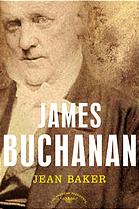
jamesbuchananAs I careen through the roster of American presidents, I knew that eventually I would hit bottom. There had to be someone whom historians considered to be THE WORST President ever. Historian Jean H. Baker of Goucher College lays out the case for why James Buchanan is as bad as they get. And it’s not a pretty sight.

Baker not only believes that Buchanan was just guilty of violating his oath of office by failing to protect and defend the Constitution of the United States. She also believes that he may have committed treason against the United States.

Why did America’s only bachelor (and the only Pennsylvanian) President end up as such a colossal failure? Was Buchanan incompetent? Was he in over his head? According to Baker, Buchanan’s main sin was that he was so pro-Southern and pro-slavery that he would do whatever it took to appease that section of the Democratic Party. Buchanan said he believed in the Constitution; but, he only believed in his very narrow interpretation of it. Buchanan would rather have been right, than to have done right.

But, even more than Buchanan’s belief that he was right, his biggest problem, according to Baker, was his pro-Southern attitude. Buchanan may have grown up in Pennsylvania, but his closest friends and advisers were Southerners. He also believed that slavery was an institution that the Federal government had a duty to protect. His ideas on how to patch up the deepening sectional divide over the expansion of slavery served only to make matters worse.

Baker explains in an introduction that not many people want to examine the life of Buchanan. People want to believe that Presidents are heroes. And almost everyone thinks that Buchanan’s successor was the greatest President ever. But, Baker explains, there is value in learning about how someone like Buchanan, who had one of the most distinguished resumes of any person elected President, could be so bad.

Buchanan was born into a well-to-do family in Mercersburg, Pennsylvania. His father sent him to Dickinson College in Carlisle, Pennsylvania. Buchanan wasn’t a great student, and was briefly expelled from school for bad behavior, but managed to graduate. He never spoke well of his alma mater. (The school website’s history section doesn’t mention that Buchanan attended. Baker did speak about this book at Dickinson.)

Upon graduation, Buchanan moved to Lancaster, Pennsylvania to study law as an apprentice. Buchanan felt that working in Pennsylvania’s capital would be beneficial to his practice. He passed the bar in 1812, the same year Pennsylvania moved its capital to Harrisburg. (I once got lost in Harrisburg after pulling off the highway too early. Don’t ever do that. Take my word for it. No one needs to see that much of Harrisburg.)

However, Buchanan kept his practice in Lancaster, which still was one of Pennsylvania’s largest cities. Apparently, he did a good job because he earned a sizable income and was pulling in what would be a six figure income today by the time he was 30.

Buchanan also became involved with a woman name Ann Coleman. They became engaged in 1819.  But, the marriage was called off. No one knows for sure why it happened. Baker believes that Coleman tired of Buchanan’s lack of affection for her. Also, Buchanan was seen in the company of another woman while they were engaged. Coleman died soon after (of an unknown cause, although she was extremely distraught) the engagement ended. Coleman’s father refused to let Buchanan come to his daughter’s funeral. Buchanan would never marry.

The bachelorhood of Buchanan has often been shown as “proof” that Buchanan was homosexual. Baker doesn’t believe there is any proof of it. First of all, Baker points out, no one in Buchanan’s time would have identified himself as homosexual. There were just men who sometimes had sex with other men. Denial was prevalent. Buchanan likely was involved in criminal cases as a lawyer where men were accused of homosexual acts that were deemed illegal at that time.

Also, Buchanan may have just been not interested in sex. Baker tells us that Buchanan never had to shave in his life. He couldn’t grow facial hair. She posits the idea that Buchanan may have suffered from a hormonal imbalance that left him generally uninterested in sex with anyone.

In his writings, Buchanan would mention his desire to get married, but only for career reasons. Buchanan liked the idea of a woman who would cook for him and take care of him, but he certainly didn’t want to have to be affectionate or caring or chatty.

According to Baker, Buchanan’s lack of a spouse was an important part of his Presidency. Because Buchanan had no wife and family to rely on for support, his closest friends became other government officials. And the people who tended to be the friendliest toward Buchanan were Southerners. Buchanan would, for a time, share a room (and a bed) with Alabama Senator William King. The two men were very close and Andrew Jackson dubbed them “Miss Nancy” and “Aunt Fancy.” (Buchanan was actually a big supporter of Jackson.)

Despite his personal setbacks, Buchanan’s political career moved along well. He worked his way through Pennsylvania state government and on to the House of Representatives, and later a position as Minister to Russia.

Upon his return from Russia, Buchanan set his sights on the Senate. He lost in his first try, but the Pennsylvania Legislature elected him in 1834 to fill a vacant term. Buchanan worked his way up to the Chairmanship of the Foreign Relations Committee.

In 1844, Buchanan felt that his time had come to run for President. However, James Polk took the nomination and won the election. Polk showed his appreciation for Buchanan’s work in the campaign by naming him Secretary of State. However, Buchanan thought that he might want to serve on the Supreme Court. He vacillated between the two. Polk decided to leave Buchanan at State, tiring of Buchanan’s indecision.

Buchanan served as Secretary of State during the Mexican War, an early demonstration of America’s desire to acquire territory by any means necessary. The new territory added by the Mexican War would almost prove to be the nation’s undoing as heated debates sprung up over whether the new territory would be free or slave. Buchanan sided with pro-slavery forces; but, the matter was not decided before Polk’s term had ended.

Denied the nomination again in 1848 by the Democrats (Lewis Cass was the nominee and he lost to Whig party candidate Zachary Taylor), Buchanan found himself without a position in government. He spent time back at his Lancaster estate, Wheatland, where he kept an eye on the political scene with hope for a run for the White House again in 1852.

Buchanan was certain that 1852 was his year. But, the Democratic Convention was deadlocked for 49 ballots until Franklin Pierce, a man who would later look great compared to Buchanan, won the nomination and the election. Buchanan was given a post as Minister to the Court of St. James in London.

While it may have seemed like political exile for Buchanan to serve in London, it actually worked out to his benefit. The debate over the expansion of slavery into the new territories became even more heated. The flash point was in Kansas, which was believed to be the last part of the country that could operate with a slave-based economy. Congress, behind the efforts of Illinois Senator Stephen Douglas, passed the Kansas-Nebraska Act. This allowed the residents of each of those territories to decide for themselves whether or not slavery would be allowed in their borders.

Instead of this turning out to be a peaceful triumph of popular democracy, “popular sovereignity” (as Douglas’ plan was called) led to pro- and antislavery forces flooding into Kansas. Eventually, two governments were established in Kansas. Deciding which one was legitimate proved to be Pierce’s undoing. Pierce backed the proslavery Lecompton government, and disavowed the antislavery Topeka government. (The relative locations of the two Kansas cities can be seen at this link.) By the end of Pierce’s term, the matter still had not been settled. Pierce was denied renomination by the Democrats because of the uproar.

So, who did the Democrats turn to in 1856? They turned to a man who hadn’t been in the country while the debate over Kansas inflamed the people. Buchanan would finally get his chance to run for President.

Buchanan had spent his time concentrating on European affairs; although, he did participate in crafting a memorandum along with two other Southern diplomats serving in Europe called the Ostend Manifesto. This manifesto stated that the United States should use whatever means necessary to acquire Cuba from Spain. Buchanan saw Cuba as crucial to American interests, as well as a place where a slave-based economy could be put in place. The Ostend Manifesto was widely denounced in the North by antislavery forces. These antislavery politicians had formed a new political party: the Republicans.

The Republicans first nominee for President was John C. Fremont, an explorer and military hero (of sorts) from the Mexican War. Although born in Georgia and married to the daughter of Missouri Senator Thomas Hart Benton, Fremont had actually served in the Senate representing California.

In a modern day campaign, the 65-year old Buchanan, a bachelor as well as a man who had to always tilt his head at an angle because his eyes didn’t always point the same direction along with being farsighted and nearsighted in different eyes, would have been no match against the dashing Fremont.  But, this was 1856. Few people saw the candidates in person. And the South dominated the Electoral College. Buchanan won election fairly easily. It also helped that the Republicans weren’t even on the ballot in Southern states.

James Buchanan now had won the job that he had sought since 1844. He filled his Cabinet with Southerners, with the exception of Lewis Cass, who was the Secretary of State. Buchanan didn’t have much use for Cass and intended to carry out foreign policy on his own, with the goal of acquiring Cuba.

In his inaugural address, Buchanan spoke of how the issue of the expansion of slavery in the territories would soon be decided by the Supreme Court. The famous case of Dred Scott v. Sandford would be decided soon after the inauguration. Scott, a slave, was suing for his freedom in Federal court on the basis that he gained his freedom when his owner moved with him to a free territory.

Buchanan had made inquiries before the March 4 inaugural to determine the status of the case. One of the justices, John Catron of Tennessee told Buchanan that the Court would rule against Scott, but only on narrow grounds.

Catron suggested that Buchanan speak with the court’s Pennsylvanian justice, Robert Grier, to get him to go along with Chief Justice Roger Taney’s broader opinion. Buchanan did so, and Taney handed down an opinion, with Grier’s concurrence, that stated that Congress had no power whatsoever to regulate slavery in the territories.

Furthermore, Taney ruled that a slaveowner held on to his slaves as his personal property in perpetuity. It was not a right that could be infringed upon by Congress. Buchanan thought that the decision settled the matter, which was naive. The Dred Scott decision only served to draw more people over to the antislavery side. Increasingly, Northerners believed that the Federal government was nothing but a tool for Southern slave owners.

More bad news came for Buchanan in the form of a financial panic. The Panic of 1857 hit the United States soon after Buchanan took office. There had been much land speculation in the West in the years prior to 1857. That market collapsed and set off a financial downturn. Buchanan, in his message to Congress about the Panic, stated that the Federal government was not empowered to give individuals any relief. Buchanan just waited for the problem to fix itself. It didn’t bother Buchanan much that Northern states were more affected by the Panic than Southern states.

But, Buchanan had more ways to screw up. And with the Kansas situation, Buchanan displayed his inability to lead in many different ways.

The problem of the two competing governments in Kansas had not been resolved when Buchanan took office. Buchanan decided to accept the proslavery Lecompton government as the legitimate one in the territory, even though it represented a minority of the residents. The Lecompton government submitted a proposed constitution to Congress. If Congress approved it, statehood would follow.

The Senate, with enough pro-slavery Southerners in office, approved the constitution. But, the House would be a different matter. The population of the free states greatly outnumbered the slave states. (Baker says it was about 80% to 20%; although, Buchanan insisted in public that it was closer to 50-50.)

Buchanan undertook an aggressive lobbying effort of House members to get them to vote in favor of the Lecompton pact. Baker writes of how Buchanan promised to use his patronage power to reward compliant House members. There was even talk that some members of the House were bribed (through intermediaries) either with money or prostitutes.

Despite Buchanan’s efforts, the House voted down the Lecompton constitution. But, Buchanan would not give up. He suggested a new bill that would have granted Kansas immediate statehood (instead of waiting to reach the recommended minimum population of 93,000) if it adopted the Lecompton constitution. Congress passed the bill, but the voters of Kansas (all of them this time as there had been earlier disputed elections), voted to not accept the pro-slavery constitution. It was rejected by a margin of 11,000 to 1,800.

In the wake of this political fiasco, the Republicans took control of Congress in the 1858 elections. An investigation was started to examine Buchanan’s actions during the Kansas constitution votes. Buchanan refused to cooperate with the investigation. He believed that Congress had no right to investigate any wrongdoing by him. (If Congress had kept looking, evidence that Buchanan’s Secretary of War received kickbacks from contractors would have turned up also.)

Buchanan had promised to serve only one term. The Democrats were happy to be rid of him. However, the Democrats split into two over the slavery issue, nominating two candidates: Stephen Douglas (whom Buchanan hated) and John Breckinridge (whom Buchanan disliked also and he was the Vice President.) John Bell of Tennessee ran as the candidate of the Constitutional Union Party, a nativist faction. And, there was a fourth candidate: a Republican from Illinois named Abraham Lincoln. Lincoln won easily despite not appearing on the ballot in any Southern state.

Faced with the prospect of an antislavery President, the state of South Carolina held a special convention and voted to secede from the United States. During the final four months of Buchanan’s administration, Buchanan showed himself to be unable to deal with the problem of secession.

Buchanan believed that: 1) no state had the right to secede and 2) the Federal government had no authority to force a state to stay in the Union. So Buchanan did very little to stop the secession movement, which soon spread to other states.

Baker, and other historians of this time period, believed that Buchanan, at least, could have tried to politically isolate the more radical secessionists. This could have isolated the problem to South Carolina or a few neighboring states. But, left unchecked, almost the entire South had seceded by the time Lincoln was inaugurated. And, the Confederate States of America had become organized.

Buchanan compounded the problems by having so many Southerners in his administration. This gave the Confederate states intimate knowledge of the strengths of the U.S. Army, as well as Federal properties throughout the South. Baker goes as far as to accuse Buchanan of treason in the amount of assistance he gave to the Confederacy.

Eventually, Buchanan would take a stand at an Army fort in Charleston called Fort Sumter. The state of South Carolina wanted the fort surrendered. Buchanan could not accept “surrendering” a Federal facility to a state. This didn’t prevent Buchanan from entering into negotiations with South Carolina officials about the fort, granting the secessionists an air of legitimacy.

In the final two months of his Presidency, Buchanan’s Southern cabinet members resigned. Northerners were appointed to take their place. Buchanan was starting to stay up late hours and asking Cabinet members to sleep over at the White House to keep him company.

Buchanan decided that he would try to send supplies to Fort Sumter to help defend it. However, the supply ship was never able to get to the fort and offload its cargo. Eventually, Fort Sumter’s supplies would run out, but that would be after March 4, 1861. That would be Abraham Lincoln’s problem.

Of all the presidential biographies I’ve read so far, this is the first one where the author had absolutely no regard for the subject. Jean Baker found nothing redeeming in Buchanan’s life. Nevertheless, the book is worth reading, if only to see just what Lincoln had to follow. No President ever took office in more trying circumstances than Lincoln. It’s quite possible that James Buchanan would be second in that category. But, only one of them succeeded at his job.

Other stuff: James Buchanan’s estate, Wheatland, is in Lancaster, Pennsylvania, and is operated by the James Buchanan Foundation. The bibliography of suggested readings about Buchanan on the estate’s website includes Baker’s book.

James Buchanan’s birthplace is a Pennsylvania state park called, Buchanan’s Birthplace State Park. It is near Cove Gap, Pennsylvania. Or Fort Loudon. Or Cowan’s Gap. Or Mercersburg. Here’s a map.

There is also a memorial to James Buchanan in Meridian Hill Park (part of Rock Creek Park) in Washington, DC.

Buchanan’s Vice President, John C. Breckinridge, was just 36 years old when inaugurated. He remains the youngest Vice President ever. Breckenridge was the SECOND Vice President to be indicted for treason (the other being Aaron Burr). Breckenridge, who served in the Confederate government, was not tried.

Add to FacebookAdd to DiggAdd to Del.icio.usAdd to StumbleuponAdd to RedditAdd to BlinklistAdd to TwitterAdd to TechnoratiAdd to FurlAdd to Newsvine

Andrew Jackson by Sean Wilentz

President #7, C-SPAN Historians Ranking #13

Coming soon to an ATM near you!

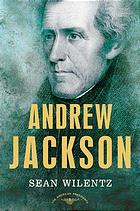
andrewjacksonJust who was Andrew Jackson? Was he the first president to create a political following among the masses and ride that to power? Was he a shameless opportunist who pandered to the lowest common denominator? Was he a war hero? Was he a man who set into place a policy that turned out to be genocidal? Was he devoutly loyal to the United States and its Constitution? Did he interpret the Constitution as he saw fit?
According to Sean Wilentz, the answer to all these questions is “yes.” However, in Wilentz’s view, there was an explanation for all of Jackson’s actions, and, ultimately, they served to benefit the United States.

Andrew Jackson’s stock among historians has risen and fallen throughout the years like the Dow Jones 30 on a day when Timothy Geithner coughs. Wilentz traces these changes in the introduction to his book and then sets out, as best you can in 170 pages, to explain the complicated life of Andrew Jackson.

The future President was born near the South Carolina/North Carolina border in 1767 and was caught up in the tail end of the Revolutionary War, when he and his brothers were captured by British soldiers. The young Jackson refused to shine a British officer’s boots, claiming he was a prisoner of war, and for his insolence, Jackson received a gash in his head with a sword that never left him. That wound would be a constant reminder of Jackson’s distaste for Britain, aristocracy, and privilege.

Jackson’s father died before he was born, and his mother died when he was still in his teens.  So, Andrew Jackson was very much a self-made man. In 1791, he married a woman named Rachel Donelson, who provided both love and some financial security for him. However, Rachel was not completely divorced from her husband. After a period, the two would marry again to make it official. This would end up being a significant event in American politics later. Jackson would also fight several duels to uphold his wife’s honor, and killed one person during one.

By 1796, Jackson, who had moved west to Tennessee, used his political connections to become that state’s first member of the House of Representatives, and, a few months later, moved on to the Senate. Jackson resigned from the Senate in 1798 to serve on the Tennessee Supreme Court, and later took up farming at his plantation, the Hermitage.

However, Jackson was not bound for a quiet life. The War of 1812 gave Jackson the chance to serve in the military, and get some measure of revenge against the British who treated him so shamelessly during the Revolution.

Jackson’s first military encounters, however, were against the Creek Indians in Alabama. Responding to a massacre by a group of Creeks called the Red Sticks at Fort Mims in 1813, Jackson led his troops to extract vengeance. In two engagements, Jackson’s troops killed nearly every Red Stick Creek male and took all the women and children as prisoners. Additionally, Jackson was able to get a treaty ceding Creek land in Georgia and Alabama to the U.S. Jackson was prepared to do whatever it took to keep whites and Indians separate. He firmly believed that the two groups could not coexist peacefully.

After his success in Alabama (at least in the eyes of President Madison), Jackson moved on to New Orleans to defend that crucial port city against the British. On January 8, 1815, Jackson famously routed the British in what would be the last battle of the War of 1812, which was technically already over since a peace treaty had been signed about 10 days earlier. However, Jackson failed to receive a Tweet from @ghentytreaty in time that read “USA and UK say war over! Woo hoo! Henry Clay is totally wasted!”

Wilentz points out that Jackson’s victory at New Orleans was just as much the product of British bungling (there were numerous logisticial problems), but history judged that from then on, Jackson would be “The Hero of New Orleans.” And Jackson didn’t take kindly to anyone saying otherwise.

With the War of 1812 over, Jackson kept up his military adventures, moving on to Florida, which was still part of Spain. Jackson ostensibly had moved his troops to Georgia to deal with the Seminoles, but that soon morphed into a mission to take control of Florida. And with a few military victories and the executions of two British subjects, the United States was able to parlay this into buying Florida from Spain. Jackson became its first territorial governor.

In 1822, Jackson was nominated for President by the Tennessee legislature, which also elected him to the Senate. But in the election of 1824, Jackson, despite winning the most popular votes AND electoral votes, lost the election. With four candidates running, no one had a majority, and the House of Representatives chose John Quincy Adams as President. Jackson made Adams his enemy. And if you were an enemy of Andrew Jackson, that was a lifetime job. (Jackson would continually advocate for the direct election of the President. That has not worked so far.)

Adams turned out to be ill-suited for the presidency, and Jackson exacted his revenge with an easy win in 1828. However, the campaign was ugly, with numerous slurs brought up about Rachel Jackson, and her questionable first marriage. Rachel Jackson died of a heart attack in December of 1828. Andrew Jackson never forgave anyone for the slights on her reputation.

Crises hit Jackson almost immediately after his inauguration. Jackson, like most Presidents, removed many Adams supporters from their officers and replaced them with people loyal to him. Jackson referred to this as “rotation in office,” but it soon was dubbed “the spoils system.” While Jackson was not the first, or last, President to use the power of patronage, he became the most closely identified with it.

Jackson also faced a crisis within his own Cabinet. Secretary of War John Eaton, one of his closest friends, had married a woman named Margaret Eaton, who was not from upper crust society in Washington. Her first husband had reportedly killed himself while at sea. She was snubbed by many of the wives of the other Cabinet members along with the wife of Jackson’s Vice President, John Calhoun. Jackson backed Eaton, although by 1831, five members of Jackson’s cabinet had resigned in the fallout.

After this, three major domestic events defined Jackson’s presidency.

First, Jackson, in agreement with Georgia’s government, ordered the removal of Cherokees from that state to western territories, such as Arkansas. The removal was not voluntary, and the Seminoles would be subject to attacks by settlers along the way. Approximately 8,000 Cherokees died on the journey west (called “The Trail of Tears”). However, Jackson stood by his decision. He believed that it was better for all parties if Native Americans lived in Federal territories where they would receive more protection than they did from local authorities. This turned out to be one of the biggest mistakes of the Jackson administration.

Jackson’s second major crisis was the Rechartering of the Second Bank of the United States. Jackson greatly distrusted banks and paper money. Jackson especially disliked the way the Bank of the United States was run. He felt that it’s director, Nicholas Biddle, was creating an aristocracy who made money from the hard work of people who needed to use the bank to buy land or get credit.

In 1831, Henry Clay pushed forth a bill that would extend the bank’s charter for another 20 years. This was done four years before the charter expired for two reasons: 1) to remove the issue from the upcoming election, and 2) to make the bank an issue in the upcoming election. Clay assumed that the Bank, which was well run, would get its recharter.

However, Jackson shocked the political establishment by vetoing the bill rechartering the bank. His veto message used populist themes to explain why he took his action. Jackson felt that the bank was unconstitutional (although the Supreme Court had already said otherwise), and in his duty as President, he couldn’t allow it to continue. He did not want the Federal Government to sponsor an institution that benefited a group of wealthy Easterners.

The third crisis Jackson faced was the Nullification Crisis. The state of South Carolina believed that tariffs were too high (one bill was named “The Tariff of Abominations”), preventing residents from buying cheap goods from Europe, instead having to rely on more expensive goods made in other parts of the country. Also, South Carolina felt that too much of the revenue from tariffs was being used to build canals and roads in the North and East.

South Carolina believed that that the Constitution was a contract among the states. And if a state believed that a law was too onerous to uphold, the state had the right to declare it null and void within its borders. Or, if it was really offended, the state could secede all together.

Jackson was not going to allow one state to opt out of the country that he believed in so much. He used a two pronged approach to the crisis. In a message to Congress, Jackson offered to work with South Carolina to adjust the tariffs to more appropriate levels. And in another bill, Jackson authorized the use of force to collect tariffs. Jackson began sending ships out to sea to meet ships and collect tariffs there before the ships would dock in Charleston.

South Carolina eventually backed down as a compromise tariff was reached. But the crisis would be revisited again,  with more deadly implications over the issue of slavery in 1860.

Jackson campaigned for reelection in 1832 using the Bank Veto as something of a campaign platform. His opponent, Clay, tried to use the Veto against Jackson. But the people loved Jackson, and he was easily reelected. Jackson also had a new Vice President in Martin Van Buren.

Jackson’s second term saw him put the finishing touches on the Bank of the United States. Not content to wait for the charter to expire, Jackson ordered all Government deposits to be withdrawn from the Bank of the United States and redistributed to a series of state chartered banks. Biddle reacted to this by greatly curtailing credit, creating a brief financial panic. However, Jackson won the battle of popular opinion over Biddle. Credit markets loosened up, and the economy grew.

Wilentz spends a chapter examining Jackson’s views on slavery. And Jackson doesn’t come out well here. Jackson was a slave owner and profited greatly from having slaves. But during Jackson’s Presidency, the nascent Abolitionist movement was starting to grow from fringe level into a major political force. Abolitionists attempted to send through the mail to nearly everyone in South Carolina, political materials advocating their side. Jackson had to figure out which was more important: maintaing the Federal Government’s duty to deliver the mail, or to keep South Carolina happy by not delivering “objectionable materials.” Jackson ultimately sided with South Carolina on this point, allowing local postal officials to skirt any obligation to deliver all the mail.

At the end of Jackson’s administration, Texas split away from Mexico. Texas had been settled by many slaveholding Americans. Jackson saw Texas as a natural part of the United States, believing that John Quincy Adams had negotiated it away in 1819. However, Jackson was not able to negotiate any method to annex Texas. That would wait until 1845.

What stands out the most for Wilentz in his view of Jackson is that Jackson was a champion of democracy. He firmly believed in democratic ideals. Wilentz acknowledges that, according to today’s standards, Jackson can look like a monster. However, Jackson was a product of his time. And in many ways, Jackson was ahead of his time in his reliance on the people to make the right choices in a democracy. Jackson believed that the President had a job to lead the country. And leadership was not something he was afraid of.

Does America need another Andrew Jackson? Probably not. Did America need Andrew Jackson in its past? It’s hard to envision the country otherwise.

Other stuff: Jackson’s home, the Hermitage, is run by a private foundation. Jackson and his wife Rachel are buried there. It is about 12 miles east of Downtown Nashville. It is not this Hermitage.

Jackson’s portrait has appeared on the $20 bill since 1928 (the year of a major redesign of American currency). He replaced Grover Cleveland. Of course, in 1928, not many people had $20 bills.

Andrew Jackson was the first President to be subject to an assassination attempt. A man named Richard Lawrence tried to shoot Jackson with a pistol at close range in January of 1835. Both of Lawrence’s pistols failed to fire and Jackson subdued Lawrence by hitting him with his walking stick. Lawrence was sent to an asylum for the mentally ill.

John F. Kennedy: An Unfinished Life by Robert Dallek

So what can I do for you?

President #35, C-SPAN Historians ranking #6

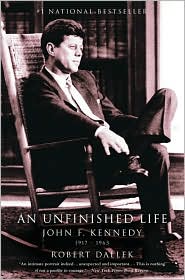
kennedyFor a man who had a shorter term in office than all but six other presidents (Barack Obama not included), John Kennedy might be studied and written about more than any other 20th Century president. Robert Dallek, who also has written biographies of Franklin Roosevelt and Lyndon Johnson, produced a scholarly biography of a man who was at times heroic, at times hesitant, often sick, and almost always on the prowl for another sexual conquest. It’s a unique combination of detailed policy analysis with generous helpings of tawdry (yet, true) details of Kennedy’s life.
Dallek was given unprecedented access to Kennedy’s medical history and what he uncovered there turned out to be what this book will be most remembered for. For all the romance of “Camelot” or “The New Frontier,” underneath it all was a man, who was elected at at the age of 43 (the youngest ever elected), who was beset by numerous serious health problems and was treated by physicians in such a way that most of us would rather just take our chances with the local HMO.

So alongside the Cuban Missile Crisis, there are descriptions of crippling back pain relieved mostly by a series of painkilling injections by doctors with questionable credentials. We find out that Kennedy took, at times, sleeping pills, antidepressants, amphetamines, testosterone, and probably a few other drugs that most of us would blanch at taking. Yet through it all, according to Dallek, Kennedy remained lucid and clear in his decision-making.
For someone who was President during the lifespan of a lot of people reading this (I missed by two years), it is surprising to me how much mythology has built up around Kennedy. Dallek tries to strip away the mythology and show how Kennedy was able to propel himself so quickly to the highest office in the U.S.

John Kennedy was born into a wealthy Irish Catholic family in Boston. His older brother, Joseph Jr., was expected to be the political star of the family, but he died in a plane crash during World War II and it was left for the second son, John (called Jack throughout the book, there’s a lot of first name reference in the book so you can keep people straight), to fulfill the wishes of his father, Joseph Sr., to become America’s first Catholic president.

Dallek details the medical problems that hit young Jack when he’s in prep school and set him on a course for lifelong illness. Kennedy was beset by intestinal problems early on and Dallek goes into quite a bit of detail on this.

The problem, as best as I could figure out, was that Kennedy’s intestinal problems were treated with a strong regimen of steroids. The problem was that doctors didn’t quite know how much to prescribe. Or when to take it. Or when to stop. And the longtime use of these steroids (not the anabolic kind, but Kennedy would take those later), led to osteoporosis (and chronic back pain that required surgery) and Addison’s disease (a deficiency in the adrenal glands that was potentially life-threatening). And then there were also chronic problems with the prostate, which probably wasn’t helped by Kennedy’s promiscuity.

John Kennedy became a war hero for his efforts to save his crew aboard PT-109, although he had to have several strings pulled for him to get into the military. Most people with Kennedy’s maladies would have spent World War II behind a desk, but Kennedy knew the importance of having a combat background if he wanted to go into politics.

Back from the war, Kennedy ran for the House in 1946 and then moved on the Senate in 1952. Despite numerous hospitalizations in 1954 and 1955 for spinal surgeries, Kennedy still had a high enough profile to get himself considered as possible running mate to Adlai Stevenson in 1956. Joseph Kennedy actually tried to get Lyndon Johnson to run for President and have his son be his running mate, but Johnson did not think that the Democrats had much chance to win in 1956.

Soon after Stevenson’s loss to Eisenhower, Kennedy started positioning himself to run for President in 1960. Few campaigns have received more attention as they were multiple story lines.

There was the young, rich, attractive Senator from Massachusetts trying to overcome religious prejudice. There were Cold War overtones throughout. The Kennedy-Nixon television debates changed the way presidential campaigns were conducted. In the end, Kennedy won by a narrow margin over Nixon, thanks in part to some “interesting” vote counting in Illinois and Texas. Dallek attributes the closeness of the election to the hesitancy of many Southern Protestant voters to elect a Catholic. The 1960 election was set up nicely for the Democrats as there was a recession and Kennedy was able to outspend Nixon. (In general, Kennedys outspend everyone in elections. It’s a family tradition.)

After Kennedy’s famous inaugural address, Dallek starts to dissect the Kennedy presidency. There were many doubts if someone so young could handle such a big job. And at the outset, Kennedy definitely looked not up to the task.

Kennedy was faced with crises external, in Laos (where he chose not to intervene), and internally, with a civil rights issue with the Freedom Riders. And in April of 1961, Kennedy gave the go ahead to the CIA plan to remove Castro from power with a paramilitary force. That turned out to be what is known as The Bay of Pigs. And it was an utter failure.

Soon after, Kennedy ventured to Vienna for a summit meeting with Soviet leader Nikita Khruschev. Kennedy’s performance at this was widely criticized as the young president was not prepared for Khruschev’s belligerence regarding East Germany and Berlin.

On the domestic front, which Kennedy didn’t seem to care about as much as foreign policy, there were problems. The Kennedy administration was slow to take action on civil rights legislation because the Congress was still dominated by conservative Southerners in important positions, and Kennedy didn’t want to alienate an important part of his party that he needed if he wanted to be reelected in 1964.

Economically, the country was in a recession and Kennedy wanted to push through a large income tax cut, although opposition from conservatives (both Democratic and Republican) kept Kennedy from getting the complete package of reforms he wanted. Plans to increase Federal funding for education also went nowhere.

The biggest crisis of Kennedy’s administration was the Cuban Missile Crisis of October of 1962. It was perhaps the closest time ever that the US and Soviet Union ever came to a full-scale nuclear exchange. But, fortunately, Khruschev backed down from placing offensive weapons in Cuba and Kennedy opted not to follow the advice of his military advisers, who wanted an armed invasion of Cuba. This event, probably more than any other, secured Kennedy’s legacy, even though all he was doing was reacting to posturing by the Soviet Union. Of course, Kennedy and his advisers didn’t know if all Khruschev was doing was posturing or was really intent on war.

By 1963, Kennedy’s popularity was steadily increasing. He gave a speech at American University in June of 1963 where he made his case for nuclear disarmament to the Soviet Union. Soon after the speech, the first comprehensive nuclear test ban treaty was agreed to between the Americans and Soviets.

Later in 1963, Kennedy had a triumphant trip to Berlin, where he rallied the hopes of West  Berlin residents with his famous (although semantically incorrect) statement of “Ich bin ein Berliner!

The final months of the the Kennedy administration (not that he was expecting them to be the final months) brought up one of the most troubling parts of that era: Vietnam. On November 1, 1963 Kennedy authorized the CIA to start a coup to overthrow South Vietnamese leader Diem, who was killed during the the military takeover. Dallek portrays Kennedy as being deeply troubled by the violence of the coup and whether or not U.S. involvement in that region would ever work. But would Kennedy have increased the military buildup in Vietnam to the point where it became what we know as the Vietnam War?

Before that question could be answered, Kennedy was assassinated in Dallas on November 22, 1963. And the answer to that question (along with many others) is still hotly debated.

So just what did John F. Kennedy do as President? What did he accomplish? In Dallek’s view, his primary accomplishments were: 1) standing up to Khruschev and the Soviets in the Cuban Missile Crisis and the negotiation of the Comprehensive Test Ban Treaty, 2) the development of the space program, which Dallek felt greatly improved America’s international standing, and 3) the establishment of the Peace Corps. Despite Dallek’s admiration for Kennedy, I doubt he would have rated Kennedy as high as the panel of historians C-SPAN assembled.

Obviously, some people are going to disagree with this assessment. For some, Kennedy will be the man who was more show than substance. He was a man who, in many ways, bought his way to the top. Kennedy didn’t get any major civil rights legislation passed (that happened in the Johnson Administration). He was a man who presented an image of a loving family man who was physically fit, when in reality he was very ill and cheated on his wife with women who were connected to mobsters.

It’s almost like John F. Kennedy is whomever people want him to be. If you’ve got the time to plow through an 830 page biography (it’s only about 700 pages of text, the rest of it is notes and an index), then Robert Dallek’s book is for you. It is not hagiography. It is not a hatchet job either. But like Kennedy, the book will ultimately reflect what you want it to be.

Other stuff: As you would expect, the John F. Kennedy Presidential Library is in Boston.

I attended John F. Kennedy High in Granada Hills, California. The 1994 Northridge Earthquake destroyed a couple buildings on campus and allowed ones that were slightly less ugly to be put in their place.

Kennedy is unique among Presidents in that he is the only one widely commemorated on the day he died, November 22, rather than on his birthday, May 29.

John Kennedy’s seat in the House was filled by future Speaker Tip O’Neill. His Senate seat was filled by Benjamin Smith, who held it for two years before John Kennedy’s youngest brother,  Edward, was elected in 1962.

Senator Robert Byrd of West Virginia is the only current member of the Senate to have served alongside John Kennedy in that body. Representative John Dingell of Michigan served alongside Kennedy in the House.

There are now two Senators who were born after John Kennedy’s death: Michael Bennett of Colorado and Kirsten Gillibrand of New York.

The New York Times review of this book was written by Ted Widmer, who wrote the Martin Van Buren bio that I had reviewed earlier. Van Buren and Kennedy remain the only two Presidents who were not partially English.

Although Kennedy was the first Catholic president, there was not a Catholic Vice President until Joe Biden. The first Catholic Chief Justice was Roger Taney, way back  in 1836.

The next bio I will review will be shorter. So there may not be as long of a gap before the next review.

James Garfield by Ira Rutkow

You should put some Bactine on that

President #20, C-SPAN Historians ranking #28

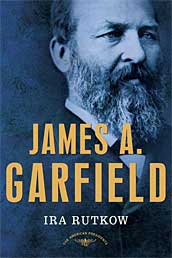
jamesgarfieldJames Garfield served as President from March 4 through September 19, 1881, the second shortest tenure of any person to hold the office. Garfield’s assassination was  tragic, although the most tragic part was not the violence perpetrated by Charles Guiteau, but rather by the the incompetent medical care that Garfield received from a group of doctors who refused to adopt some of the most basic medical principles that we take for granted today.
Because Garfield’s presidency was so short and he spent much of it (80 days) dying from his bullet wound, this biography of Garfield was given to Ira Rutkow, a surgeon who has written numerous books on medical history. Garfield’s biography is intriguing, although if reading about gruesome medical conditions is not your thing, you may wish to pass this book by.

Rutkow does discuss Garfield’s rise from his humble beginnings in Ohio (he was the last president to be born in a log cabin) to the White House. And Garfield was undoubtedly a brilliant man, although politically, his greatest gift was giving good speeches.  He was not an especially inspiring leader, but he was respected.

Garfield rose to fame during the Civil War serving as the chief of staff to Union General William Rosecrans, although Garfield left the Army in 1863 to take over a House seat for Ohio. Rosecrans was relieved of his command of the Army of the Cumberland after a terrible defeat at the Battle of Chickamauga. Garfield and Rosecrans are linked in the city of Paramount, California where streets named after them intersect. (Although some sources say Garfield Avenue is actually named for Garfield’s widow, Lucretia.)

While serving in the House, Garfield aligned himself with the Radical Republicans and he even came out against the reelection of Abraham Lincoln. But he built a reputation as a thoughtful and well-read Representative and someone to watch out for in the future.

And like so many politicians of the era, Garfield was touched by scandals, including the Credit Mobilier scandal (it’s another one of those events you hoped your teacher didn’t put on the midterm) and also for receiving excessive fees for serving as a lobbyist for a company. But compared to what was going in the Grant Administration, Garfield looked pretty clean.

In 1880, the Republican Party, which barely held on to the White House in 1876 thanks to some last-minute Electoral College chicanery (the Democrats were equally guilty of chicanery. It was a very chicanerous time.), was divided into two factions: the Stalwarts who wanted to bring back Ulysses Grant for a third term. This faction was led by New York Senator Roscoe Conkling. The Stalwarts liked the spoils system and political appointments for cronies all around.

The other faction was called the Half-Breeds and they were led by James Blaine, who had been Speaker of the House. This group tended to be a bit more conciliatory toward the South and wanted some civil service reform. The Half-Breeds had two candidates: Blaine and Ohio Senator John “my older brother burned down Georgia” Sherman.

Three strong candidates at a political convention lends itself well to a deadlock and one quickly developed. Garfield, who was hoping for such a deadlock, ended up being the compromise choice and he prevailed in the general election over Democrat Winfield Scott Hancock (another Union General) by margin of about 7,000 votes (Rutkow uses a figure of 2,000). The Electoral Vote wasn’t as close with Garfield winning 214-155.

Upon election, nothing went well for Garfield. Conkling demanded that his faction of the party be represented in Garfield’s Cabinet, even though the Vice-President, Chester Arthur, was a Conkling crony. Garfield ended up piecing together a Cabinet that no one liked.

After his inauguration, Garfield soon discovered that his campaign manager was involved in a scandal where he took exorbitant fees to deliver mail to rural areas through companies he controlled. But the mail never got delivered in those areas.

The biggest headache for Garfield came when he tried to appoint someone to the lucrative position of Customs Collector for the Port of New York who was not acceptable to Conkling, who tried to block the move with some parliamentary tricks. Conkling’s effort failed and, out of spite or pique, Conkling resigned his Senate seat (as did New York’s other Senator, Thomas “Me Too” Platt) hoping to be reelected to the Senate by the New York legislature. The New York legislature chose two other people.

So Conkling was out of the picture and life seemed better for James Garfield as he was heading to catch a train to  his alma mater of Williams College and a vacation with his wife in New Englad.

Enter Charles Guiteau. Guiteau was a man with many psychiatric problems (this amateur psychiatrist thinks he was schizophrenic) and he was disappointed that Garfield and his new Secretary of State, Blaine, had not appointed him to be a U.S. consul in either Vienna or Paris. People in Washington knew Guiteau as “that crazy guy who keeps asking for a job.” But they didn’t know that he wasn’t harmless. He had a gun and he fired twice into Garfield’s back.

The first medical officer to examine Garfield stuck his unsterilized finger into the wound to look for the bullet, but couldn’t find it. (Rutkow speculates that the first person examining Garfield may have had manure on his hands.) Then another doctor came in and he tried to find the bullet with his finger. Then he took a metal probe and stuck it inside Garfield’s bullet wound and poked around, but didn’t find the bullet. However, it was assumed that the bullet hit Garfield’s liver. It hadn’t.

Garfield was taken back to the White House where the doctor who took over the case, a man who was literally a doctor in name only. The man’s name was Doctor William Bliss. Was he Dr. Doctor William Bliss? Who knows for sure? It didn’t take much in 1881 to call yourself “Doctor” as licensing of physicians hadn’t started, but Doctor was the man’s given name. Bliss wasn’t even the Garfield family physician. They frequented a homeopathic doctor in Washington.

Bliss never could figure out that Garfield kept suffering from high fevers, extreme nausea, and a rapid heart rate because he had developed massive infections from his wound being continually poked and prodded at with unsterilized instruments. Garfield spent the last 80 days of his life in misery and agony that would have been easily preventable today and could have been prevented back in 1881 if Bliss hadn’t held on to his belief that antiseptic practices were just a fad. Alexander Graham Bell was even brought in to help out and that was pretty much a disaster.

Rutkow’s description of Garfield’s care can be quite harrowing to read. It’s also remarkable to find out how much medical science has changed in the past 128 years. Rutkow compares the treatment that Ronald Reagan received in 1981 to the treatment that Garfield received 100 years later earlier. Garfield’s wound would have been treated fairly simply in 1981 and he likely would have been out of the hospital in a day or two. Reagan’s injuries in 1881 likely would have killed him within a day if Bliss had taken over the case (mostly because Bliss wouldn’t have bothered to check on Reagan’s respiration or blood pressure.) Guiteau’s bullet did not hit any of Garfield’s vital organs nor did it cause any spinal cord damage.

Bliss would later publish articles on his treatment of Garfield in an attempt to rehabilitate his reputation. Here is an example of one such document, but I don’t suggest clicking that link until you’re sure you aren’t going to eat for a while.

James Garfield didn’t want to leave a legacy of dying at a young age (49) from medical malpractice, but that’s what history remembers him for. But at least he helped get doctors to wash their hands and sterilize their instruments.

Notes: James Garfield’s home, dubbed Lawnfield by reporters during the 1880 campaign, is run by the National Park Service as the James A. Garfield National Historic Site. It is located in Mentor, Ohio.

Garfield was the first president whose mother watched his inauguration. Garfield’s widow, Lucretia, moved to Pasadena, California for the winters after her husband’s death and passed away in 1918, although she is buried alongside her husband in a cemetery in Cleveland.

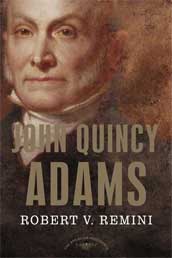
John Quincy Adams by Robert V. Remini

All Three Names Please!

President #6, C-SPAN historians ranking #19

jqadamsJohn Quincy Adams had one of the most distinguished careers in service to the United States that any person may have had. However, the four years he was president, from 1825 through 1829, were a series of political missteps compounded by the fact that he was the only president ever to be elected despite not getting the most ELECTORAL votes.

JQA, as he styled himself in correspondence, was the son of the second president, John Adams. He accompanied his father to Europe during the Revolution and learned French and German along the way. At the age of 14, he accompanied the American minister to St. Petersburg, Richard Dana, because French was spoken among diplomats at the time.

When Adams returned home to the U.S., he attended Harvard (however his admission was delayed because it was felt he didn’t speak Greek or Latin well enough) and graduated with honors and set up a law practice.

Adams fell in love with a Massachusetts woman, but neither her family nor Adams’ parents could ever agree on when or if the marriage should take place, and Adams never married the only woman he apparently ever truly loved. Adams eventually married a British woman and started a family, but he never seemed to truly love his wife.

Eventually, Adams was given a diplomatic post in Europe, first in the Netherlands and then later in Russia, and moved up to the post of Secretary of State under President James Monroe in 1817. And according to author Robert V. Remini, one of the foremost authorities on Adams’ era and a biographer of Andrew Jackson, Adams may have been the greatest Secretary of State ever.

Adams acquired Florida from Spain and in the same negotiation managed to get Spain to acknowledge that the Louisiana Territory extended all the way to the Pacific Ocean. There was also a successful treaty signed with the British in 1818 that settled part of what is now the U.S.-Canada border and also helped U.S. commercial interests greatly. And Adams was the man who wrote what would become known as “The Monroe Doctrine,” a cornerstone of American foreign policy that stated that any further attempts by European powers to colonize any country in the Western Hemisphere would be opposed by the United States.

With a pedigree and a list of accomplishments like Adams, it would seem that his elevation to the White House would have been a cinch. But it most certainly wasn’t.

In 1824, American politics was nominally a one-party system as the Federalists had gone the way of the tricorn hat. But this “one party” had numerous factions and little or no formal structure. Four people were nominated for president: Adams, Andrew Jackson (the extremely popular military hero of the War of 1812), William Crawford (the Secretary of the Treasury and the favored candidates of what would be considered the party regulars in Congress), and Henry Clay (who thought he was the best equipped man for the job because he had an ego the size of his home state of Kentucky.)

1824 was the first year that popular vote totals were recorded in a Presidential election. Jackson came out on top with about 152,000 votes and Adams had about 113,000. Jackson won 99 electoral votes, Adams won 84, Crawford won 41, and Clay finished in 37. Under the terms of the Twelfth Amendment, the top three in the Electoral College vote would be eligible for selection by the House.

This put Clay in the position of kingmaker as he could instruct the states that voted for him to vote a particular way. According to Remini, Clay didn’t hesitate to make his choice. Clay didn’t want Crawford to become President because that man had recently had a stroke and was nearly blind and couldn’t talk.  And Clay despised Jackson and didn’t want to see a military man as President. So that left Adams.

But what would Adams do to make it worth while for Clay to support him? It was pretty clear. Adams had to make Clay his Secretary of State. And in doing so, Adams prevailed in the House, winning 13 of the 23 state delegations. And as an added “prize,” Adams pretty much destroyed any chance of accomplishing anything as President because now Jackson and his supporters were, to put it mildly, pissed off.

To make matters worse, in Adams’ first message to Congress (presidents did not directly address Congress at the time, but rather sent over messages to be read), he laid out an ambitious legislative agenda. Adams wanted numerous internal improvements with roads and canals built all over the country. Adams wanted a national university and a national observatory. He wanted to go on the metric system. He wanted to send representatives to a Pan American Congress that was convening in Panama.

Adams ended up getting none of these and was widely ridiculed in the press. It didn’t help that Adams felt it was unseemly for a President to answer any criticism publicly. It also didn’t help that his Secretary of State, Clay, was even more disliked. And the Vice President, John Calhoun, didn’t like Adams.

And to be fair, Adams was hard to love. He didn’t exude a lot of warmth. He was the product of an unhappy childhood. Despite the way HBO had Laura Linney portray Abigail Adams, JQA’s mother, on TV, she was never going to win Mother of the Year. She was a parent, according to Remini’s description of her, who withheld affection and gave out a lot of criticism. JQA didn’t attend his own mother’s funeral and didn’t seem too broken up about it.  And Adams in turn was a bad father and had one son kill himself and another drink himself to death.

The John Quincy Adams Presidency was a four-year long trainwreck and in 1828, Jackson won the rematch easily despite a bitter campaign where Jackson’s people accused Adams of pimping out his own son to the Prussian court and Adams’ people accusing Jackson’s wife of bigamy.

After leaving the White House (Adams, like his father, didn’t stick around for the inauguration of his successor), JQA wanted to retire to Massachusetts, but eventually he was asked to run for a House seat and took his seat in 1831. Adams found his true calling in the House of Representatives.

While serving in Congress, Adams argued against the “gag rule” which prevented any discussion of the abolition of slavery. Adams also would represent the Africans on the Amistad, who had taken over the ship that was taking them to America and slavery and tried to return home. Adams won that case and the Africans were free men. It was a sign of the times though that it took a Supreme Court ruling for human beings to actually be given human rights.

Remini’s book on JQA’s presidency tried to highlight four years of John Quincy Adams’ distinguished career. But Adams’ life was much more than four bad years in the 1820s. And Remini reminds us of that. Some great men aren’t necessarily great presidents. And even Adams knew this about himself.

Other stuff: If you want to visit parts of John Quincy Adams’ history, you should visit the Adams National Historical Park in Quincy, Massachusetts. Adams had a granchild born in the White House, the first child ever to be born there. He passed away in the U.S. Capitol.