William Howard Taft: An Intimate History by Judith Icke Anderson

President #27, C-SPAN historians’ ranking #24

Why Am I President? It Was On My Wife’s To Do List.
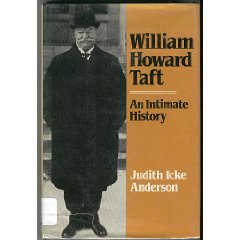
taftWhen it came time to find a biography of President William Taft, it wasn’t easy. Despite holding office during a time when Constitutional Amendments introducing the income tax and the direct election of senators, the admission of two states (New Mexico and Arizona), and running in an election against two of the 20th Century’s most famous presidents (Theodore Roosevelt and Woodrow Wilson), Taft hasn’t received much interest from historians.

This left me finding this book, which was published commercially in 1981, but was actually a more commercial version of a UCLA dissertation by a woman for whom I can find no trace further trace of.

“An Intimate History” is the same subtitle that Jefferson biographer Fawn Brodie used for his study of our third president. That book was published in 1974. Brodie was Anderson’s adviser at UCLA and she followed in her footsteps. And in this book, the reader learns about William Taft, the man, and why he did what he did. And in Anderson’s view, Taft’s actions in all aspects of life were mostly an attempt to please his mother, and, then later, his wife.

And Anderson goes on at length about Taft’s weight. It is not something that can be ignored, especially since Taft tipped the scales at up to 355 pounds while he served as President.

Why was Taft so heavy? According to Anderson, Taft was someone who took solace in eating when he was either stressed out or felt a need to please someone. And when Taft was in the White House, he was stressed out. His enormous weight likely gave Taft a case of apnea as he often dozed off at inappropriate times and snored loudly during public gatherings.

Taft’s career path to the White House was not a normal one. The son of a former Secretary of War, Alphonso Taft, William went to college at Yale and then to law school at the University of Cincinnati. His mother assumed that William, like all Tafts would achieve greatness.

But first, Taft needed to find a wife. And he eventually met Helen “Nellie” Herron at a sledding party in Cincinnati. Taft courted Nellie for years before she agreed to marry him. Nellie’s hesitancy stemmed from the fact that she considered herself to be fairly independent. However, she also wanted to be attached to important people. And she sensed that William Taft was someone who could bring up her to the highest circles of power, even the White House.

But, Taft’s ambition was to be a judge. He served in a local court in Ohio and loved it. However, he was picked to go to Washington by President Benjamin Harrison to serve as Solicitor General.  Nellie loved the change of scenery. Although Taft was a good judge, he was a lousy litigator. He did not have an adversarial nature. He wanted to be everyone’s friend. Although I am not a lawyer, I’m guessing being conciliatory and jovial isn’t the tone you’re looking for.

In Washington, Taft became friends with a young man who was serving as the Assistant Secretary of the Navy. His name was Theodore Roosevelt.

President William McKinley offered Taft a position on the Federal District Court back in Ohio, so Taft returned there to a job he loved above all other.  Later, McKinley asked Taft back when he needed someone to serve as the first civil governor of the newest United States territories, the Philippines.

The people of the Philippines didn’t particularly enjoy being under Spanish control, and they didn’t particularly like having Americans tell them what to do either. The American military governor, General Arthur MacArthur (who had a son named Douglas), had to suppress an insurrection. MacArthur did so, but in a brutal fashion that often involved torture.

Taft had to work to repair America’s image both in the Philippines and the world while building up a system of government for the people of the Philippines. Anderson describes Taft as being well regarded by the Filipinos, although coming after MacArthur, that’s not much of a surprise.

By 1904, President Theodore Roosevelt needed a new Secretary of War and he asked his old friend William Taft to take over that post. Taft didn’t know much about running the Army, but Roosevelt thought well of him. Taft actually spent much of his time travelling on diplomatic missions as Roosevelt had stretched U.S. interests to all parts of the globe.

Roosevelt had promised Taft that he would get him a seat on the Supreme Court, preferably Chief Justice, if one ever came up. But the time was never right, so Taft remained in Roosevelt’s Cabinet.

When Roosevelt was elected to a full term in 1904, he promised he wouldn’t run again. This was a bit of a problem for him in 1908 because he was still relatively young (50 on Election Day) and extremely popular. But Roosevelt felt he couldn’t go back on his promise, so he designated Taft to be his successor.

Taft was not particularly interested in becoming President, but Nellie was quite interested in being First Lady. And in most discussions between William and Nellie, Nellie won. Taft was elected easily over Democratic nominee, and three-time loser, Wililam Jennings Bryan.

Almost as soon as the election was over, things went wrong for Taft. The President-elect had sent a telegram to supporters thanking two people for his election: Roosevelt (for his popularity that made it easy for another Republican to win) and his brother Charles Taft (for extensive financial support). Roosevelt was appalled to be lumped in with someone who just wrote checks.

One of the first major pieces of legislation Taft wanted to get passed was a tariff reform bill. Roosevelt advised Taft that tariffs needed to be lowered, but he didn’t do while he was in office because he knew the issue was too sensitive with an election coming up.

In 1909, the Republicans were the party of high tariffs. And the more conservative Republicans liked the tariffs to be as high as possible. The bill that passed Congress, the Payne-Aldrich Tariff ended up raising duties on nearly every type of imported goods. Conservatives were happy, but Progressive Republicans (who were Roosevelt supporters) were appalled. Taft was immediately branded as a weak leader.

Also in 1909, Taft faced a major political crisis in the Interior Department. Taft had appointed former Seattle mayor Richard Ballinger as his new Secretary of the Interior. However, Taft kept on in the Forestry Service, a Roosevelt loyalist named Gifford Pinchot.

Pinchot, who would likely be called an environmentalist now, although “conservation” was the term used in the day, accused Ballinger of leasing public lands in Alaska to large corporations for mining and other ways to tap their natural resources. Charges flew back and forth between the two men. Pinchot was eventually fired by Taft, an action that Roosevelt’s supporters could not abide. Eventually, Ballinger resigned as well. Taft bungled the matter every way possible. And mostly this happened because Taft didn’t want to take command of the situation, but rather just try to make everybody happy.

Another problem for Taft was one that was not of his own making. Roosevelt had established himself as a Progressive Republican, with a penchant for going after big business. Taft was a conservative. Roosevelt had to know this. Yet, Roosevelt backed a man for President whom he had to believe was going to reverse some of his policies.

In the midterm elections, the Republicans lost control of both houses of Congress. Soon after, Roosevelt returned from a long trip to Africa to great national acclaim. And soon set into his old friend Taft and started to position himself for another run at the White House.

Taft pretty much knew that he couldn’t get reelected in 1912. He just didn’t have the national support. His only reason for being elected in the first place was that he was Theodore Roosevelt’s friend. And now Roosevelt hated him. That left Taft without much to go on.

But Nellie was determined that her husband at least not lose the Republican nomination to Roosevelt. And Taft agreed with his wife. He decided he wanted to make Roosevelt run as a third party candidate.

Fortunately for Taft, there were only a handful of these newfangled things called primaries during the nominating season. Roosevelt won the majority of those, but Taft, through the power of patronage, was able to control enough delegates to win the nomination. Roosevelt was left to run on his own as the Progressive Party Candidate. Meanwhile, the Democrats nominated the nerdy, yet popular, governor of New Jersey, Woodrow Wilson.

Almost nothing went write right for Taft during the campaign. His trusted confidante and personal aide, Archie Butt, had left him because of personal issues in 1912. Butt had served as Roosevelt’s personal aide as well and he couldn’t decide whom to work for. So, he went to Europe to think about it. Butt booked passage on the Titanic for the trip home. He didn’t make it.

Taft’s Vice President, James “Sunny Jim” Sherman, died a few weeks before Election Day as well. Taft made odd statements to the press, including one where he said he would campaign “like a cornered rat.”

When the counting was done, Wilson was an easy winner. Taft won just two states, the worst showing of any incumbent President ever. And Taft won one of the states, Vermont, by just 923 votes. In 1912, Vermont was not yet run by the Ben & Jerry’s types, and was one of the most conservative states in the country.

Losing the election relieved a great burden from Taft. He no longer had to be the bad guy who told people “no.” Not that Taft said “no” all that often.

Once leaving office, Taft taught law at Yale, but finally got his dream job in 1921 when President Warren Harding appointed him to be Chief Justice of the United States. Taft loved this job more than any other. And according to Anderson, his weight dropped into the 260 lb range. He no longer had to eat his way through stress. He had found his dream job, the one he had thought about since he came to Washington in 1886.

William Taft passed away in 1930 and was buried in Arlington National Cemetery, the first President to be so honored. His wife Nellie wanted that honor. However, few people wander over to the section of Arlington to see Taft’s grave. Just like finding a biography of Taft, it’s something you have to seek out. Perhaps a better story of Taft’s life is still to be written.

But the life of Willam Howard Taft teaches us one thing: if you want to be remembered by historians as president, don’t have your term fall in between those of two far more famous presidents.

Psychobiography was a popular discipline in the 1970s, but it isn’t used now. Brodie was able to apply it to it someone like Jefferson because there was quite a bit to work on. The inner workings of the psyche of William Howard Taft may not be that be interesting. Especially since Anderson spells it all out very early in the book. The final 200 or so pages are more repetitions of the theme of “Taft tries to please wife, eats too much, becomes less happy, repeat.” Perhaps there is more to Taft than just a domineering wife and a battle with obesity. However, that book hasn’t been written yet.

But Nellie Taft got a major biography written about her just three years ago. Sorry Bill, you can’t win this game.

Other stuff: Taft, despite his great size, was an avid sportsman and he tried to play a round of golf nearly everyday. Taft was also the first U.S. President to throw out the ceremonial first pitch to mark the beginning of baseball season. This started in 1910.

The National Park service operates the William Howard Taft National Historic Site in Cincinnati.

Taft’s son, Robert, served as a Senator from Ohio and ran for the Republican nomination for President in 1940, 1944, and 1952. A William Howard Taft IV (great-grandson of the president) worked for a time in the George W. Bush Administration. Robert Taft III, who went by Bob Taft, served as governor of Ohio. Generally, if you run into something in the U.S. with the name “Taft” in it, it’s probably this president’s family.
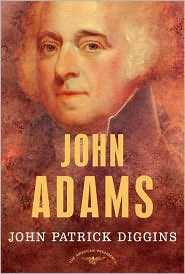
John Adams by John Patrick Diggins

President #2, C-SPAN Historians’ ranking #17

May all your wars be Quasi Wars

johnadamsFor most of our lives, John Adams was an historical figure whom people recognized, yet thought little of. We figured he must have been important since he helped write the Declaration of Independence and also became President. But he was no George Washington, a larger than life military hero and “Father of the Country.” He was no Thomas Jefferson, Renaissance man, and thinker of deep thoughts.
John Adams was one of the Founding Fathers whom people had never developed a great deal of reverence for. His face didn’t appear on any currency that was commonly in use. He was just “that guy between Washington and Jefferson.” He doesn’t have a monument or memorial in Washington, D.C. that people go out of their way to see. (There are plans to build a new Adams memorial there.)

But recently, John Adams has had a significant revival among historians. Much of this came from David McCullough’s John Adams, which was a best-seller and later an HBO miniseries. And 175 years after he passed away, John Adams has become one of the most popular historical figures in American history.

John Patrick Diggins, a professor of history at City University of New York, got on board the John Adams train with his biography of the second president, which was published in 2003. Diggins’ biography, for a 150+ page book, is densely packed with discussions about Adams political writings. If you’re looking for something that would be starring Paul Giamatti and Laura Linney, this isn’t the book.

Diggins spends one chapter discussing at length (at least it seemed so to me because it was a slog despite being just over 20 pages) going over two of Adams political writings. One is A Defence of the Constitutions of the United States of America, which Adams had published in 1787 and 1788. It was Adams’ response to criticisms of the new U.S. Constitution by French philosophers.

In Defence, Adams explains why America needed a relatively complex system of government with numerous checks and balances instead of a model like the French National Assembly, where all the power was held by one body. If you’ve read the whole thing (it’s three volumes long), you have my admiration.

The other book Adams penned was titled Discourses on Davila. It serves as something of a fourth volume to Defence and it was published in 1790. In it, Adams answered charges that he was a monarchist and an aristocrat.

Adams felt that an aristocracy was something that could not be avoided in society. There was a natural tendency for people to associate with people from their own backgrounds economically. Also people always wanted to better themselves, so there was always going to be some group that people wanted to aspire to become part of. Adams felt that the U.S. Constitution was well-suited to providing a maximum amount of liberty despite the presence of an aristocracy.

Diggins spends a long time in a short book comparing the political philosophies of Adams and Thomas Jefferson and Diggins clearly believes that Adams was the superior. Jefferson is portrayed by Diggins as someone who claimed to be a champion of civil liberties and the common man, but failed to grasp the fact that the style of government Jefferson advocated ended up being the Directory of France, which led to the Reign of Terror. Diggins argues that Adams, as a constitutionalist, actually did more for civil liberties because it takes government action to grant such liberties. The Constitution, as Lincoln said, protects us from ourselves.

One of Adams arguments against always bending to majority rule boiled down to this “What if one day 51 people supported one issue and 49 people opposed it? And what happens if one person changes his mind the next day?”  John Adams would not be a big fan of California’s initiative system.

However, Diggins book was supposed to be about Adams’ presidency. And after about 80 pages, Adams takes over the Presidency, edging out Jefferson in the election of 1796 by three electoral votes (there was no popular vote at the time). Prior to 1804, the Vice President was whomever finished second. So, Adams had the uncomfortable position of having his arch-rival serving as his second in command. (Hey, it’s like California where we have a Republican governor and a Democratic lieutenant governor!)

Adams was not a successful president as he was presented with a difficult diplomatic situation with France and he faced opposition from Jefferson’s Republicans (who thought Adams was a monarchist) and  Alexander Hamilton’s arch-Federalists (who thought Adams was too conciliatory toward Jefferson).

One of Adams first acts was sending three envoys to France to start negotiations about the problem of French ships preying on American merchant ships that were trading with England. But the French demanded, for lack of a better word, a bribe before they would talk with the Americans. This event became known as the XYZ affair and since zippers had not been invented, I will state that XYZ referred to the three anonymous people who solicited the bribes. That ended that attempt at diplomacy and the United States and France soon started what became known as the Quasi War, a war that existed in all but name (see also Korea, Vietnam, Iraq, etc.).

Adams hoped that building an American Navy would help with the problems with France, but Hamilton wanted an Army and managed to get himself appointed to be general. Jefferson and his faction opposed any hostility with the French because they admired the French Revolution, which was mostly about lopping off heads at the time. A full-scale war was averted through a mixture of diplomacy and increased internal problems in France (such as Napoleon coming to power) which left the French not particularly interested in pursuing a war with a pipsqueak republic in North America.

Tensions during the Quasi War ran high in the press, which was extraordinarily partisan at the time. Personal attacks on Adams and Jefferson by either side were the norm, and often done by printers who were on the government payroll.  To combat this, Adams signed into law the Alien and Sedition Acts, which served to curb immigration (Irish and French immigrants tended to be on Jefferson’s side) and also make it crime to say anything bad about the President and Congress in the press.

So you might be saying to yourself, “This Sedition Act sounds unconstitutional.” It very well was, but there was never a court test of it and the concept of judicial review wouldn’t be established until 1803. The Acts themselves had built in expiration dates, and they ended as Adams left office. Diggins doesn’t believe Adams came up with the idea of the Alien and Sedition Acts, but since they happened on his watch, he was ultimately responsible, and they remain the biggest blot on the historical record for Adams.

Another event in Adams’ term in office that is little remembered now, but was a big issue at the time was something called Fries’ Rebellion. John Fries was a German immigrant who worked as auctioneer in Pennsylvania. To help fund the Quasi War, Adams had Congress pass a measure which was called the House Tax, which was a nationwide property tax of sorts. Fries led a movement (a rather tame one) that encouraged Pennsylvanians to not pay the tax since it wasn’t proportional to the population. Fries and two others were arrested for this and convicted of treason and sentenced to hang.

However, Adams pardoned Fries because he felt that he had not committed treason, but rather just led a protest that was not intended to overthrow the government. Hamilton and his supporters were aghast and in the election of 1800 they would get revenge on Adams for his perceived apostasy.

The election of 1800 is often called “The Revolution of 1800.” As Diggins points out, it was the first time that a nation that was born out of a violent revolution ever had a peaceful change of power. The election was nasty as Adams’ and Jefferson’s supporter slung mud in what would soon become an American tradition for campaigns. Jefferson and his running mate Aaron Burr tied for the top spot and Hamilton (who didn’t campaign too much for Adams) was able to get the House of Representatives to put Jefferson in the top spot, because while Hamilton hated Jefferson, Hamilton hated Burr twice as much. And of course, Hamilton and Burr ended up as the Tupac and Biggy of the early 19th Century.

And on March 4, 1801, heroic Thomas Jefferson rode his horse into Washington, D.C. and was inaugurated in front of an adoring crowd and gave an inaugural address that would be the standard by which others were judged for over a century. And dour John Adams slipped out of town and didn’t watch his successor’s inauguration, although Diggins speculates that Jefferson never invited Adams.

After both men had left office, Adams and Jefferson patched up their differences and started a famous series of correspondence where they debated the issues of the day. The standards of the time prevented either man from going on the lecture circuit or writing memoirs to make money, which is sad because I would have paid pretty good money to watch John Adams and Thomas Jefferson debate the issues of the day. It sounds a bit more appealing than watching David Frost interviewing Richard Nixon.

If you are inclined to take in Diggins book about Adams, bring your thinking cap. It is not a romp through the American Revolution and the Federalist Era. It’s a study about how Adams and his political philosophy stood up against the likes of Jefferson, Montesquieu, and Rousseau. It’s a biography of Adams for people who may be interested in placing Adams in the grand scheme of things as a political thinker, rather than just picturing him as a character in a premium cable series.

Other stuff: As mentioned in his son’s post, the Adams are remembered at the Adams National Historic Park in Quincy, Massachusetts. Henry Adams, the great grandson of John Adams, does have a famous statue by Augustus Saint-Gaudens by his grave at Rock Creek Cemetery in Washington.

John Adams died on July 4, 1826 at the age of 90 years, 247 days. That was the longest lifespan of any President until Ronald Reagan surpassed Adams in 2001. Gerald Ford later surpassed Reagan’s lifespan, passing away at age 93.

Adams was the first U.S. President who was a college graduate. Adams graduated from Harvard, the first of five alums (as undergrads) from Harvard who would become Chief Executive. John Quincy Adams, Theodore Roosevelt, Franklin Roosevelt, and John Kennedy were the others. George W. Bush received an MBA from Harvard, but was an undergrad at Yale. Rutherford Hayes and Barack Obama attended Harvard Law School, but were undergrads elsewhere.

For technical reasons (like me not knowing how the software worked) this might have appeared in your RSS reader before it was visible. Sorry about that.


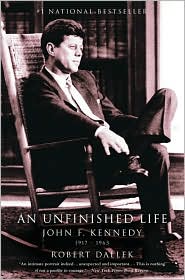
John F. Kennedy: An Unfinished Life by Robert Dallek

So what can I do for you?

President #35, C-SPAN Historians ranking #6

kennedyFor a man who had a shorter term in office than all but six other presidents (Barack Obama not included), John Kennedy might be studied and written about more than any other 20th Century president. Robert Dallek, who also has written biographies of Franklin Roosevelt and Lyndon Johnson, produced a scholarly biography of a man who was at times heroic, at times hesitant, often sick, and almost always on the prowl for another sexual conquest. It’s a unique combination of detailed policy analysis with generous helpings of tawdry (yet, true) details of Kennedy’s life.
Dallek was given unprecedented access to Kennedy’s medical history and what he uncovered there turned out to be what this book will be most remembered for. For all the romance of “Camelot” or “The New Frontier,” underneath it all was a man, who was elected at at the age of 43 (the youngest ever elected), who was beset by numerous serious health problems and was treated by physicians in such a way that most of us would rather just take our chances with the local HMO.

So alongside the Cuban Missile Crisis, there are descriptions of crippling back pain relieved mostly by a series of painkilling injections by doctors with questionable credentials. We find out that Kennedy took, at times, sleeping pills, antidepressants, amphetamines, testosterone, and probably a few other drugs that most of us would blanch at taking. Yet through it all, according to Dallek, Kennedy remained lucid and clear in his decision-making.
For someone who was President during the lifespan of a lot of people reading this (I missed by two years), it is surprising to me how much mythology has built up around Kennedy. Dallek tries to strip away the mythology and show how Kennedy was able to propel himself so quickly to the highest office in the U.S.

John Kennedy was born into a wealthy Irish Catholic family in Boston. His older brother, Joseph Jr., was expected to be the political star of the family, but he died in a plane crash during World War II and it was left for the second son, John (called Jack throughout the book, there’s a lot of first name reference in the book so you can keep people straight), to fulfill the wishes of his father, Joseph Sr., to become America’s first Catholic president.

Dallek details the medical problems that hit young Jack when he’s in prep school and set him on a course for lifelong illness. Kennedy was beset by intestinal problems early on and Dallek goes into quite a bit of detail on this.

The problem, as best as I could figure out, was that Kennedy’s intestinal problems were treated with a strong regimen of steroids. The problem was that doctors didn’t quite know how much to prescribe. Or when to take it. Or when to stop. And the longtime use of these steroids (not the anabolic kind, but Kennedy would take those later), led to osteoporosis (and chronic back pain that required surgery) and Addison’s disease (a deficiency in the adrenal glands that was potentially life-threatening). And then there were also chronic problems with the prostate, which probably wasn’t helped by Kennedy’s promiscuity.

John Kennedy became a war hero for his efforts to save his crew aboard PT-109, although he had to have several strings pulled for him to get into the military. Most people with Kennedy’s maladies would have spent World War II behind a desk, but Kennedy knew the importance of having a combat background if he wanted to go into politics.

Back from the war, Kennedy ran for the House in 1946 and then moved on the Senate in 1952. Despite numerous hospitalizations in 1954 and 1955 for spinal surgeries, Kennedy still had a high enough profile to get himself considered as possible running mate to Adlai Stevenson in 1956. Joseph Kennedy actually tried to get Lyndon Johnson to run for President and have his son be his running mate, but Johnson did not think that the Democrats had much chance to win in 1956.

Soon after Stevenson’s loss to Eisenhower, Kennedy started positioning himself to run for President in 1960. Few campaigns have received more attention as they were multiple story lines.

There was the young, rich, attractive Senator from Massachusetts trying to overcome religious prejudice. There were Cold War overtones throughout. The Kennedy-Nixon television debates changed the way presidential campaigns were conducted. In the end, Kennedy won by a narrow margin over Nixon, thanks in part to some “interesting” vote counting in Illinois and Texas. Dallek attributes the closeness of the election to the hesitancy of many Southern Protestant voters to elect a Catholic. The 1960 election was set up nicely for the Democrats as there was a recession and Kennedy was able to outspend Nixon. (In general, Kennedys outspend everyone in elections. It’s a family tradition.)

After Kennedy’s famous inaugural address, Dallek starts to dissect the Kennedy presidency. There were many doubts if someone so young could handle such a big job. And at the outset, Kennedy definitely looked not up to the task.

Kennedy was faced with crises external, in Laos (where he chose not to intervene), and internally, with a civil rights issue with the Freedom Riders. And in April of 1961, Kennedy gave the go ahead to the CIA plan to remove Castro from power with a paramilitary force. That turned out to be what is known as The Bay of Pigs. And it was an utter failure.

Soon after, Kennedy ventured to Vienna for a summit meeting with Soviet leader Nikita Khruschev. Kennedy’s performance at this was widely criticized as the young president was not prepared for Khruschev’s belligerence regarding East Germany and Berlin.

On the domestic front, which Kennedy didn’t seem to care about as much as foreign policy, there were problems. The Kennedy administration was slow to take action on civil rights legislation because the Congress was still dominated by conservative Southerners in important positions, and Kennedy didn’t want to alienate an important part of his party that he needed if he wanted to be reelected in 1964.

Economically, the country was in a recession and Kennedy wanted to push through a large income tax cut, although opposition from conservatives (both Democratic and Republican) kept Kennedy from getting the complete package of reforms he wanted. Plans to increase Federal funding for education also went nowhere.

The biggest crisis of Kennedy’s administration was the Cuban Missile Crisis of October of 1962. It was perhaps the closest time ever that the US and Soviet Union ever came to a full-scale nuclear exchange. But, fortunately, Khruschev backed down from placing offensive weapons in Cuba and Kennedy opted not to follow the advice of his military advisers, who wanted an armed invasion of Cuba. This event, probably more than any other, secured Kennedy’s legacy, even though all he was doing was reacting to posturing by the Soviet Union. Of course, Kennedy and his advisers didn’t know if all Khruschev was doing was posturing or was really intent on war.

By 1963, Kennedy’s popularity was steadily increasing. He gave a speech at American University in June of 1963 where he made his case for nuclear disarmament to the Soviet Union. Soon after the speech, the first comprehensive nuclear test ban treaty was agreed to between the Americans and Soviets.

Later in 1963, Kennedy had a triumphant trip to Berlin, where he rallied the hopes of West  Berlin residents with his famous (although semantically incorrect) statement of “Ich bin ein Berliner!

The final months of the the Kennedy administration (not that he was expecting them to be the final months) brought up one of the most troubling parts of that era: Vietnam. On November 1, 1963 Kennedy authorized the CIA to start a coup to overthrow South Vietnamese leader Diem, who was killed during the the military takeover. Dallek portrays Kennedy as being deeply troubled by the violence of the coup and whether or not U.S. involvement in that region would ever work. But would Kennedy have increased the military buildup in Vietnam to the point where it became what we know as the Vietnam War?

Before that question could be answered, Kennedy was assassinated in Dallas on November 22, 1963. And the answer to that question (along with many others) is still hotly debated.

So just what did John F. Kennedy do as President? What did he accomplish? In Dallek’s view, his primary accomplishments were: 1) standing up to Khruschev and the Soviets in the Cuban Missile Crisis and the negotiation of the Comprehensive Test Ban Treaty, 2) the development of the space program, which Dallek felt greatly improved America’s international standing, and 3) the establishment of the Peace Corps. Despite Dallek’s admiration for Kennedy, I doubt he would have rated Kennedy as high as the panel of historians C-SPAN assembled.

Obviously, some people are going to disagree with this assessment. For some, Kennedy will be the man who was more show than substance. He was a man who, in many ways, bought his way to the top. Kennedy didn’t get any major civil rights legislation passed (that happened in the Johnson Administration). He was a man who presented an image of a loving family man who was physically fit, when in reality he was very ill and cheated on his wife with women who were connected to mobsters.

It’s almost like John F. Kennedy is whomever people want him to be. If you’ve got the time to plow through an 830 page biography (it’s only about 700 pages of text, the rest of it is notes and an index), then Robert Dallek’s book is for you. It is not hagiography. It is not a hatchet job either. But like Kennedy, the book will ultimately reflect what you want it to be.

Other stuff: As you would expect, the John F. Kennedy Presidential Library is in Boston.

I attended John F. Kennedy High in Granada Hills, California. The 1994 Northridge Earthquake destroyed a couple buildings on campus and allowed ones that were slightly less ugly to be put in their place.

Kennedy is unique among Presidents in that he is the only one widely commemorated on the day he died, November 22, rather than on his birthday, May 29.

John Kennedy’s seat in the House was filled by future Speaker Tip O’Neill. His Senate seat was filled by Benjamin Smith, who held it for two years before John Kennedy’s youngest brother,  Edward, was elected in 1962.

Senator Robert Byrd of West Virginia is the only current member of the Senate to have served alongside John Kennedy in that body. Representative John Dingell of Michigan served alongside Kennedy in the House.

There are now two Senators who were born after John Kennedy’s death: Michael Bennett of Colorado and Kirsten Gillibrand of New York.

The New York Times review of this book was written by Ted Widmer, who wrote the Martin Van Buren bio that I had reviewed earlier. Van Buren and Kennedy remain the only two Presidents who were not partially English.

Although Kennedy was the first Catholic president, there was not a Catholic Vice President until Joe Biden. The first Catholic Chief Justice was Roger Taney, way back  in 1836.

The next bio I will review will be shorter. So there may not be as long of a gap before the next review.

Martin Van Buren by Ted Widmer

Don’t Panic!

President #8, C-SPAN Historians Ranking #31

martinvanburenMartin Van Buren is not a president who inspires people in this day and age. He exists mainly as a name to remember when you’re trying to remember the names of all the presidents. Fortunately, Ted Widmer, a former speechwriter for Bill Clinton, penned a biography of the first president born after the Declaration of Independence, the first president who wasn’t at least part English (there have been only two and Barack Obama isn’t the other one), and the first president who grew up speaking a language other than English.
Born into a lower middle class Dutch family in the upstate New York city of Kinderhook, Martin Van Buren was the first president to get elected primarily because he had the political smarts to pull it off. Van Buren was neither a military hero nor was he a Founding Father (or son of one). He was a man who became quite taken with the beliefs of Thomas Jefferson as a young man and then was able to work his way up to the highest office in the land.

And almost as soon as he took office, the United States economy plunged into a financial panic that had not been seen since the Constitution had been adopted. And master politician Martin Van Buren was not a master economist and after four years, Van Buren was bounced out of office in the 1840 “Log Cabin and Hard Cider” campaign of the Whig Party that got the American people used to buying into catchy slogans in an effort to make them feel better about themselves.

Widmer has a sense of humor that appealed to me. Here is a passage from a chapter where the author discusses Van Buren’s attempts to organize opposition to then incumbent president John Quincy Adams.

None of this activity was lost on President Adams, who could not have looked upon Van Buren’s activity with more disfavor if he was an emissary from the Vatican seeking to convert Yankee maids to Papism and then sell them into white slavery.

Van Buren’s accomplishments are usually presented in terms that a reader could compare to the political realities of today. The problems may have been different (well, except for the major financial disaster, that seems to be something we can relate to now), but there are parallels to today. When Van Buren’s opponents couldn’t find an actual solution to a problem that Van Buren couldn’t solve either, the alternative became to attack the person. Van Buren had done the same thing when he was attacking Adams as president and Van Buren ended up with a taste of his own medicine.

But just what did Van Buren do as president? If you’re looking for a major accomplishment that Van Buren had while he was president, you aren’t going to find one. But before Van Buren moved into the White House, he had begun the development of the Democratic Party as the first truly organized political party in the United States. But Van Buren did little to end or even ameliorate the financial panic.

Much of what we think of when we think of a political party were started by Van Buren. He established state party committees and tried to keep all parts of the country informed as to what the Democratic “message” was.  This was all at a time when communications in the United States were revolutionized by the development of the telegraph and railroads. Politics was no longer local, it was national. (Well, until the 1980s, when Tip O’Neill told us that all politics was local.)

Van Buren’s became a confidante of Andrew Jackson after the election of 1824. Although Van Buren had backed William Crawford in 1824, he saw that Jackson was the man who was going to go places. Van Buren advised Jackson to stay out of the political arena and, in the words of Widmer, “to look presidential.” Van Buren’s strategy paid off and in 1828, Jackson won the presidency over Adams, who had to ruin his image by actually trying to govern (which he did poorly.)

At the same time, Van Buren was elected governor of New York. However, he held that office for only a few months as Jackson appointed Van Buren Secretary of State. Later, Jackson appointed Van Buren to serve as U.S. minister to Britain (this was not considered a demotion at the time), but the Senate rejected Van Buren’s nomination with Vice President John Calhoun casting the tiebreaking vote against Van Buren. Calhoun would later resign the Vice Presidency before Jackson could not invite him back and Van Buren took over the #2 job in 1833. Calhoun had also been John Quincy Adams’ Vice President and was getting tired of the job. And Calhoun was just an all around miserable person.

Following after one of America’s most popular presidents in Jackson, Van Buren had little trouble defeating a combination of Whig Party candidates in 1836 (William Henry Harrison finished second). However, Van Buren’s Vice President, Richard Johnson of Kentucky, had to be elected by the Senate as he failed to get a majority of the electoral votes as many Southerners objected to the fact that Johnson had been married to one of his former slaves.

But the economic hard times defined Van Buren’s four years in office. He was not equipped for the job and likely wasn’t helped that Jackson had shut down the Bank of the United States, the national bank that had provided some sense of semblance of rationality while speculators were driving up land prices and then going broke. Interestingly at this time, one of the economy’s problems was that the Federal Government was running a SURPLUS and was returning money to the states. It would be even more interesting if I knew why running a surplus was bad. But I’m not an economist, just a guy with a blog. Economists today still don’t agree on why there was a panic in 1837, but banks refusing to lend people money was a start.

Widmer includes this description of the Panic of 1837 (as its familiarly called) that was penned by Ralph Waldo Emerson.

Cold April; hard times; men breaking who ought not to break; banks bulled into the bolstering of desperate speculators; all the newspapers a chorus of owls.

While in office, Van Buren had to face the issue of slavery head on and most of the time he tried his best to not make eye contact. Van Buren did refuse to annex the new nation of Texas to the United States because he feared what a large slave-owning state would do to the balance of power in the U.S. And Van Buren has been portrayed as the villain in the Amistad affair, but Widmer attributes this more to Steven Spielberg’s direction of the 1997 film. Nigel Hawthorne portrayed Van Buren in the film. (For more on the Amistad case, read the John Quincy Adams review.)

However, after leaving office, Van Buren had a change of heart about slavery. Widmer can’t point out exactly why except that perhaps Van Buren realized that some things were more important that than trying to keep the South placated as part of a nationa coalition. Van Buren tried for office again in 1844, but lost the nomination to James Polk, who ended up snubbing Van Buren or any of his associates for his administration. In 1848, Van Buren ran again, but the Democrats wouldn’t have him and he ran on a third party ticket called the Free Soil Party, but failed to win any electoral votes, but was enough of a pest to throw the election to Whig candidate Zachary Taylor. Van Buren got to be the Ross Perot of 1848.

Widmer managed to pull off the not so easy task of making the life of a career politician, not known for his soaring oratory or military bravery (Van Buren didn’t go to college or serve in the military), into a living, breathing, relevant figure for our times. Martin Van Buren definitely was not a great president. And he may be forgotten, but he is a part of our nation’s history and he is worth looking into.

Other stuff: Van Buren’s wife, Hannah, died in 1819 and he never remarried, although he supposedly was quite popular with the ladies. Widmer believes though that he never had a sexual relationship with anyone after his wife passed away.

Van Buren’s home, Lindenwald, is now part of the Martin Van Buren National Historic Site in Kinderhook, New York.

At 5’6″, Van Buren is believed to be the second shortest U.S. president. Only James Madison (5’4″ to 5’5″) was shorter. However, there aren’t any accurate measurements as few presidents have submitted to getting measured as if they were attending the NFL Draft Combine.

After Van Buren was elected President while serving as Vice President, no other sitting Vice President pulled off that feat until George H.W. Bush did in 1988.

Martin Van Buren was also reference in an episode of “Seinfeld.”

The next president up in my list doesn’t yet have a biography published in the American Presidents Series. So I’m going to read a biography from a different publisher. And it will be about 5 times longer (800 or so pages) than the books in this series. So it may take a while to get the next review published. But stay tuned.

James Garfield by Ira Rutkow

You should put some Bactine on that

President #20, C-SPAN Historians ranking #28

jamesgarfieldJames Garfield served as President from March 4 through September 19, 1881, the second shortest tenure of any person to hold the office. Garfield’s assassination was  tragic, although the most tragic part was not the violence perpetrated by Charles Guiteau, but rather by the the incompetent medical care that Garfield received from a group of doctors who refused to adopt some of the most basic medical principles that we take for granted today.

Because Garfield’s presidency was so short and he spent much of it (80 days) dying from his bullet wound, this biography of Garfield was given to Ira Rutkow, a surgeon who has written numerous books on medical history. Garfield’s biography is intriguing, although if reading about gruesome medical conditions is not your thing, you may wish to pass this book by.

Rutkow does discuss Garfield’s rise from his humble beginnings in Ohio (he was the last president to be born in a log cabin) to the White House. And Garfield was undoubtedly a brilliant man, although politically, his greatest gift was giving good speeches.  He was not an especially inspiring leader, but he was respected.

Garfield rose to fame during the Civil War serving as the chief of staff to Union General William Rosecrans, although Garfield left the Army in 1863 to take over a House seat for Ohio. Rosecrans was relieved of his command of the Army of the Cumberland after a terrible defeat at the Battle of Chickamauga. Garfield and Rosecrans are linked in the city of Paramount, California where streets named after them intersect. (Although some sources say Garfield Avenue is actually named for Garfield’s widow, Lucretia.)

While serving in the House, Garfield aligned himself with the Radical Republicans and he even came out against the reelection of Abraham Lincoln. But he built a reputation as a thoughtful and well-read Representative and someone to watch out for in the future.

And like so many politicians of the era, Garfield was touched by scandals, including the Credit Mobilier scandal (it’s another one of those events you hoped your teacher didn’t put on the midterm) and also for receiving excessive fees for serving as a lobbyist for a company. But compared to what was going in the Grant Administration, Garfield looked pretty clean.

In 1880, the Republican Party, which barely held on to the White House in 1876 thanks to some last-minute Electoral College chicanery (the Democrats were equally guilty of chicanery. It was a very chicanerous time.), was divided into two factions: the Stalwarts who wanted to bring back Ulysses Grant for a third term. This faction was led by New York Senator Roscoe Conkling. The Stalwarts liked the spoils system and political appointments for cronies all around.

The other faction was called the Half-Breeds and they were led by James Blaine, who had been Speaker of the House. This group tended to be a bit more conciliatory toward the South and wanted some civil service reform. The Half-Breeds had two candidates: Blaine and Ohio Senator John “my older brother burned down Georgia” Sherman.

Three strong candidates at a political convention lends itself well to a deadlock and one quickly developed. Garfield, who was hoping for such a deadlock, ended up being the compromise choice and he prevailed in the general election over Democrat Winfield Scott Hancock (another Union General) by margin of about 7,000 votes (Rutkow uses a figure of 2,000). The Electoral Vote wasn’t as close with Garfield winning 214-155.

Upon election, nothing went well for Garfield. Conkling demanded that his faction of the party be represented in Garfield’s Cabinet, even though the Vice-President, Chester Arthur, was a Conkling crony. Garfield ended up piecing together a Cabinet that no one liked.

After his inauguration, Garfield soon discovered that his campaign manager was involved in a scandal where he took exorbitant fees to deliver mail to rural areas through companies he controlled. But the mail never got delivered in those areas.

The biggest headache for Garfield came when he tried to appoint someone to the lucrative position of Customs Collector for the Port of New York who was not acceptable to Conkling, who tried to block the move with some parliamentary tricks. Conkling’s effort failed and, out of spite or pique, Conkling resigned his Senate seat (as did New York’s other Senator, Thomas “Me Too” Platt) hoping to be reelected to the Senate by the New York legislature. The New York legislature chose two other people.

So Conkling was out of the picture and life seemed better for James Garfield as he was heading to catch a train to  his alma mater of Williams College and a vacation with his wife in New Englad.

Enter Charles Guiteau. Guiteau was a man with many psychiatric problems (this amateur psychiatrist thinks he was schizophrenic) and he was disappointed that Garfield and his new Secretary of State, Blaine, had not appointed him to be a U.S. consul in either Vienna or Paris. People in Washington knew Guiteau as “that crazy guy who keeps asking for a job.” But they didn’t know that he wasn’t harmless. He had a gun and he fired twice into Garfield’s back.

The first medical officer to examine Garfield stuck his unsterilized finger into the wound to look for the bullet, but couldn’t find it. (Rutkow speculates that the first person examining Garfield may have had manure on his hands.) Then another doctor came in and he tried to find the bullet with his finger. Then he took a metal probe and stuck it inside Garfield’s bullet wound and poked around, but didn’t find the bullet. However, it was assumed that the bullet hit Garfield’s liver. It hadn’t.

Garfield was taken back to the White House where the doctor who took over the case, a man who was literally a doctor in name only. The man’s name was Doctor William Bliss. Was he Dr. Doctor William Bliss? Who knows for sure? It didn’t take much in 1881 to call yourself “Doctor” as licensing of physicians hadn’t started, but Doctor was the man’s given name. Bliss wasn’t even the Garfield family physician. They frequented a homeopathic doctor in Washington.

Bliss never could figure out that Garfield kept suffering from high fevers, extreme nausea, and a rapid heart rate because he had developed massive infections from his wound being continually poked and prodded at with unsterilized instruments. Garfield spent the last 80 days of his life in misery and agony that would have been easily preventable today and could have been prevented back in 1881 if Bliss hadn’t held on to his belief that antiseptic practices were just a fad. Alexander Graham Bell was even brought in to help out and that was pretty much a disaster.

Rutkow’s description of Garfield’s care can be quite harrowing to read. It’s also remarkable to find out how much medical science has changed in the past 128 years. Rutkow compares the treatment that Ronald Reagan received in 1981 to the treatment that Garfield received 100 years later earlier. Garfield’s wound would have been treated fairly simply in 1981 and he likely would have been out of the hospital in a day or two. Reagan’s injuries in 1881 likely would have killed him within a day if Bliss had taken over the case (mostly because Bliss wouldn’t have bothered to check on Reagan’s respiration or blood pressure.) Guiteau’s bullet did not hit any of Garfield’s vital organs nor did it cause any spinal cord damage.

Bliss would later publish articles on his treatment of Garfield in an attempt to rehabilitate his reputation. Here is an example of one such document, but I don’t suggest clicking that link until you’re sure you aren’t going to eat for a while.

James Garfield didn’t want to leave a legacy of dying at a young age (49) from medical malpractice, but that’s what history remembers him for. But at least he helped get doctors to wash their hands and sterilize their instruments.

Notes: James Garfield’s home, dubbed Lawnfield by reporters during the 1880 campaign, is run by the National Park Service as the James A. Garfield National Historic Site. It is located in Mentor, Ohio.

Garfield was the first president whose mother watched his inauguration. Garfield’s widow, Lucretia, moved to Pasadena, California for the winters after her husband’s death and passed away in 1918, although she is buried alongside her husband in a cemetery in Cleveland.