The 1956 Presidential Campaign by Charles A.H. Thomson and Frances M. Shattuck

1956presidential

Joe Smith’s brief moment of fame

You might guess from the rather straightforward title of this book is that it is probably not a page turner relating the ups and downs of a Presidential campaign that few people really care much about. And you may be right. But, if you’re the kind of person who thinks that the only reason for getting cable is to get C-SPAN so you can watch gavel to gavel coverage of political conventions, this is the book for you.

Charles Thomson was a Brookings Institution member who wrote about politics and Frances Shattuck was a researcher there. However, that’s about all that I could find about them.

The 1956 Presidential campaign was not full of drama. The most exciting part of the campaign may have been the selection of the running mate for Democratic challenger Adlai Stevenson. And even that wasn’t all that thrilling.

President Dwight Eisenhower was a very popular incumbent President and the economy was doing well. The war in Korea was over, and, for the time being, things seemed peaceful. But, in 1955, Eisenhower suffered a heart attack. He recovered, but people were worried that he would not run for reelection. Or, if he did run, he would be certain to die in office.

That led to people worrying that Vice President Richard Nixon would be taking over. And that was not something that most of America seemed ready for in 1956. However, Eisenhower recovered well from his heart attack (and a subsequent bout of ileitis) and announced that the would run for a second, and final, term, as the 22nd Amendment was now in effect and there would no more Franklin Roosevelts.

For a while, a member of Eisenhower’s national security team, Harold Stassen, insisted that the Republicans would be better off dumping Nixon from the ticket and replacing him with a more palatable running mate in Massachusetts governor Christian Herter. While Eisenhower’s support of Nixon was always a little sketchy, the Republicans stayed with Nixon.

The Democrats had three principal candidates: the 1952 loser Adlai Stevenson, Tennessee Senator Estes Kefauver, and New York Governor Averell Harriman. Stevenson and Kefauver faced off in primaries, while Harriman waited on the sidelines to see if he could pull off a late draft by the convention, whom he presumed wouldn’t want to nominate someone who had already lost.

Kefauver had the advantage in the early primaries. He was well-organized and loved campaigning. Stevenson was not as willing to put in the time to work crowds and make speeches at first. Eventually, Stevenson realized that he wasn’t going to get nominated by just hoping that people thought he was a good candidate.

The deciding contest turned out to be the California primary, then the second biggest state. The Democratic primary was a winner take all affair for the state’s 68 delegates. Stevenson and Kefauver campaigned hard in a state that had few Democrats in office. (Attorney General Pat Brown was the only statewide officeholder who was a Democrat.) Stevenson won in California to take a decisive lead. Kefauver dropped out of the race.

At the Democratic Convention in Chicago, former President Harry Truman came out in favor of Harriman and tried to start a late push for the New York governor. However, Stevenson’s forces were able to fight back that late effort and won on the first ballot.

In an attempt to draw more attention to the Convention, Stevenson decided to not express any favorite for a running mate and said he would accept whomever the convention chose. Kefauver, who still had a lot of support, wanted the job badly. So did Massachusetts Senator John F. Kennedy. Tennessee’s other Senator, Albert Gore, also wanted the job. Minnesota Senator Hubert Humphrey got to the convention hoping to be chosen as Vice President, but didn’t seem too eager to campaign for it. It took two ballots for Kefauver to win the nomination.

Stevenson gave a speech talking about how he wanted to create a “New America.” Although he was not exactly big on specifics, but presumably it would be nicer than Eisenhower’s America. Most likely, it would have been remarkably similar, just a few tweaks of basic New Deal policies.

The Republican Convention in San Francisco was pretty much just a victory lap for Eisenhower. The only somewhat remarkable event came during the Vice Presidential nominating process when a rogue Republican delegate from Nebraska by the name of Terry Carpenter, frustrated by the fact that he could not nominate anyone else to oppose Nixon, said he was nominating “Joe Smith.” Supposedly, Convention Chairman Rep. Joseph Martin said that Smith could just leave (or words to that effect, it’s in dispute. but you can watch the linked video to see what happened. I dare you!) The Democrats jumped on this example of the Republicans closing off debate and started calling their official campaign vehicles “the Joe Smith Express.”

The campaign itself had very little of interest going on. Eisenhower took it fairly easy and left most of the hard work of campaigning to Nixon. Stevenson and Kefauver traveled all over the country to try to get their message across, but not many people were buying it. (Or understanding it.) Also, Stevenson was prone to making gaffes about foreign policy. This didn’t help when a major international crisis sprung up in the time just before Election Day in the Middle East when British and French troops tried to take control of the Suez Canal from Egypt.

Ultimately, Stevenson was left to implying that a vote for Eisenhower was a vote for Nixon to be President because Eisenhower would not likely live out his term. (Of the four candidates, they passed away in this order: Kefauver in 1963, Stevenson in 1965, Eisenhower in 1969, and Nixon in 1994.)

The Republicans hoped that a big win from Eisenhower would allow them to reclaim control of Congress, which they held for just the first two years of Eisenhower’s term. But that was not to be. Eisenhower won big again, claiming 57% of the popular vote and 457 electoral votes to just 42% and 73 electoral votes for Stevenson. Eisenhower even managed to break into the Solid South winning Louisiana for the Republicans.

However, the Democrats held on to their narrow 49-47 edge in the Senate and picked up two House seats for a 234-201 majority. Texas Senator Lyndon Johnson would go on to become a dominant figure in American politics at the time while serving as the Senate Majority Leader. The Republicans would not regain control of the Senate again until 1980 and would not win the House again until 1994.

1956 was an election year that was just a time for America to take a breather before they started into the wild elections of the 1960s.

The 1956 Presidential Campaign is perhaps not the most fascinating Presidential election history book, but it was still somewhat fun to read. If not, at least it helped make me sense of the bumper sticker below.

adlaiestes

Eisenhower Decides to Run: Presidential Politics & Cold War Strategy by William B. Pickett

Guy who voluntarily joined the Army, wants to get drafted
Image
While looking for a book on the 1952 election, I stumbled across this one and it turned out to have a much narrower focus than I like when reading a book about an election. However, author William B. Pickett is definitely true to the words in the title. This book is solely about Dwight Eisenhower’s decision to run for President in 1952 against the backdrop of the Cold War. The general election of 1952 is never mentioned nor his Eisenhower’s Democratic opponent, Adlai Stevenson, ever turn up in the book.

If you are particularly fascinated with the inner workings of how Eisenhower changed his stance from being a somewhat apolitical figure who worked as both President of Columbia University and Supreme Allied Commander of NATO in Europe, this is an ideal book. I found it a little bit too much detail about one particular decision.

Eisenhower was floated as a candidate for President by the Democrats in 1948 because it was believed that Harry Truman was too unpopular to win reelection. Obviously, Truman was still somewhat popular.

By 1952. Truman’s unfavorable ratings were hovering around the 65% mark, a figure which would remain the lowest of any President until Richard Nixon came around. George W. Bush would match Truman’s mark. (At various times, some presidential approval ratings really crater. The only President who never dropped below a 50% approval mark during his term in office according to Gallup is John F. Kennedy. Polling for this figure though did not start until Truman took office.)

Pickett believes that Eisenhower wanted to run (while trying to look like he wasn’t running) because he feared that the Republicans would nominate Ohio Senator Robert Taft, who: 1) opposed the formation of NATO, 2) opposed U.S. involvement in postwar Europe, and 3) wanted to return the U.S. to a prewar isolationist foreign policy.

Eisenhower did not want to see all that he worked for in Europe to go to waste. And he also felt that the Republicans were almost assured of being reelected. At one point, Truman tried to convince Eisenhower to run for President as a Democrat and he would run as Vice President. Eisenhower did not seem to think that would be a good idea.

Although he was still a member of the Army, Eisenhower won the New Hampshire primary. And he started winning just about every other primary that did not have a favorite son candidate. However, coming to the convention in New York, the nomination was still in doubt between Eisenhower and Taft, who controlled a lot of delegates from state caucuses and party bosses.

The Eisenhower forces, borrowing the organization that Thomas Dewey had put in place for 1944 and 1948, were able to outflank Taft’s people again. The first ballot was a deadlock, but before a second ballot could be called, Minnesota, as planned, changed its vote to Eisenhower, setting off several other states to change their votes and make Eisenhower an easy winner.

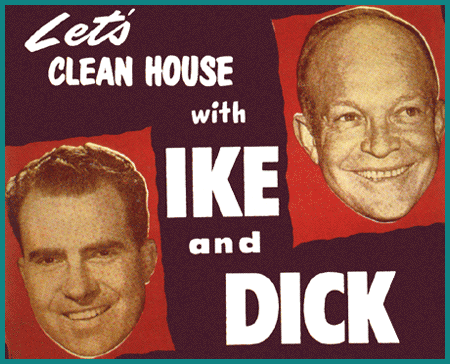
The choice of California Senator Richard Nixon as running mate is not covered in the book, which means I don’t have to write about the Checkers speech. I am glad for that.

The Democrats are barely mentioned in the book, so, to fill you in on the process: Truman thought about running again, but fared poorly in New Hampshire and dropped out. Then everybody and his brother started running, but no one grabbed a lead. The Democrats waited until the third ballot to nominate Illinois Governor Adlai Stevenson for President. Senator John Sparkman of Alabama was named as his running mate.

In the general election, the Republicans won big, winning 39 of 48 states for 442 electoral votes. Eisenhower and Nixon won 55% of the popular vote to Stevenson and Sparkman’s 44%. The Republicans also narrowly won control of both houses of Congress. Taft was able to return to the Senate as majority leader, although he would pass away from cancer in July of 1953.

ikeanddick

The Last Campaign: How Harry Truman Won the Election of 1948 by Zachary Karabell

lastcampaign

Nice Stache!

Whenever a candidate in any type of election is trailing in the polls before Election Day, the surprise result of the 1948 Presidential Election is referenced. However, the events of 1948 are unlikely ever to replicated today. Zachary Karabell’s book about the election, written back in 2000, shows how changes in the way candidates communicate the public make it almost impossible for anyone to pull off a comeback like Harry Truman did.

Harry Truman’s first term in office was far from smooth as he had to steer a postwar economy while working with a Republican majority in Congress. The Republicans, out of office since 1933, were determined to pass legislation to frustrate the core constituency of the Democrats, organized labor, with the Taft-Hartley Act, which placed numerous restrictions on union organizing and the right to strike. It went into law after Congress overrode a Truman veto.

(Most of the links in this piece will take you to YouTube videos of newsreels.)

The Republicans were ready to reclaim the White House. They had three main candidates: New York Governor Thomas Dewey, who had lost to Roosevelt in 1944; Harold Stassen, former Governor of Minnesota and current President of the University of Pennsylvania; and Senator Robert Taft of Ohio. Taft controlled the conservative wing of the party with Dewey and Stassen fighting for supremacy among the moderate and liberal wings. During the primary season (which was much briefer in 1948 than it is today), Stassen was running ahead of Dewey in most contests. Dewey chose the Oregon primary to show his primacy over Stassen. He campaigned all over the state. The big issue was Stassen’s idea of abolishing the Communist Party in the United States. Dewey strongly opposed it because, while he abhorred Communism (we will find out that not all candidates for office in 1948 did), he believed it was unconstitutional for the country to prohibit any form of political thought. Dewey’s viewpoint prevailed and he won a clear victory in Oregon. With the momentum from that election, Dewey was able to overcome Taft’s opposition (he picked up delegates mostly through state party caucuses and conventions) in the convention in Philadelphia to win the nomination on the first ballot. California governor Earl Warren was chosen for the second slot.

Truman had more problems. His Commerce Secretary, Henry Wallace, gave a speech in New York in 1946 where he strongly opposed Truman’s policy of strongly confronting Soviet expansion in Eastern Europe. Wallace thought that the Soviet Union and the U.S. should just be friends and agree never to fight and everything would be fine. Truman fired Wallace. Wallace, in turn, went on to form his own party on the left, which he called the Progressives. He would run alongside Idaho Senator Glen Taylor. Yes, in 1948, there were far left candidates from Idaho.

Truman also had problems on his right. Truman had formed a commission to study civil rights, which immediately raised the ire of Southerners, who feared Federal involvement in sacred Southern matters, such as oppressing African-American voters and preventing lynching from becoming a crime. Several Southern states planned to bolt the party if a civil rights plank was added to the platform.

Some Democrats thought that Dwight Eisenhower, then the President of Columbia, would make a great candidate and there was a plan to draft him. But, Eisenhower declined. Besides, nobody knew if he was a Republican or Democrat.

In the end, Truman was nominated. 35 Southern delegates bolted the convention in protest of a civil rights plank. They went on to form the States Rights Party, although they were more popularly known as the Dixiecrats. They ended up nominating Strom Thurmond of South Carolina for President and Fielding Wright of Mississippi for Vice President. Truman needed a running mate and settled on Kentucky senator Alben Barkley, who had delivered a rousing speech to the convention.

When it came time to campaign, the polls showed Dewey with a strong lead. However, the Democrats back in 1947 had set up a strategy where they thought Truman could win. They would work hard to shore up labor’s support and then hammer Dewey and the Republicans on populist issues. They figured that the election would be close, but the Democrats were in a much stronger position in the electoral vote, even with some defections in the South.

Dewey’s campaign was rather restrained. He and his campaign team believed that they had a safe lead and wanted to act statesmanlike. Dewey gave bland speeches that avoided promises. Dewey did not attack Truman much, certainly not with the same vigor he used going after Roosevelt in 1944.

Truman went on the attack as soon as he gave his acceptance speech. During that speech, Truman said he would call the 80th Congress, whom he dubbed “The Do Nothing Congress”, into special session to pass a package of bills that would include minimum wage laws, Federal health insurance, and housing. (Nothing of consequence passed during the session.)

1948 was the last Presidential election before television coverage became widespread (although TV did exist). This worked to Truman’s advantage as he could travel the country in his special train and give speeches tailored to whatever crowd he encountered. Some speeches were good, some were not, but there was not constant scrutiny on everything he said. Truman relentlessly hammered home a populist message, proclaiming the Democrats as the party of the working man (and woman) who would stand up for them against the nefarious forces of Wall Street.

Wallace’s campaign never went anywhere. Few American voters were interested in a campaign that was based on defusing world tensions by just agreeing to be nice. Wallace took his campaign to the South and was pelted with eggs at many stops. He seemed to enjoy the role of martyr, according to Karabell.

Thurmond and the Dixiecrats hoped to win enough states to throw the election into the House, but could not make any gains past four core states: Louisiana, Alabama, Mississippi, and South Carolina. In those states, Thurmond appeared on the ballot as the official Democratic party nominee instead of Truman. Those would be the only states Thurmond would win with his underfunded campaign.

One warning sign that the Republicans missed out on was polling data showing that Congressional races throughout the country were trending Democratic. However, Dewey and his advisors were unconcerned. A few Republican donors advised Dewey to go on the attack in the closing weeks, but that did not happen.

Election Day was November 2. Dewey went to bed before the outcome was settled. Truman stayed up a little longer. When the results came in, Truman had won. And by a healthy margin (49% to 45% with Thurmond and Wallace splitting up the rest) at the polls. The electoral vote had an ever bigger disparity: 303 for Truman, 189 for Dewey, and 39 for Thurmond. While Dewey had reclaimed New York for the Republicans, Truman cleaned up in the Midwest and Plains. One important issue in the campaign that the Republicans had not realized would come back to bite them was the elimination of Federal financial support for grain storage. Since nearly every farmer grew more wheat and corn than could be sold at the time of harvest, much of it needed to be stored in grain elevators. But storage cost money. With no money for them, farmers faced huge financial losses. Truman used this issue to show how Republicans had no interest in protecting the middle and lower class.

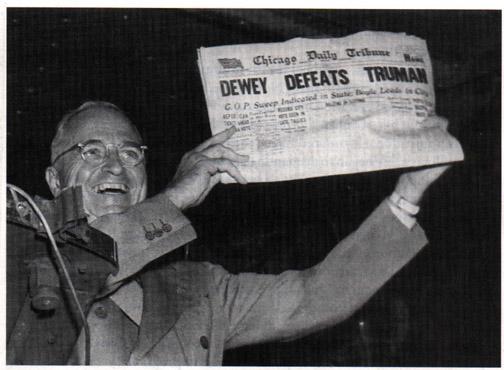
Karabell asserts that in the long run, candidates like Dewey would be the likely winners of presidential campaigns. It was much easier in the television era to just look like a good candidate and not say too much to anger either side. A campaign like Truman’s, which was extremely nasty, is off-putting to voters of today. (Although that may not be as true as much now as the Democrats and Republicans are starting to polarize more.) 1948 was supposed to be the first election when truly scientific polling was supposed to tell people who was going to win. And while the polls of 1948 were far better than the one in 1936 that predicted an Alf Landon win over Roosevelt, they were still new. They were not perfect. They are not perfect today, but they are still better. Don’t expect, I wouldn’t expect another upset like 1948 to happen again. Then again, in 1995, I told someone that no one would ever be elected President without winning the popular vote. Dewey-Defeats-Truman

FDR, Dewey, and the Election of 1944 by David M. Jordan

Vote for me! I’m not quite dead yet!
fdrdewey

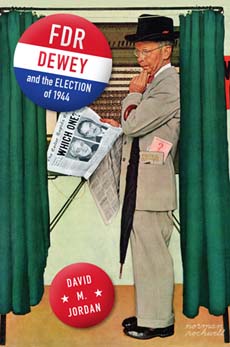
The  election of 1944 was actually somewhat anticlimactic compared to everything that came before it. Franklin Roosevelt, despite being in faltering health and overseeing the crisis of World War II, did not appear to have much trouble in defeating New York governor Thomas Dewey on Election Day. But, political observers of the time thought that the election would be close. And Roosevelt’s fourth win was far from a given.

David M. Jordan authored this entertaining book about an election that was much more about backroom deals and shrouded mysteries about Roosevelt’s health than it was about campaigning. There was a lot going on in 1944, more than people might realize.

Although Roosevelt did not officially announce that he was seeking a fourth term and would only accept a “draft,” he was making arrangements to get nominated and run again. All this despite his health failing to the point that he was sometimes unaware of his surroundings or was unable to finish sentences. This was caused by a heart problem that greatly hampered his circulation. Continue reading

Five Days in Philadelphia by Charles Peters (1940 election)

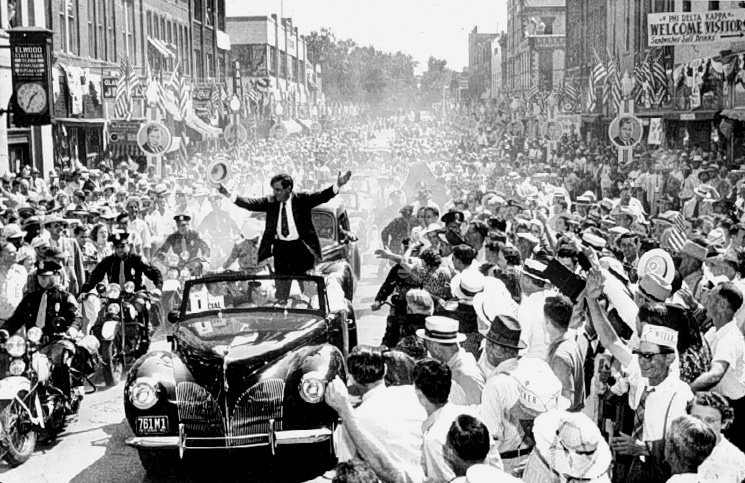
Five-Days-in-Philadelphia-Peters-Charles-9781586481124What Do We Want? Somebody Sort of Like What We Already Have?
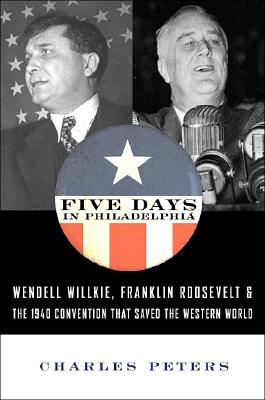
Can the losing candidate in a Presidential election be more influential than the person who won? Charles Peters, in his book about the nomination of Wendell Willkie as the Republican challenger to Franklin D. Roosevelt in 1940, argues that world history was changed, for the better, because of a remarkable series of events at the GOP Convention in Philadelphia in June 1940.

Peters was the longtime editor of the Washington Monthly and his father worked in Democratic Party circles in his native West Virginia. He personally witnessed some of the events in this book during his childhood. He clearly has a fondness for the “Greatest Generation” narrative that was made popular in the late 1990s and early 2000s by the likes of Tom Brokaw and Stephen Ambrose, although it is not overdone.

Roosevelt won reelection in 1936 by winning 46 of 48 states. In 1940, Roosevelt faced two problems: war in Europe and the reluctance of Americans to give a President a third term.

While Roosevelt was clearly on the side of Britain and France, there was a significant isolationist movement in the United States, headed up by Charles Lindbergh. The Republicans were running two candidates who were closely identified with this movement: Michigan Senator Arthur Vandenberg and Ohio Senator Robert Taft. New York County District Attorney Thomas Dewey was also making a run for the Presidency, despite being just 37.

Vandenberg, Taft, and Dewey were not overly appealing candidates to the Republicans however. Dewey did well in the states that held primaries (there were just eight at the time), but he was regarded as being too young for the job. Vandenberg was an indifferent campaigner. Taft was considered too much out of the mainstream.

In late 1939, some Republicans, mostly from Wall Street and the Luce Family (Time-Life) wing of the party, backed a utility company executive named Wendell Willkie. Willkie grew up in Indiana and came across to some as the Jefferson Smith character in “Mr. Smith Goes to Washington” with the notable exception of not being nearly so naive.

When Willkie left the Midwest to head to work on Wall Street in the late 1930s, he became part of the New York literary scene, both in terms of what he read and whom he slept with. His mistress, Irita Van Doren, introduced Willkie to publishers and writers. He became the darling of the New York intelligentsia to some extent.

In 1939, Willkie was still a registered Democrat. He switched over to the Republicans ostensibly because he differed sharply with Roosevelt over New Deal policies regarding utility policies. He was a staunch opponent of the Tennessee Valley Authority. Also, Willkie harbored Presidential ambitions and he wasn’t going to be able to unseat Roosevelt or anyone else the Democrats could run.

Willkie’s prominence shot up after appearing on a radio debate show against Attorney General Robert Jackson in 1938. The two men debated government-business cooperation under the New Deal. It was generally regarded at the time that Willkie took Jackson to school during the debate. And Jackson was not a lightweight. He would later become a Supreme Court Justice and also led the war crimes trials at Nuremberg.

As the Republicans met in Philadelphia in late June, Taft had a slight lead in delegates, but no one had a majority. Vandenberg had dropped out of the race. Dewey still had delegates, but was not expected to win. Two other candidates hoped for a late surge to come to them: Willkie and former President Herbert Hoover.

A month before the convention started, the Arrangements Chairman, who controlled tickets to the convention, passed away (some say he was murdered by British intelligence agents, but most thought he just had a heart attack) and a pro-Willkie man got the job.

Shortly before the convention started, France surrendered to Germany, completely changing the dynamics of the contest. Isolationism was looking more like capitulation. Roosevelt’s plan for starting a peacetime draft was receiving support. Roosevelt also named two prominent Republicans, Henry Stimson and Frank Knox, to his Cabinet.

Early in the convention, Hoover gave a speech espousing his isolationist policy that he hoped would rally support back to him, even after his humiliating defeat to Roosevelt in 1932 (Hoover despised Roosevelt for the rest of his life.) However, Hoover was not very adept at using the microphones in the arena (or they were not turned on, opinions vary) and few delegates heard his speech.

The keynote speaker for the convention, Minnesota governor Harold Stassen, gave a well-received speech and threw his support to Willkie. The upper reaches of the arena were filled with Willkie supporters who constantly chanted “We Want Willkie!”

When it came time to vote, no candidate had a majority on the first ballot. Or the second. Or the third. But Willkie’s vote total kept growing. Dewey dropped out of the race. Vandenberg, who was out of the race but controlled the Michigan delegation, released it and Willkie made a deal to get its support. On the sixth ballot, Willkie prevailed. Oregon Senator Charles McNary was nominated for Vice President.

Willkie, although he opposed some New Deal economic policies, was in agreement with nearly all of Roosevelt’s foreign policy aims. This proved to be helpful to Roosevelt when he got the draft passed through Congress as well as keeping down opposition to a plan for the U.S. to swap 50 destroyers to the British in exchange for the use of British naval bases in North America.

Roosevelt, because of precedent, said he would not seek a nomination for a third term, but would accept a “draft” from the convention. However, Roosevelt wanted a third term. His only opposition came from Postmaster General James Farley, who did not think a third term was appropriate. Farley also wanted the job for himself.

Farley managed to get his name put into nomination, but Roosevelt was the choice of the Democratic Convention. (Some polls showed him with 92% support among Democrats.) Vice President John Nance Garner had no desire to keep the job any longer, so Roosevelt chose Agriculture Secretary Henry Wallace as his running mate. Wallace was not popular with a lot of Democrats because he was regarded as a kook (some of that was because he studied Eastern religions, others would argue that he was just a little too fond of Communism), but Roosevelt respected his intelligence. However, Wallace’s nomination was so contentious on the floor, that he was told not to deliver an acceptance speech in person because of fear that he would be booed off the stage.

The 1940 campaign was overshadowed by the events in Europe. Roosevelt and Willkie did not differ too much, so much of Willkie’s arguments for getting elected were just that Roosevelt shouldn’t have a third time. Toward the end of the campaign, Willkie made some isolationist arguments.

On Election Day, Willkie ended up doing better than Hoover in 1932 and Landon in 1936, but he still lost by a sizable margin. (54.7%-44.8% and 449-82 in the electoral vote).

Willike added Michigan and Indiana along with some states in the Great Plains to the Republican side, but that was it.

After the election, Willkie wrote a book about his views on foreign policy entitled “One World.” Willkie called for an international organization that would have been stronger than even the United Nations that Roosevelt would back. Willkie would later fly throughout the world for Roosevelt helping with diplomatic efforts during the war.

Despite his cooperation with Roosevelt, Willkie decided to run against Roosevelt again in 1944. He entered a primary in Wisconsin and was soundly beaten by Dewey. He dropped out of the race. On October 7, 1944, Willkie died of a heart attack at the age of 52. (Not germane to this article, but Wendell Willkie would later have a grandson named Sleeth Hefflefinger Willkie.)

Peters believes that without Willkie to provide political cover for Roosevelt with the draft, the destroyers swap, and, after the election, Lend-Lease, that the course of World War II would have been dramatically altered. This may be a bit much to ascribe to a series of mostly back-room political events, but Peters tries his best.

Wendell Willkie may be the only case of someone getting nominated for President by a major party because people wanted an outsider at the time. And this “outsider” was closely allied with Wall Street, so he may not have been all that much of an outsider. But, for a few months in 1940, Wendell Willkie was the second most famous person in the United States behind Franklin Roosevelt. And that was probably an improvement on Charles Lindbergh holding that title.

wendell-willkie1