President #27, C-SPAN historians’ ranking #24
Why Am I President? It Was On My Wife’s To Do List.
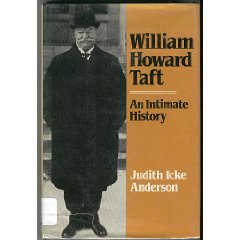 When it came time to find a biography of President William Taft, it wasn’t easy. Despite holding office during a time when Constitutional Amendments introducing the income tax and the direct election of senators, the admission of two states (New Mexico and Arizona), and running in an election against two of the 20th Century’s most famous presidents (Theodore Roosevelt and Woodrow Wilson), Taft hasn’t received much interest from historians.
This left me finding this book, which was published commercially in 1981, but was actually a more commercial version of a UCLA dissertation by a woman for whom I can find no trace further trace of.
“An Intimate History” is the same subtitle that Jefferson biographer Fawn Brodie used for his study of our third president. That book was published in 1974. Brodie was Anderson’s adviser at UCLA and she followed in her footsteps. And in this book, the reader learns about William Taft, the man, and why he did what he did. And in Anderson’s view, Taft’s actions in all aspects of life were mostly an attempt to please his mother, and, then later, his wife.
And Anderson goes on at length about Taft’s weight. It is not something that can be ignored, especially since Taft tipped the scales at up to 355 pounds while he served as President.
Why was Taft so heavy? According to Anderson, Taft was someone who took solace in eating when he was either stressed out or felt a need to please someone. And when Taft was in the White House, he was stressed out. His enormous weight likely gave Taft a case of apnea as he often dozed off at inappropriate times and snored loudly during public gatherings.
Taft’s career path to the White House was not a normal one. The son of a former Secretary of War, Alphonso Taft, William went to college at Yale and then to law school at the University of Cincinnati. His mother assumed that William, like all Tafts would achieve greatness.
But first, Taft needed to find a wife. And he eventually met Helen “Nellie” Herron at a sledding party in Cincinnati. Taft courted Nellie for years before she agreed to marry him. Nellie’s hesitancy stemmed from the fact that she considered herself to be fairly independent. However, she also wanted to be attached to important people. And she sensed that William Taft was someone who could bring up her to the highest circles of power, even the White House.
But, Taft’s ambition was to be a judge. He served in a local court in Ohio and loved it. However, he was picked to go to Washington by President Benjamin Harrison to serve as Solicitor General. Nellie loved the change of scenery. Although Taft was a good judge, he was a lousy litigator. He did not have an adversarial nature. He wanted to be everyone’s friend. Although I am not a lawyer, I’m guessing being conciliatory and jovial isn’t the tone you’re looking for.
In Washington, Taft became friends with a young man who was serving as the Assistant Secretary of the Navy. His name was Theodore Roosevelt.
President William McKinley offered Taft a position on the Federal District Court back in Ohio, so Taft returned there to a job he loved above all other. Later, McKinley asked Taft back when he needed someone to serve as the first civil governor of the newest United States territories, the Philippines.
The people of the Philippines didn’t particularly enjoy being under Spanish control, and they didn’t particularly like having Americans tell them what to do either. The American military governor, General Arthur MacArthur (who had a son named Douglas), had to suppress an insurrection. MacArthur did so, but in a brutal fashion that often involved torture.
Taft had to work to repair America’s image both in the Philippines and the world while building up a system of government for the people of the Philippines. Anderson describes Taft as being well regarded by the Filipinos, although coming after MacArthur, that’s not much of a surprise.
By 1904, President Theodore Roosevelt needed a new Secretary of War and he asked his old friend William Taft to take over that post. Taft didn’t know much about running the Army, but Roosevelt thought well of him. Taft actually spent much of his time travelling on diplomatic missions as Roosevelt had stretched U.S. interests to all parts of the globe.
Roosevelt had promised Taft that he would get him a seat on the Supreme Court, preferably Chief Justice, if one ever came up. But the time was never right, so Taft remained in Roosevelt’s Cabinet.
When Roosevelt was elected to a full term in 1904, he promised he wouldn’t run again. This was a bit of a problem for him in 1908 because he was still relatively young (50 on Election Day) and extremely popular. But Roosevelt felt he couldn’t go back on his promise, so he designated Taft to be his successor.
Taft was not particularly interested in becoming President, but Nellie was quite interested in being First Lady. And in most discussions between William and Nellie, Nellie won. Taft was elected easily over Democratic nominee, and three-time loser, Wililam Jennings Bryan.
Almost as soon as the election was over, things went wrong for Taft. The President-elect had sent a telegram to supporters thanking two people for his election: Roosevelt (for his popularity that made it easy for another Republican to win) and his brother Charles Taft (for extensive financial support). Roosevelt was appalled to be lumped in with someone who just wrote checks.
One of the first major pieces of legislation Taft wanted to get passed was a tariff reform bill. Roosevelt advised Taft that tariffs needed to be lowered, but he didn’t do while he was in office because he knew the issue was too sensitive with an election coming up.
In 1909, the Republicans were the party of high tariffs. And the more conservative Republicans liked the tariffs to be as high as possible. The bill that passed Congress, the Payne-Aldrich Tariff ended up raising duties on nearly every type of imported goods. Conservatives were happy, but Progressive Republicans (who were Roosevelt supporters) were appalled. Taft was immediately branded as a weak leader.
Also in 1909, Taft faced a major political crisis in the Interior Department. Taft had appointed former Seattle mayor Richard Ballinger as his new Secretary of the Interior. However, Taft kept on in the Forestry Service, a Roosevelt loyalist named Gifford Pinchot.
Pinchot, who would likely be called an environmentalist now, although “conservation” was the term used in the day, accused Ballinger of leasing public lands in Alaska to large corporations for mining and other ways to tap their natural resources. Charges flew back and forth between the two men. Pinchot was eventually fired by Taft, an action that Roosevelt’s supporters could not abide. Eventually, Ballinger resigned as well. Taft bungled the matter every way possible. And mostly this happened because Taft didn’t want to take command of the situation, but rather just try to make everybody happy.
Another problem for Taft was one that was not of his own making. Roosevelt had established himself as a Progressive Republican, with a penchant for going after big business. Taft was a conservative. Roosevelt had to know this. Yet, Roosevelt backed a man for President whom he had to believe was going to reverse some of his policies.
In the midterm elections, the Republicans lost control of both houses of Congress. Soon after, Roosevelt returned from a long trip to Africa to great national acclaim. And soon set into his old friend Taft and started to position himself for another run at the White House.
Taft pretty much knew that he couldn’t get reelected in 1912. He just didn’t have the national support. His only reason for being elected in the first place was that he was Theodore Roosevelt’s friend. And now Roosevelt hated him. That left Taft without much to go on.
But Nellie was determined that her husband at least not lose the Republican nomination to Roosevelt. And Taft agreed with his wife. He decided he wanted to make Roosevelt run as a third party candidate.
Fortunately for Taft, there were only a handful of these newfangled things called primaries during the nominating season. Roosevelt won the majority of those, but Taft, through the power of patronage, was able to control enough delegates to win the nomination. Roosevelt was left to run on his own as the Progressive Party Candidate. Meanwhile, the Democrats nominated the nerdy, yet popular, governor of New Jersey, Woodrow Wilson.
Almost nothing went write right for Taft during the campaign. His trusted confidante and personal aide, Archie Butt, had left him because of personal issues in 1912. Butt had served as Roosevelt’s personal aide as well and he couldn’t decide whom to work for. So, he went to Europe to think about it. Butt booked passage on the Titanic for the trip home. He didn’t make it.
Taft’s Vice President, James “Sunny Jim” Sherman, died a few weeks before Election Day as well. Taft made odd statements to the press, including one where he said he would campaign “like a cornered rat.”
When the counting was done, Wilson was an easy winner. Taft won just two states, the worst showing of any incumbent President ever. And Taft won one of the states, Vermont, by just 923 votes. In 1912, Vermont was not yet run by the Ben & Jerry’s types, and was one of the most conservative states in the country.
Losing the election relieved a great burden from Taft. He no longer had to be the bad guy who told people “no.” Not that Taft said “no” all that often.
Once leaving office, Taft taught law at Yale, but finally got his dream job in 1921 when President Warren Harding appointed him to be Chief Justice of the United States. Taft loved this job more than any other. And according to Anderson, his weight dropped into the 260 lb range. He no longer had to eat his way through stress. He had found his dream job, the one he had thought about since he came to Washington in 1886.
William Taft passed away in 1930 and was buried in Arlington National Cemetery, the first President to be so honored. His wife Nellie wanted that honor. However, few people wander over to the section of Arlington to see Taft’s grave. Just like finding a biography of Taft, it’s something you have to seek out. Perhaps a better story of Taft’s life is still to be written.
But the life of Willam Howard Taft teaches us one thing: if you want to be remembered by historians as president, don’t have your term fall in between those of two far more famous presidents.
Psychobiography was a popular discipline in the 1970s, but it isn’t used now. Brodie was able to apply it to it someone like Jefferson because there was quite a bit to work on. The inner workings of the psyche of William Howard Taft may not be that be interesting. Especially since Anderson spells it all out very early in the book. The final 200 or so pages are more repetitions of the theme of “Taft tries to please wife, eats too much, becomes less happy, repeat.” Perhaps there is more to Taft than just a domineering wife and a battle with obesity. However, that book hasn’t been written yet.
But Nellie Taft got a major biography written about her just three years ago. Sorry Bill, you can’t win this game.
Other stuff: Taft, despite his great size, was an avid sportsman and he tried to play a round of golf nearly everyday. Taft was also the first U.S. President to throw out the ceremonial first pitch to mark the beginning of baseball season. This started in 1910.
The National Park service operates the William Howard Taft National Historic Site in Cincinnati.
Taft’s son, Robert, served as a Senator from Ohio and ran for the Republican nomination for President in 1940, 1944, and 1952. A William Howard Taft IV (great-grandson of the president) worked for a time in the George W. Bush Administration. Robert Taft III, who went by Bob Taft, served as governor of Ohio. Generally, if you run into something in the U.S. with the name “Taft” in it, it’s probably this president’s family.
 James Garfield served as President from March 4 through September 19, 1881, the second shortest tenure of any person to hold the office. Garfield’s assassination was tragic, although the most tragic part was not the violence perpetrated by Charles Guiteau, but rather by the the incompetent medical care that Garfield received from a group of doctors who refused to adopt some of the most basic medical principles that we take for granted today.
 Gerald Ford had a unique presidency. He was not elected to be vice president. He was not elected to be president. His vice president was not elected either. He was the first president to born with an entirely different first and last name than what he used while in office. He was a remarkably successful politician who never lost an election, until he ran for president on his own.
 One through Forty-Two or Forty-Three