John Quincy Adams by Robert V. Remini

All Three Names Please!

President #6, C-SPAN historians ranking #19
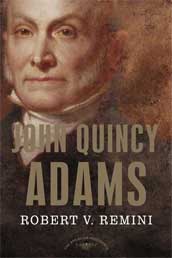
jqadamsJohn Quincy Adams had one of the most distinguished careers in service to the United States that any person may have had. However, the four years he was president, from 1825 through 1829, were a series of political missteps compounded by the fact that he was the only president ever to be elected despite not getting the most ELECTORAL votes.

JQA, as he styled himself in correspondence, was the son of the second president, John Adams. He accompanied his father to Europe during the Revolution and learned French and German along the way. At the age of 14, he accompanied the American minister to St. Petersburg, Richard Dana, because French was spoken among diplomats at the time.

When Adams returned home to the U.S., he attended Harvard (however his admission was delayed because it was felt he didn’t speak Greek or Latin well enough) and graduated with honors and set up a law practice.

Adams fell in love with a Massachusetts woman, but neither her family nor Adams’ parents could ever agree on when or if the marriage should take place, and Adams never married the only woman he apparently ever truly loved. Adams eventually married a British woman and started a family, but he never seemed to truly love his wife.

Eventually, Adams was given a diplomatic post in Europe, first in the Netherlands and then later in Russia, and moved up to the post of Secretary of State under President James Monroe in 1817. And according to author Robert V. Remini, one of the foremost authorities on Adams’ era and a biographer of Andrew Jackson, Adams may have been the greatest Secretary of State ever.

Adams acquired Florida from Spain and in the same negotiation managed to get Spain to acknowledge that the Louisiana Territory extended all the way to the Pacific Ocean. There was also a successful treaty signed with the British in 1818 that settled part of what is now the U.S.-Canada border and also helped U.S. commercial interests greatly. And Adams was the man who wrote what would become known as “The Monroe Doctrine,” a cornerstone of American foreign policy that stated that any further attempts by European powers to colonize any country in the Western Hemisphere would be opposed by the United States.

With a pedigree and a list of accomplishments like Adams, it would seem that his elevation to the White House would have been a cinch. But it most certainly wasn’t.

In 1824, American politics was nominally a one-party system as the Federalists had gone the way of the tricorn hat. But this “one party” had numerous factions and little or no formal structure. Four people were nominated for president: Adams, Andrew Jackson (the extremely popular military hero of the War of 1812), William Crawford (the Secretary of the Treasury and the favored candidates of what would be considered the party regulars in Congress), and Henry Clay (who thought he was the best equipped man for the job because he had an ego the size of his home state of Kentucky.)

1824 was the first year that popular vote totals were recorded in a Presidential election. Jackson came out on top with about 152,000 votes and Adams had about 113,000. Jackson won 99 electoral votes, Adams won 84, Crawford won 41, and Clay finished in 37. Under the terms of the Twelfth Amendment, the top three in the Electoral College vote would be eligible for selection by the House.

This put Clay in the position of kingmaker as he could instruct the states that voted for him to vote a particular way. According to Remini, Clay didn’t hesitate to make his choice. Clay didn’t want Crawford to become President because that man had recently had a stroke and was nearly blind and couldn’t talk.  And Clay despised Jackson and didn’t want to see a military man as President. So that left Adams.

But what would Adams do to make it worth while for Clay to support him? It was pretty clear. Adams had to make Clay his Secretary of State. And in doing so, Adams prevailed in the House, winning 13 of the 23 state delegations. And as an added “prize,” Adams pretty much destroyed any chance of accomplishing anything as President because now Jackson and his supporters were, to put it mildly, pissed off.

To make matters worse, in Adams’ first message to Congress (presidents did not directly address Congress at the time, but rather sent over messages to be read), he laid out an ambitious legislative agenda. Adams wanted numerous internal improvements with roads and canals built all over the country. Adams wanted a national university and a national observatory. He wanted to go on the metric system. He wanted to send representatives to a Pan American Congress that was convening in Panama.

Adams ended up getting none of these and was widely ridiculed in the press. It didn’t help that Adams felt it was unseemly for a President to answer any criticism publicly. It also didn’t help that his Secretary of State, Clay, was even more disliked. And the Vice President, John Calhoun, didn’t like Adams.

And to be fair, Adams was hard to love. He didn’t exude a lot of warmth. He was the product of an unhappy childhood. Despite the way HBO had Laura Linney portray Abigail Adams, JQA’s mother, on TV, she was never going to win Mother of the Year. She was a parent, according to Remini’s description of her, who withheld affection and gave out a lot of criticism. JQA didn’t attend his own mother’s funeral and didn’t seem too broken up about it.  And Adams in turn was a bad father and had one son kill himself and another drink himself to death.

The John Quincy Adams Presidency was a four-year long trainwreck and in 1828, Jackson won the rematch easily despite a bitter campaign where Jackson’s people accused Adams of pimping out his own son to the Prussian court and Adams’ people accusing Jackson’s wife of bigamy.

After leaving the White House (Adams, like his father, didn’t stick around for the inauguration of his successor), JQA wanted to retire to Massachusetts, but eventually he was asked to run for a House seat and took his seat in 1831. Adams found his true calling in the House of Representatives.

While serving in Congress, Adams argued against the “gag rule” which prevented any discussion of the abolition of slavery. Adams also would represent the Africans on the Amistad, who had taken over the ship that was taking them to America and slavery and tried to return home. Adams won that case and the Africans were free men. It was a sign of the times though that it took a Supreme Court ruling for human beings to actually be given human rights.

Remini’s book on JQA’s presidency tried to highlight four years of John Quincy Adams’ distinguished career. But Adams’ life was much more than four bad years in the 1820s. And Remini reminds us of that. Some great men aren’t necessarily great presidents. And even Adams knew this about himself.

Other stuff: If you want to visit parts of John Quincy Adams’ history, you should visit the Adams National Historical Park in Quincy, Massachusetts. Adams had a granchild born in the White House, the first child ever to be born there. He passed away in the U.S. Capitol.
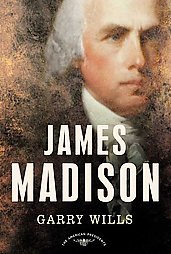
James Madison by Garry Wills

Invade Canada!

President #4, C-SPAN historians rank #20

jamesmadisonJames Madison was definitely a president with an impressive resume. For starters, Madison wrote much of the Constitution and the Bill of Rights. He was a passionate defender of religious freedom. He served in the House of Representatives. He was Secretary of State for eight years under Thomas Jefferson. But his eight years spent as President are almost entirely remembered for the War of 1812 (which only lasted a little over two years), an event that had two effects: 1) it made Madison appear to act in a way that was very much the opposite of what he believed in for most of his life and 2) created dread in the minds of American schoolchildren who feared that their history teacher would make them write about the War of 1812 on a test and they’d have to figure out just what the whole war was about.

Garry Wills, who has profiled historical figures such as Abraham Lincoln and Saint Augustine, tries to make sense of the presidency of one of the Founding Fathers who seemingly succeeded at everything in life, except being president. But Wills makes the case that Madison’s eight years as president were not as bad as some historians made them out to be. Wills doesn’t believe that Madison was the greatest president, but he defends Madison for not giving up his most cherished principles, embodied in the Bill of Rights, in a time of war. Madison’s biggest problem in Wills’ eyes was that he made poor choices for his Cabinet and tried to fight a war without much of a standing army.

Madison’s contributions to the Constitution and the Bill of Rights are easily his greatest achievements. And it would have been hard for Madison to accomplish anything greater during his term as a president, especially in light of the world he was entering. And just what was that world?

When Madison was inaugurated in March of 1809, the United States was still suffering the effects from an embargo on trade that President Thomas Jefferson had pushed for, and Madison, his Secretary of State, fully supported. The embargo on trade was supposed to put economic pressure on both the British and French from attacking American ships who tried to trade with either country. The United States wanted to be a neutral. But in the Napoleonic Wars, there were just winners and losers and don’t get caught on the wrong side of that line. Wait, that’s a Bruce Springsteen song. Sorry…

Where were we? Oh yes, the Napoleonic wars and the U.S. getting caught up in them. Madison hoped that economic pressure would force either the British or French to give in and allow the U.S. neutral trading rights, but that was not to be. And by 1812, Madison, tiring of British attacks on U.S. merchant ships by press gangs trying to get back sailors who had left the British Navy, asked Congress to declare war on Britain. The U.S. had an equal beef with France, but the French had slightly better P.R. among Americans. Madison, who always thought economic sanctions could fix any problem, had aligned himself with the “War Hawks” in Congress, led by Speaker Henry Clay.

With a war started over maritime matters, the American response, logically, was to attack Canada. Why? Well, why not? It’s Canada. How hard could it be?

It turned out to be rather difficult. It was especially difficult because Madison entrusted the command of the troops to Revolutionary War heroes (who were old and mostly incomptetent), political appointees (who were mostly incompetent, but not necessarily old), or people who were crooks (such as General Robert Wilkinson who had taken bribes from Spain and thought about overthrowing the government in a plot with Aaron Burr and once decided to quarter most of his soldiers near a swamp in New Orleans in the summertime and half of them got malaria and died.). The U.S. takeover of Canada never happened, although U.S. troops did burn the city of York (now Toronto) to the ground. This served only to make the British angry and they responded in kind by burning down large parts of Washington, such as the White House.

The U.S. Navy had a few big victories, but the biggest one served to give them control of Lake Erie, which seemed like a lot of effort to just keep the future site of Cleveland safe. And the U.S. had enough victories on the battlefield to keep the British at bay. The biggest U.S. victory came in New Orleans in 1815, a few days after a peace treaty was signed in Ghent, Belgium. The battle went something like this.

Wills mentions how the U.S. had little intelligence of British troop movements during the war. The primary source of information came from reading newspapers. The Secretary of State, James Monroe, decided to do some scouting on his own since few people in the Army were willing to do so. Monroe was also told to go take command of the troops in the Northwest that had failed to take over Canada, although Monroe did not take official command.

Many of these problems that Madison encountered were Jefferson’s fault, in the eyes of Wills. Jefferson shunned a large navy, preferring a system of small gunboats, which proved to be almost, but not quite entirely, useless in defending the coastline. And Jefferson feared a standing army. However, a standing army can come in handy when you’re going to war against a very, very, very, very big and rich country.

However, Madison, unlike other presidents during wartime (including revered figures such as Abraham Lincoln and Franklin Roosevelt) did not restrict civil liberties. Madison didn’t shut down presses of people who opposed the war. Madison didn’t imprison the members of the Hartford Convention, a group of New England Federalists who were thinking of seceding from the United States (they didn’t, mainly because they realized it was a bad idea and people were making fun of them.) And when Congressional leaders asked Madison to proclaim a National Day of Prayer and Fasting when the war started, Madison declined, figuring that people who wanted to pray “would do so on their own.”

Wills’ history of Madison’s presidency accomplishes something that took this history major his whole life to figure out: just what was the War of 1812 fought for. And now I can drop in references to Macon’s Bill Number Two and force people to use Google to see if I am making sense.

For those interested in the full James Madison experience, you should visit his home, Montpelier, which is in Orange, Virginia. Or perhaps you can just take a look at the Bill of Rights. Madison would probably appreciate that more.

Miscellany: Madison’s first vice president, George Clinton, also ran against him as president and received six electoral votes for president. Clinton was Jefferson’s second vice president. Clinton was one of Madison’s chief political rivals. Clinton died before his term was up.

For his second term, Madison chose Elbridge Gerry as his Vice President. While Gerry agreed with Madison, he died in office too.

Being James Madison’s Vice President was sort of like being a drummer for Spinal Tap.

Housekeeping note: You can reach this site now also by using the URL http://allthepresidentsbooks.com.

Also I’ve gone through my backlog of books I’ve read, so give me a few days to get to a new one.

Furthermore, I’m going to use the tag “Democrats” for presidents who would have been described as “Republican” or “Democratic-Republican” at the time because it’s simpler. And if you don’t know what I’m getting at, you’re probably not interested in reading this blog to begin with.

Gerald Ford by Douglas Brinkley

President #38, C-SPAN ranking 22

Pardon me!

geraldford2Gerald Ford had a unique presidency. He was not elected to be vice president. He was not elected to be president. His vice president was not elected either. He was the first president to born with an entirely different first and last name than what he used while in office. He was a remarkably successful politician who never lost an election, until he ran for president on his own.
But what will history remember Gerald Ford for? He was the man who pardoned Richard Nixon. And that one act, something which Ford did not regret, is like that big  blemish on someone’s face that you just can’t help staring at.

Douglas Brinkley, who has written a biography of Jimmy Carter among his many other books, writes the Gerald Ford obituary and does a good job of presenting the two sides of Ford. One side was the grandfatherly, pipe-smoking calm leader who led America out of the dark years of  Watergate. The other side was the man who spent most of this adult life in politics and based many of his decisions based on what was feasible in a hostile political climate.

Ford came into the world with the name Leslie King, but his mother took her son away from her abusive husband and moved to Grand Rapids, Michigan, where she remarried a successful local business man, who adopted  young Leslie King and renamed him Gerald R. Ford, Jr. The R stands for Rudolph, which was originally Rudolf, but Ford changed that spelling too.

Ford was an All-America center for the University of Michigan’s football team in 1934.  That Michigan squad went 1-7 and scored just 21 points.

Eventually Ford went on to Yale Law School, served in the Navy in World War II, and then came back to Grand Rapids and started a law practice and went into politics and won a House seat in 1948 and held it until he resigned to become the replacement for Spiro Agnew as Vice President in 1973.

Ford remained loyal to Nixon for as long as he could, but even he had his limits. When it became clear that Nixon had to resign, White House Chief of Staff Alexander Haig came to Ford with a series of scenarios. One of them was that Nixon would resign in exchange for a pardon from Ford. Did Ford agree to this? According to Brinkley, Ford didn’t. But he also didn’t explicitly say he wouldn’t pardon Nixon. And in such gray areas, Ford’s legacy was made.

The rest of Ford’s presidency featured events such as an attempt to end inflation by getting people to wear WIN (Whip Inflation Now!) buttons and telling people that it was their patriotic duty to spend less, the signing of the Helsinki accords on human rights (which made Ford a pariah to the Republican right, aka Ronald Reagan), watching South Vietnam fall into the hands of Communists, sending Marines to rescue a captured U.S. freighter in Cambodia, and getting to look very presidential during the Bicentennial.

One aspect of Ford’s presidency that Brinkley mentions is Ford’s role in  East Timor. When the Timorese tried to break away from Indonesia, Ford, upon advice from his Secretary of State Henry Kissinger, gave the Indonesians free rein to suppress the insurgency. Hundreds of thousands died in a conflict that lasted over 20 years. In his memoirs, Ford pointed to his actions in this matter as one of his biggest mistakes.

Ford lost his chance to be elected in his own right in 1976. Reagan almost denied Ford the nomination and did little campaigning for him in the general election against Jimmy Carter. And despite having the stain of the Nixon pardon and making a huge gaffe in a debate (“There is no Soviet domination of Eastern Europe.”), Ford narrowly lost in 1976, 50.1%-40.8% 48.0%.

Gerald Ford, unlike the other presidents with official libraries, opted to have the museum attached to it in a different city. Ford’s papers are at the University of Michigan in Ann Arbor, while a museum dedicated to his life is in his home town of Grand Rapids (I’ve been to it. TWICE!). Ford’s widow, Betty, is of course better known for the rehab clinic she and her husband helped to open in Rancho Mirage, California.

Rancho Mirage is where Gerald Ford passed away on December 26, 2006 at the age of 93. Ford lived longer than any other President, 45 days longer than Reagan.

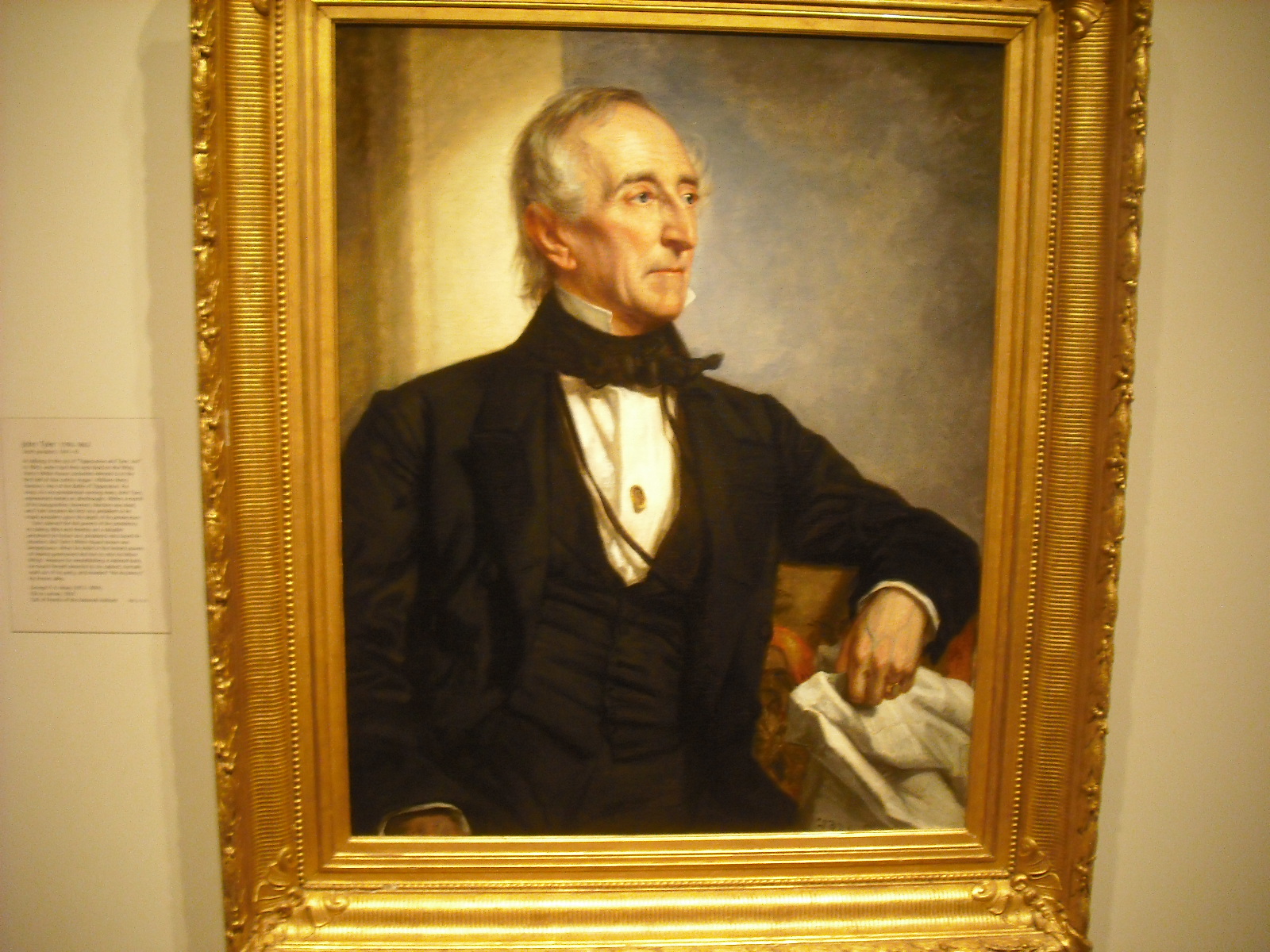
John Tyler by Gary May

Him too!
10th President. C-Span historians rank: 35

My chaotic journey through the history of the U.S. Presidency begins with a book about the first vice-president to succeed a president who passed away while in office. Gary May, a professor at the University of Delaware, penned this surprisingly sympathetic look at one of America’s lesser presidents.

John Tyler was tacked on to the Whig Party’s ticket in 1840 because he had a recognizable name and could help the party out in Virginia, which was still a big player in national politics at the time, as it had 23 electoral votes. The two problems with this were: 1) Tyler had until very recently before the election been a Democrat and had only switched over to the Whigs more or less out of spite and 2) the Whigs, with William Henry (“I died in 30 days”) Harrison leading the way, won the election by a large margin (234-60) and still lost Viriginia.

Harrison, who was 68 when elected and not in the best of health to begin with, died a month into office. So it was time for Tyler to take over. Tyler hadn’t even been living in Washington since the inauguration as he really had nothing to do. But he comes back, tells everyone he’s the boss, vetoes Henry Clay’s favorite legislation, the chartering of a national bank, and almost his entire Cabinet resigns on the spot.

It didn’t get much better for Tyler. He couldn’t get any legislation passed. He couldn’t appoint judges. His wife died. And in 1844, while he and his Cabinet were cruising the Potomac on the U.S.S. Princeton, a cannon exploded on deck and killed his Secretary of State, Secretary of Navy, and dozens more. The gory details are here. For a traumatic event that wiped out many high ranking members of government, very few people know about it. Tyler was below deck at the time and unhurt by the explosion. (For those not scoring at home, Senate President Pro Tem Willie Mangum would have been next in line to become president at the time.)

But Tyler eventually remarried while in office and ended up fathering 14 15!! children in all. And he still has grandchildren (or least a grandchild) alive. Think of when your grandfathers were born. John Tyler was born in 1790!

Tyler’s biggest accomplishment was the annexation of Texas. Tyler had made it his quest to get at least that done before he left office. Thanks to the lobbying of his second wife, Julia, who by all reports was one of the best looking women in Washington, but she was also not afraid to throw herself into the political arena to help her husband.

Since both parties didn’t like Tyler, he didn’t run for reelection. James Polk, the Democratic candidate in 1844 and the eventual victor, campaigned on adding Texas to the United States. But Tyler managed to get Texas added to the U.S. on his watch when he signed a Congressional resolution the day before he left office annexing Texas. Perhaps Tyler knew that there was a city there named after him.

When Tyler passed away in 1862, he was about to start serving in the Confederate Congress. So his passing was not exactly mourned throughout the land.

However, Tyler should be remembered mostly for setting the precedent that when the President dies, the Vice-President becomes president. Some (read “Henry Clay”) wanted to call Tyler the “Acting President.” But Tyler called himself “President” and insisted that he had all the rights and privileges of the office. This principle didn’t become a formal part of the Constitution until 1967.

May wants us to believe that Tyler, a man who financed his first trip to Washington to serve in Congress by auctioning off his most beloved household slave, is not as bad as most historians view him. He believes that Tyler worked as well as he could in such an impossible situation. It’s not easy to govern when you have no constituency. But Tyler didn’t quit. You can’t blame a President for trying I guess.

(Postscript: From the introduction to this book, I have the impression that William Henry Harrison will get his own book, which will be an interesting task. If you’re ever in the Charles City, Virginia area, you can visit Tyler’s home, called Sherwood Forest.)

A man, a plan, and a big long list of books

A man needs a goal in life.  Even better, a man needs a relatively easily achievable goal. And my goal is to read all the biographies of the U.S. Presidents in the American Presidents Series, published by Times Books.

All the presidents from Washington to Bush the Second are supposed to get biographies (42 in all!) and I’m going to read each one and give a brief review and some interesting stuff I learned from reading the book.

The series lists its editors as Arthur Schlesinger, Jr. (whose lack of being alive has limited his day-to-day editing) and Sean Wilentz. The authors are an interesting mix from professional historians (such as Douglas Brinkley and William Leuchtenberg) to political figures (such as Gary Hart and George McGovern) and even a Watergate conspirator (John Dean) tossed in to the mix.

I’ve read two books in the series and have started a third. They are all around 150-170 pages. I was trying to figure out what the best order to read them would be and I figured that a random order would be the best.  So stay tuned!

When I was a kid, my mom bought my brothers and me a copy of a book called the Look-It-Up Book of U.S. Presidents. I think I read it all the way through a dozen times or more.  Presumably the titles I’m going to read are a little bit more advanced than Mr. Blassingame’s classic.