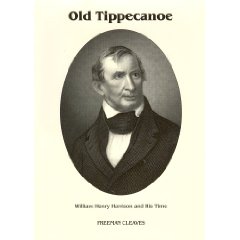
Old Tippecanoe: William Henry Harrison and His Time by Freeman Cleaves

President #9, C-SPAN Historians Ranking #39
Let Me Be Brief…

If you mention the name William Henry Harrison to most people, the initial reaction will be “I don’t know anyone by that name.” So, after you get past the people who are completely ignorant of the man, you might get the reaction of “Oh, the guy who died after a month in office as President.” And after you get past those people, you get the people who say, “Wasn’t his nickname ‘Tippecanoe’?”  Then you run into someone who is a direct descendant of Tecumseh, and you get punched in the face.

Finding a biography of William Henry Harrison was not an easy task. The book I found was published in 1939. And, it goes on for 343 pages, not counting the end notes, bibliography, and index. And Harrison does not get elected President until page 329. There was a  lot to slog through. In the end, I learned that perhaps one reason people do not write full-length biographies of William Henry Harrison is that is he was not very interesting.

Freeman Cleaves, who wrote mostly about the Civil War, penned a lengthy book that utters nary a bad word about William Henry Harrison. Either Harrison was beyond reproach, or he was incredibly boring. You could decide if you read the book, but you do not have to. I have read it for you as a public service. This public service does not extend to telling you if William Henry Harrison was a good person. But, I do know a lot about Indiana in the early 19th Century now.

The life of William Henry Harrison is somewhat interesting. It is not 343 pages worth of interest, but it is a little more interesting than reading about Millard Fillmore.

William Henry Harrison was the youngest child of Benjamin Harrison V, a signer of the Declaration of Independence, and Elizabeth Bassett. He was born on February 9, 1773 on the Berkeley Plantation in what is now Charles City, Virginia.

When he was 14, Harrison went off to Hampden-Sydney College. But, after two years, Harrison left when the college changed its religious affiliation from Episcopalian to Methodist.

Harrison then was going to try his hand at medicine and enrolled at the University of Pennsylvania, but he dropped out because his family told him that there was not enough money for him to stay in school. So, Harrison decided to join the Army. He received a commission as an ensign in the Army in 1791.

The United States Army was not a prestigious institution at the time. The country feared a large standing army. Almost all of the forces were stationed in what was then called the Northwest Territory (think Big Ten Conference.)  The Army posted Harrison to a fort outside of Cincinnati.

Harrison quickly moved up the ranks. He distinguished himself at the Battle of Fallen Timbers (near Toledo) in 1794. This battle, along with the subsequent Treaty of Greenville (negotiated by Harrison) brought some peace between American settlers and a confederation of Great Lakes area Indian nations.

In 1795, Harrison married Anna Symmes, daughter of a prominent judge in Ohio.  They would have 10 children together, nine of whom lived to adulthood.

Harrison settled down in 1797 and was appointed to the job of Secretary of the Northwest Territory. Two years later, Harrison won the election for the territory’s non-voting delegate in Congress. This job is similar to positions today held by people from exotic places like Guam and the District of Columbia.

In 1801, outgoing President John Adams appointed Harrison as the first territorial governor for the new territory of Indiana. Harrison moved his family to the bustling metropolis of Vincennes, the capital city.

Harrison tried to attract settlers to Indiana. He had two approaches. One was to relax prohibitions on slavery and indentured servitude in the territory. The other was to make sure that some of the Indian tribes that did not sign the Treaty of Greenville did not make any trouble.

By 1809, the Indiana Territory was allowed to choose its own legislature. This body had a pro-abolition majority that voted to prohibit slavery in the territory. In that same year, Harrison negotiated another treaty, this one with the Delaware, Wea, Kickapoo, and Potawatomi nations that allowed white settlement along the Wabash River.

This treaty, known as the Treaty of Fort Wayne, raised the ire of a Shawnee chief named Tecumseh. A charismatic leader, Tecumseh formed his own confederation of tribes to oppose the terms of the treaty. In 1811, Tecumseh, with 1100 men, visited Harrison at his home in Vincennes for a contentious meeting (not aided by the fact that neither men could speak directly to each other because neither spoke the other man’s language.) Tecumseh wanted the Treaty of Fort Wayne abrogated, or else he would side with the British. (The discussion between Harrison and Tecumseh also took longer because no one had a dictionary handy to find out what ‘abrogate’ meant.)

Tecumseh, along with his brother Tensketawa, ratcheted up the tension. Harrison and Tecumseh traded accusations and slurs against each other.

On November 6, 1811, Harrison decided to lead an expedition against Tecumseh’s forces at an encampment called Prophetstown (Tensketawa was also known as The Prophet.). This encampment was near the confluence of the Wabash and Tippecanoe Rivers. The forces led by Tensketawa made an attack on Harrison’s forces, but we were driven back, suffering heavy losses. Harrison received wide acclaim for this victory at what would be called the Battle of Tippecanoe. He also received criticism for not continuing the battle and capturing or killing Tecumseh and Tensketawa.

Harrison’s battle with Tecumseh became of the larger War of 1812. Harrison wanted to  command the American forces in the Northwest, but that command was given to General William Hull. Hull proved himself to be such a capable general that he had to surrender Detroit to a troop of British and Canadian soldiers. Tecumseh also was on the British side. (The Army court martialed Hull for the unpardonable crime of losing to Canadians.)

With Hull disgraced, Harrison was given command. He started a march up through Northern Ohio. His forces split in two, and a group of Kentucky militia under the command of General James Winchester, went well beyond the lines of communication to find supplies at a town called Frenchtown (which is now Monroe, Michigan.)

While Winchester and his men were well fed, they were also sitting ducks for a large force leaving from Detroit under the command of British General Henry Procter. Tecumseh’s men were also part of the contingent.

Winchester’s troops were caught by surprise. Nearly all of them were killed in an engagement known as the Massacre of the River Raisin. Nearly 400 men were killed, with the rest taken prisoner. Those taken prisoner were almost all subsequently killed.

Avenging this defeat became of primary importance to the United States. Harrison was able to marshal his forces, augmented by more Kentucky militia eager to avenge the deaths of their comrades. Aiding this cause was a spectacular naval victory on Lake Erie by Commodore Oliver Perry. Procter now faced a nearly impossible situation in trying to resupply his troops. So, Procter ordered a retreat.

Harrison and his men pursued Procter, along with Tecumseh, and finally engaged them near the Canadian city of Moraviantown on October 5, 1813. The American forces routed the British and Indian forces in what would become known as the Battle of the Thames. During this battle, someone killed Tecumseh. No one knows for certain who it was, although Colonel Richard Mentor Johnson of Kentucky would take credit for it in public, and parlay that into election as Vice-President in 1837.

Despite the victory, Harrison still received criticism from the Secretary of War, John Armstrong, over spending on supplies. Harrison resigned his commission and Andrew Jackson was given the command of the Army in the West. The War of 1812 would last into 1814 and most of Washington, D.C. would be burned to the ground by British troops.

In the aftermath of the war, Harrison decided to leave the world of the military behind. He won election to the House of Representatives from Ohio in 1816, riding in on a wave of anti-incumbency. Prior to the 1816 election, Congress had voted to change its pay scale from eight dollars a day to $1500 for an entire two-year term. Since Congress met for about five months a year at the time, this was a big salary boost. The public outcry was enormous.

When the new Congress convened in 1817, the salary reverted back to a per diem, at nine dollars per day. Harrison supported this measure, although he did not do much else of note in Congress. In 1820, Harrison ran for Governor of Ohio, but lost. In 1824, he was chosen to the United States Senate by the Ohio Legislature.

Harrison was facing financial problems at the same time. He actually wanted a diplomatic job (which paid around $9000 per year plus expenses). He wanted to go to Mexico, but President John Quincy Adams gave that appointment to Joel Poinsett. (Yes, the flower guy.)

In 1828, Harrison was given the title of Minister to Colombia. He ventured by ship through the Caribbean to Maracaibo in Venezuela. Eventually, he took a 10-day trip by mule to the Colombian capital of Bogotá. There he met Cololmbian President Simon Bolivar.

Bolivar, who had been the Great Liberator, was now bordering on becoming the Great Dictator. Harrison sent dispatches back to Washington, warning of Bolivar’s increasing paranoia and restrictions of personal liberties.

But, Harrison was not in Colombia long. In 1829, Andrew Jackson became President and appointed a new minister to Colombia. Harrison returned home to Ohio.

For several years, Harrison had little to do. He managed his estate (which was not overly profitable). He welcomed back veterans of his various campaigns. He wrote books, and had books written about him.

In 1836, the Whig Party decided on a unique strategy for the Presidential election. Instead of nominating one candidate, the Whigs would nominate several candidates, each of whom was supposed to be very popular in one part of the country. The hope was then to split the electoral vote and send the election to the House. This plan had several flaws. First, the Democrats controlled the House and would win any election there. Second, it is hard enough to find one good presidential nominee, let alone two or three. In 1836, the Whigs nominated four candidates: Daniel Webster, Hugh White, Willie Mangum, and Harrison. Harrison was chosen because of his military background and his popularity in the West.

In the end, Martin Van Buren won the election with 170 electoral votes and over 50% of the popular vote. Harrison polled the second most votes of any of the Whigs and won 73 electoral votes. Van Buren’s running mate, Richard Johnson, did not get a majority of the electoral vote, sending his election to the Senate. (Virginia Democrats would not vote for Johnson because he had a black mistress. Johnson prevailed in the Senate by a 33 to 16 margin.)

Harrison did not have to do much after the 1836 election to become popular. In 1837, the nation went into a scary depression known as the Panic of 1837. Credit markets dried up and tens of thousands of people were left in poverty. Van Buren could not solve the economic mess (or did not have enough time for the economy to right itself) and he was going to be an easy target in the Election of 1840.

Henry Clay saw 1840 as being his chance to finally win the Presidency. But, it was not to be. Clay had made too many enemies. Harrison was the choice of the Whig Convention. The congenial general from Ohio would run for President despite being a relatively elderly 67 years old at the time.

The presidential campaign of 1840 was groundbreaking. The campaign would not be about the issues, but about personalities. Van Buren was portrayed as an out of touch aristocrat. Harrison was the hard working military hero.

When a Democratic newspaper printed that “Harrison would like to retire to his log cabin and drink hard cider and contemplate moral philosophy,” the Whigs turned the dig into a campaign slogan. Harrison, along with running mate John Tyler, adopted the “Log Cabin and Hard Cider” as a theme for the campaign. In 1840, it was hip to be a country bumpkin. (Not that Harrison was actually born in a log cabin or lived in one.)

The Whigs also adopted a campaign slogan of “Tippecanoe and Tyler too” to emphasize Harrison’s military background. A large paper ball was rolled through various cities after Whig candidates won local elections. The idea was “to get the ball rolling for Harrison!” After the victory, the names of the winning candidates would be written on the ball.

Harrison, contemptuously referred to by Clay as nothing more than “a Trajan”, beat Van Buren easily, winning 19 of 26 states for 234 electoral votes. Harrison won nearly 53% of the popular vote.

Not many people knew which issues Harrison campaigned on. They just liked him, and he seemed better than Van Buren.

Harrison believed in a national bank, the supremacy of Congress to the President (which meant almost no vetoes), Federal funding of internal improvements, reform of the spoils system, and a promise to serve one term.

When Harrison got to Washington, he was greeted as a hero. He was also besieged by job seekers. He picked a Cabinet and planned to have all major decisions ratified by its members. The stress of the transition quickly began to wear Harrison down.

Hundreds of people would see Harrison each day, begging for a job. The Whigs wanted to get rid of all the Democrats in office. Harrison wanted to take a more restrained approach. But, after eight years of  Jackson and four years of Van Buren, the Whigs wanted their share of Federal jobs.

Harrison was inaugurated on March 4, 1841 on a cold and wet day in Washington. He gave the longest inaugural address in history, over 8,000 words, and that was after Daniel Webster heavily edited it. With the poor weather and the long speech, many of the estimated 50,000 in attendance stopped paying attention and left.

History books tell us that Harrison picked up a cold during his inaugural address because of the poor weather. However, most doctors would tell you that cold weather itself will not make you sick. But, a 68-year old man, under a high amount of stress, living among many unfamiliar people in crowded conditions, is a good candidate to pick up a virus from someone.

Harrison’s cold turned into pneumonia. And, even today, you do not want to get that. His health quickly deteriorated. On April 4, 1841, William Henry Harrison became the first President to die in office.  William Henry Harrison went from President to historical footnote.

Other stuff: Harrison’s birthplace, the Berkeley Plantation is available for visits and run by a private foundation. William Henry Harrison was laid to rest in a tomb in North Bend, Ohio. The tomb is maintained by the Ohio Historical Society. Harrison’s estate in Vincennes, Indiana was called Grouseland, and it is available for visits. Tippecanoe Battlefield Park is a National Historic Landmark, although it is maintained by the state of Indiana.

Tecumseh’s final resting place is unknown. He does have a line of air conditioners named after him. And noted Civil War general William Sherman has the middle name of Tecumseh.

The battlefield for River Raisin was designated as a National Battlefield Park on March 30, 2009.

William Henry Harrison’s grandson, Benjamin, would become President in 1889. Benjamin was the son of John Scott Harrison, who served in the House of Representatives for Ohio. Harrison’s brother, Carter Bassett Harrison, was a member of the House for Virginia. Harrison’s great-great-grandson, also named William Henry Harrison, represented Wyoming in the House.

Add to FacebookAdd to DiggAdd to Del.icio.usAdd to StumbleuponAdd to RedditAdd to BlinklistAdd to TwitterAdd to TechnoratiAdd to FurlAdd to Newsvine

Theodore Roosevelt by Louis Auchincloss

President #26, C-SPAN historians’ ranking #4

Bullfeathers!!!!

There is no person whose has been President who led a life that seems like it came out of a work of fiction more than Theodore Roosevelt. It seemed apropos that a novelist, Louis Auchincloss (The Rector of Justin among many other titles) wrote this biography of a larger than life figure.

Theodore Roosevelt was a President that America seemed to need. After Abraham Lincoln’s death in 1865, the Presidency had passed through the hands of men who ranged from highly capable to grossly incompetent. Even a Civil War hero like Ulysses Grant could not elevate the office to the same stature that it had in Lincoln’s time.

It took a man, born of privilege, but who still took nothing for granted in life, to bring the United States fully up to the level of a world power on par with the British and French. It took a man who could bring together upper crust New Yorkers and rough-edged Westerners into a cohesive fighting unit, for one day of military success. A triumph that would propel him to the White House.

Theodore Roosevelt was born on October 27, 1858 in New York City. His father, also named Theodore (as an adult, President Theodore Roosevelt did not use the “Junior” suffix), did not serve in the Union Army in the Civil War, instead buying a replacement. This was a source of great embarrassment to young Theodore, who felt his father, whom he idolized, displayed cowardice.

As a child, Roosevelt was plagued with debilitating asthma attacks. There was no effective treatment for that condition at that time, aside from just being propped up in a chair. The condition made it difficult for Roosevelt to attend school on a regular basis.

In an effort to improve his physical condition, young Theodore Roosevelt took up boxing. This led to a lifelong interest in physical fitness, as well as a love of the outdoors. Roosevelt called this “the vigorous life.”

Through home schooling, Roosevelt was able to develop a sufficient background to get himself admitted to Harvard in 1876. He proved to be an excellent student, devouring knowledge in seemingly every field. Roosevelt had an encyclopedic knowledge of literature, and was also well-versed in geography, the natural sciences, and history. After graduating from Harvard, Roosevelt would write a book, the Naval War of 1812.

In 1878, while at Harvard, Theodore Roosevelt’s father passed away at age 47 from a form of colon cancer. Young Theodore missed seeing his father before he passed away, and always regretted it. As it would turn out, tragedy would stalk him much of his life. It is amazing that he was able to overcome it.

Theodore Roosevelt married Alice Lee in 1880 and seemed to be a happy couple. Roosevelt had carefully picked out his wife, wanting only a woman of the finest breeding, as well as one who was a virgin. He was strongly opposed to sex outside of a marriage. However, he was a big supporter of sex in marriage and believed it was every person’s duty to have as many children as possible.

Alice became pregnant in 1883 and gave birth to a daughter, also named Alice, on February 12, 1884. Two days later, the new mother passed away from kidney failure. On the same day, Roosevelt’s mother passed away as well as from typhoid fever. Roosevelt never spoke about his first wife to anyone ever again, even to his daughter.

In response to these tragedies, Roosevelt decided not to run for reelection to the New York State Assembly (where he had begun to build his resume as a reformer) and moved out to his ranch, Elk Horn, in the Dakota Territory. He spent time living a life that would seem to be too fantastic for even a Hollywood Western.  Roosevelt caught a group of thieves and marched them back through the wilderness for a week until he could turn them over to the nearest law enforcement authority.

Roosevelt returned to the political arena later in 1884, making an appearance at the Republican National Convention. He held his nose and endorsed James Blaine for the nomination, even though he could not stand Blaine’s policies. Roosevelt felt that politically, he could not go out on a limb just yet.

In 1886, Roosevelt had his ups and downs. He ran for mayor of New York, but lost. But, he also remarried. Edith Carow was a childhood acquaintance of Roosevelt. The two married in London. They would have five children together.

Roosevelt then served in a series of political jobs that burnished his image as a reformer. He also was a member of the Federal Civil Service Commission from 1888 through 1895. He then moved on to become the Police Commissioner of New York. Roosevelt would walk the beats of officers and often find them asleep. He completely revamped the police force. (It is not known if alarm clocks were part of the revamping.)

The election of William McKinley as President in 1896 would give Roosevelt his chance to shine. He was appointed Assistant Secretary of the Navy. The Secretary of the Navy, John T. Long, was getting on in years and not an active manager of the department. Roosevelt took this opportunity to push across a plan to improve the Navy. He knew that a war with Spain over Cuba was likely. Roosevelt, when Long was on vacation, ordered the Pacific fleet to Manila Bay in the Philippines in preparation for the war. When war was declared, the Navy, under Admiral George Dewey, immediately scored a major victory over the Spanish fleet and kept other European powers from joining the fray.

Roosevelt did not want to sit out of the fighting in the Spanish-American War. So, he managed to get the Army to let him create his regiment, which would be known as the Rough Riders. The unit was a mixture of Western cowboys and wealthy New York scions. Although they trained to fight on horseback, they could not bring the horses to Cuba.

In what turned out to be the single biggest ground action of the war, Roosevelt led his men in a charge up San Juan Hill on July 1, 1898. Going up against heavy Spanish fire, Roosevelt and his men captured the hill. And, in turn, captured the imagination of the American public.

Roosevelt knew that malaria was an even bigger enemy than the Spanish. He quickly got his men sent back to the United States. Roosevelt came back and was elected governor of New York later in the year. Two years later, Roosevelt was elected Vice-President alongside McKinley. And on September 13, 1901, McKinley died from his gunshot wound seven days earlier. At age 42, Roosevelt was now the youngest President in American history. In the words of Ohio Senator Mark Hanna, a conservative Republican, “that damned cowboy is in the White House.”

After five years of solid, although perhaps not awe-inspiring, leadership from McKinley, America now had a dynamic man in the White House who wanted to get things done. And, he would do so.

Roosevelt soon faced a major strike by coal miners. Labor relations at this time were summed up by one coal corporation executive, “The rights and interests of the laboring man will be protected and cared for — not by labor agitators but by the Christian men to whom God in his infinite wisdom has given control of the property interests of the country.” Roosevelt ended up threatening to have the Army to operate the mines if a settlement could not be reached.  The mine operators agreed to binding arbitration.

The hot button political issue of Roosevelt’s time was the influence of corporations. Antitrust laws were routinely skirted by railroads, oil companies, and financiers. Roosevelt decided to go after one trust, known as the Northern Securities Company. It was a holding company that controlled two railways (the Northern Pacific and the Union Pacific) along with J.P. Morgan’s investment house. The company had a value, in 1902 dollars of $400 million. That would be about $9.5 billion today.

Roosevelt had the Justice Department prosecute Northern Securities for violations of the Sherman Antitrust Act. Morgan was outraged. He felt that Roosevelt should have just negotiated with him personally. Roosevelt was having none of that.

Ultimately, the government prevailed in the Supreme Court, although Roosevelt did not get the broad interpretation of the Sherman Act that he wanted. Nevertheless, the days of corporate mergers on a grand scale were over. So says, the guy who has a checking account at a bank that is owned by the House of Morgan. Roosevelt would pick up the nickname “The Trust Buster.”

In 1903, Roosevelt sent Secretary of State John Hay to Colombia to negotiate a treaty that would allow the United States to build a canal across the Isthmus of Panama. The Colombian Senate would not ratify the deal, upsetting Roosevelt.

Around this same time, French engineer Philippe Bunau-Varilla was still trying to push the idea of a Panama Canal in the United States. But without Colombia’s cooperation, the United States and Bunau-Varilla had to take a different approach. So, an independence movement in Panama sprung up. The United States backed the Panamanians with a naval force. The Republic of Panama came into existence on November 3, 1903. Bunau-Varilla offered himself up to the Panamanians to serve as their minister to the United States. On November 6, 1903, the Hay-Bunau-Varilla Treaty granted the United States the right to build a canal.

Construction on the canal would begin in 1907. Roosevelt would become the first sitting President to leave the United States when he made a visit to the site. In his usual style, he asked to operate a large steam shovel to help do some excavation. The Panama Canal would not open until 1914.

Roosevelt ran for election in his own right in 1904. Prior to that time, no Vice President who had assumed the Presidency because of a death had been elected. Usually, the former VPs were not even considered. Roosevelt was different. He had become the most popular man in the country.

The Democrats had little to offer in opposition to Roosevelt. New York Appellate Judge Alton Parker was given the unenviable task of taking on Roosevelt. It was no contest. Roosevelt won with 56% of the vote and 336 electoral votes. Upon his election, Roosevelt pledged to not run for another term in office. That statement would come back to haunt him.

In his one full term, Roosevelt was still a whirlwind of activity. In 1905, Roosevelt brokered a peace treaty that ended the Russo-Japanese War. For his efforts, Roosevelt won a Nobel Peace Prize.

In 1906, Roosevelt had the United States participate in a multinational conference in Algeciras, Spain to sort out how the European colonies in North Africa would be governed. The Kaiser of Germany, Wilhelm II, made a personal appeal to Roosevelt to help reduce tensions. The conference only ended up delaying the onset of World War I.

Some of the territories that the United States occupied after the war with Spain were granted independence or autonomy in Roosevelt’s time, in particular, Cuba. However, the Philippines remained a troublesome spot. A bloody insurgency, which the United States tried to stem with often brutal methods, persisted throughout Roosevelt’s Administration.

Roosevelt also oversaw a major buildup in American naval forces. To demonstrate this, Roosevelt dispatched a fleet of newly constructed battleships (“The Great White Fleet”) to take an around the world journey to show that America was now a world power on a par with Britain, France, Russia, and Japan.

On the domestic front, Roosevelt brought the issue of conservation to the forefront. Roosevelt established the United States Forest Service, created five National Parks, and 18 National Monuments. Roosevelt’s attitude toward forests was that they were a resource that could be managed and preserved.

In response to the publication of Upton Sinclair’s novel The Jungle, which exposed unsanitary practices in the food industry (even if that was not Sinclair’s main point in writing the book), Roosevelt pushed for the Pure Food and Drug Act to regulate the industry.

Roosevelt had pushed the Republican Party farther to the left than many in the party felt comfortable with. However, Roosevelt’s enormous popularity made it hard to stop him.

When Roosevelt left office in 1908, he anointed William Howard Taft as his successor. Roosevelt and Taft were good friends and the former hoped the latter would further extend his policies. But, William Taft was not Theodore Roosevelt. He was far more conservative. Friction between the two men began almost as soon as the election of 1908 was over.

Roosevelt departed the political scene for a period. He went on safari in Africa. He toured Europe. He thought he would be happy being a respected world figure.

But, it was not enough. By 1912, Roosevelt had completely broken with Taft and decided to run against his successor for the Republican nomination. However, Roosevelt made his decision too late. Taft was able to secure enough delegates to win the nomination. Roosevelt would not quit. His supporters bolted the Republican Party and formed the Progressive Party.

During the campaign, Roosevelt was shot in an assassination attempt in Milwaukee. The bullet was slowed down by the papers that Roosevelt had in his jacket to use for a speech. Despite his wound, Roosevelt insisted on delivering his speech. During the speech, Roosevelt said “it takes more than that [a bullet] to kill a bull moose.” And so, Roosevelt’s supporters became known as the Bull Moose Party. (The bullet was not removed from Roosevelt’s body, but he had to shut down his campaign for the final few weeks.)

The split in the Republican Party handed the 1912 election to the Democratic nominee, Woodrow Wilson. Roosevelt’s 27.4% of the popular vote was the best showing by a third party candidate in the 20th Century. Wilson was everything Roosevelt was not. Wilson was not an advocate of the “vigorous life.” Wilson was dour. Wilson worked in academia. Roosevelt was a man of action. He fought in a war. He inspired men to do great things. Roosevelt never respected Wilson.

With politics closed off to him, Roosevelt went on another journey. He led an expedition to explore a Brazilian river called The River of Doubt (it’s now called Rio Roosevelt.) During the expedition, Roosevelt almost died from an infection in one of his legs. His health would never be good again after the trip.

When World War I began in 1914, Roosevelt cajoled Wilson into getting America involved on the side of the Allies. He could not tolerate Wilson’s cautious plan of neutrality. Once the United States finally did enter the war in 1917, Roosevelt asked Wilson if he could form his own unit like he did in the Spanish-American War. Wilson declined the offer. Wilson did not want to run the risk of having someone like Roosevelt criticizing him in the field. Also, Wilson could tell that Roosevelt was not in the best of health.

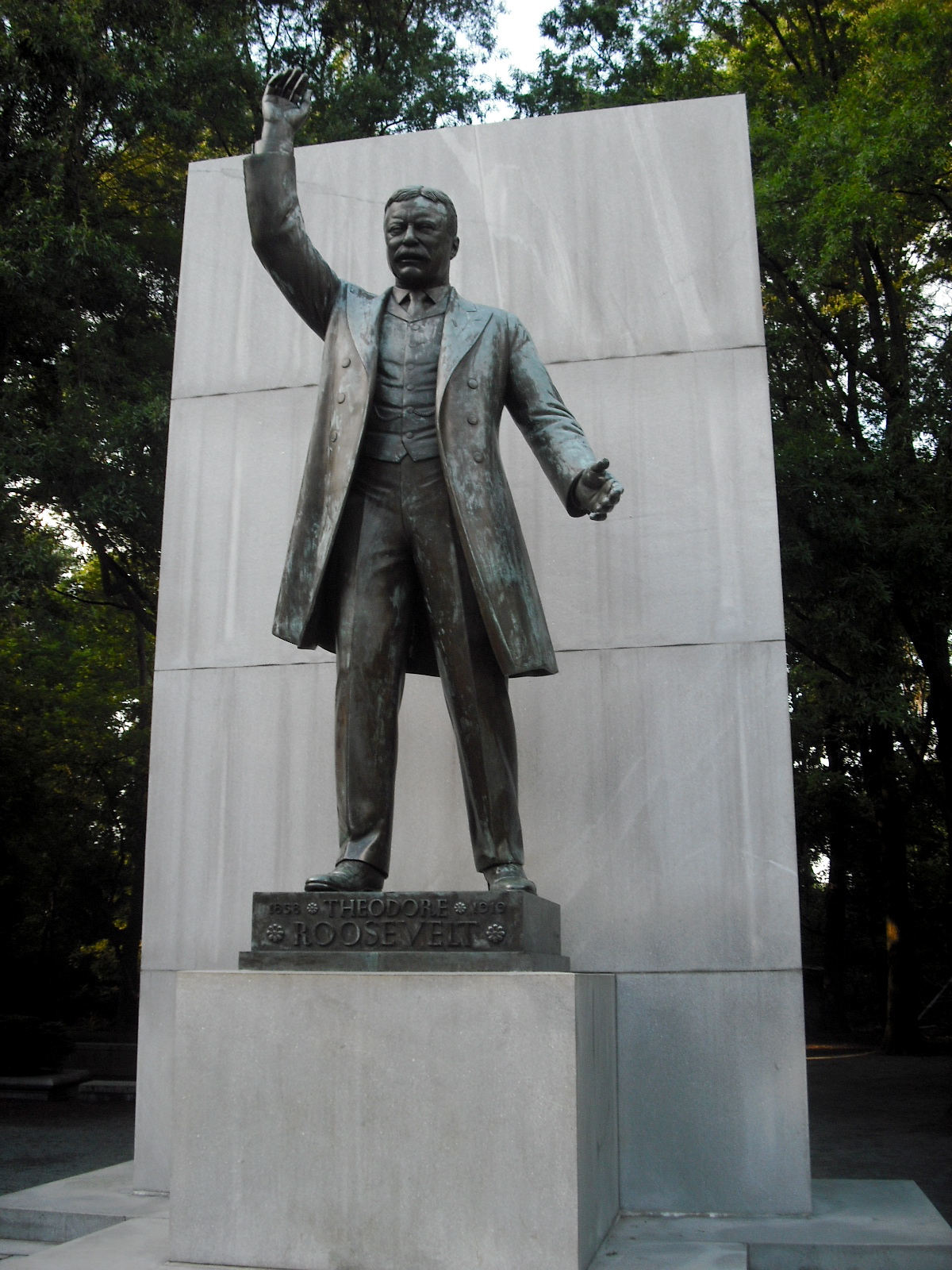
Theodore Roosevelt Island National Memorial in Washington, DC

Some of Roosevelt’s sons fought in the war. His youngest son, Quentin, served as a pilot and died when he was shot down behind German lines. Roosevelt was crushed both emotionally and physically by this.

Roosevelt still hoped to run for the White House one more time in 1920. But, on January 6, 1919, Theodore Roosevelt died in his sleep of a heart attack. His health had been compromised by rheumatism, malaria, and the leg infection he picked up in Brazil. Theodore Roosevelt, the youngest man ever to be President, died at the age of 60.

It is hard not to find a good biography of Theodore Roosevelt. His life is so rich that historians constantly write about him. If Theodore Roosevelt lived today, there would probably be a “Facts of Theodore Roosevelt” website along the lines of “Chuck Norris Facts.”

Auchincloss starts off his biography of Roosevelt by trying to immediately present him as a flawed individual. This serves to make Roosevelt’s life seem even more remarkable because you realize that he was just a regular person like each one of us. Auchincloss has a portrait of Roosevelt that is respectful, not fantastic.

Theodore Roosevelt, more so than any other President, transformed the office of President. He transformed the nation. Was he a perfect man? No, but none of us are.

For nearly all of us, Theodore Roosevelt is almost a mythical figure. And he very well may have been the last President to achieve that status.

Other stuff: There is a Theodore Roosevelt National Park in North Dakota in the area where he had his ranch. There is a Theodore Roosevelt Island National Memorial in Washington, DC. Theodore Roosevelt’s home, Sagamore Hill, is a National Historic Site. Roosevelt is buried at Youngs Memorial Cemetery in Oyster Bay, New York. Roosevelt’s birth place is a National Historic Site.

Since Roosevelt passed away in 1919, the only President to die of natural causes who was younger than Roosevelt (60 years and 71 days) was Warren Harding, who was 57 years and 273 days old, when he passed away in 1923.

Add to FacebookAdd to DiggAdd to Del.icio.usAdd to StumbleuponAdd to RedditAdd to BlinklistAdd to TwitterAdd to TechnoratiAdd to FurlAdd to Newsvine

Richard M. Nixon by Elizabeth Drew

President #37, C-SPAN Historians Ranking #27

I’m going to count to 10, if you don’t like this post, just stop reading before I get to 10

Richard Milhous Nixon was the first President I ever knew. He became President when I was three years old. He left office when I was all of eight. To me, he was the image of what the President of the United States is supposed to be. You can make of that what you will.

For a man who was not easy to like, he was elected President twice, once by a slim margin and the other time in a landslide. Nixon made himself into one of the towering figures in American foreign policy. But, his legacy is one of paranoia that fueled an unprecedented abuse of power by the Executive branch. In trying to be a statesman, Richard Nixon ended up a pathetic figure, even though history seems to be treating him better now.

One person not treating Richard Nixon better now is Elizabeth Drew, the longtime Washington correspondent for the New Yorker magazine. Nixon would likely be appalled that someone like Drew, an East Coast journalist and Wellesley alumna, is trying to write about his life. Drew paints a picture of Richard Nixon as a man who was deeply troubled. He was often depressed. He was often paranoid. He drank to excess. He could not form friendships or make small talk. And in Drew’s view, he was unfit to hold office and the nation was fortunate that Nixon did not steer the nation into a disaster.

Nixon’s childhood proved to be a key to understanding him as an adult. Even Henry Kissinger would say, “He would have been a great, great man if someone had loved him.”

Richard Nixon was born on January 9, 1913 in Yorba Linda, California. Today, Yorba Linda is a pleasant Orange County suburb that bills itself as “the Land of Gracious Living.” In 1913, Yorba Linda was a farming community. Nixon’s father tried to grow oranges, but was unsuccessful. The family moved to Whittier, which if you grew up in Southern California, you would know that it is the part of Los Angeles County that you just cannot seem to get to. Nixon’s parents were Quakers, although not the peace-loving, friendly types. Both Nixon’s father (Francis) and mother (Hannah) were rather demanding and often cruel to Richard. Two of Nixon’s brothers died of tuberculosis. (And there may have been an incident with a hobo. But you have to find this book. I’ve tried to read it. I have not succeeded in finishing it. Or making it through more than five or six pages.)

With good grades in high school, Harvard and Yale beckoned to Richard Nixon. But, financial concerns forced Nixon to attend nearby Whittier College. Nixon formed his own fraternity, called the Orhtogonian Society, to combat the influence of the fraternities on campus. (“Orthogonian” is not a real word.) Nixon played on the football team despite being small and unathletic. (During Nixon’s time in college, Whittier actually played USC twice, losing 51-0 in 1933 and 40-14 in 1934.)

Nixon hoped to attend an Ivy League law school after he graduated second in his class at Whittier. Finances again did not allow that. Nixon settled for going to Duke University Law School, which offered him a scholarship. After gaining his degree, Nixon returned home to Whittier to set up his own practice.

One of Nixon’s interests was community theater. He met a woman named Thelma Ryan, who went by Pat, after being cast in a play with her. Nixon pursued her, even to the point of driving her to dates with other men. Eventually, the two married in 1940. They had two daughters, Julie and Patricia.

When World War II started, Nixon served in the Navy. While not seeing any combat, Nixon did receive commendations for his work, which was almost all logistical.  When Nixon returned home, he set out on a career in politics.

Step one for Nixon was the House of Representatives. He challenged Democrat Jerry Voorhis in a district that covered a large portion of the suburbs east of Los Angeles. Nixon painted Voorhis as a tool of labor, and, by extension, possibly involved with Communism. (Nixon and Voorhis held a debate at South Pasadena Junior High, now South Pasadena Middle School, which is about four blocks from where I am presently typing this.) Nixon won the election by 15,000 votes.

Nixon immediately made a splash in Washington. He got a seat on the House Un-American Activities Committee (HUAC). He took on a State Department official named Alger Hiss, who was accused of being a Communist spy.  Nixon eventually produced evidence (via Whittaker Chambers) that would lead to Hiss’ conviction for perjury charges for lying to the Committee. (While some at the time thought that Nixon and HUAC had railroaded Hiss, an examination of the archives of the KGB would later reveal that Hiss may have had some espionage activities. The matter is still hotly debated.)

In 1950, Nixon decided to run for the open California Senate seat. Nixon easily won the Republican primary. The Democratic candidate was Representative Helen Gahagan Douglas, who upset Los Angeles newspaper publisher Manchester Boddy.

The Senate campaign would be a nasty one. Nixon came after Douglas hard, describing her as “the Pink Lady” because of the similarities in her voting record with Socialist Representative Vito Marcantonio. Of course, if you look at the roll call votes on any two members of the House, there will be a lot of similarities since many issues voted are procedural or the result of a compromise. Nevertheless, Nixon would claim that Douglas was “pink right down to her underwear.” Nixon won with 59% of the vote. Drew claims that most of Nixon’s efforts (through his campaign manager Murray Chotiner) were overkill as Douglas had little chance of winning anyway as 1950 was a down year for Democrats throughout the country. Also, Douglas had lost a lot of support among California Democrats as she was viewed as being too liberal.

After just two years in the Senate, Nixon found himself on the national ticket as Dwight Eisenhower’s running mate. Eisenhower agreed to Nixon to satisfy the party’s conservative wing. Nixon’s anti-Communist credentials were strong; and, he was not considered as divisive of a figure as Joseph McCarthy.

Nixon’s political career almost came to a sudden halt during the campaign when it was revealed that

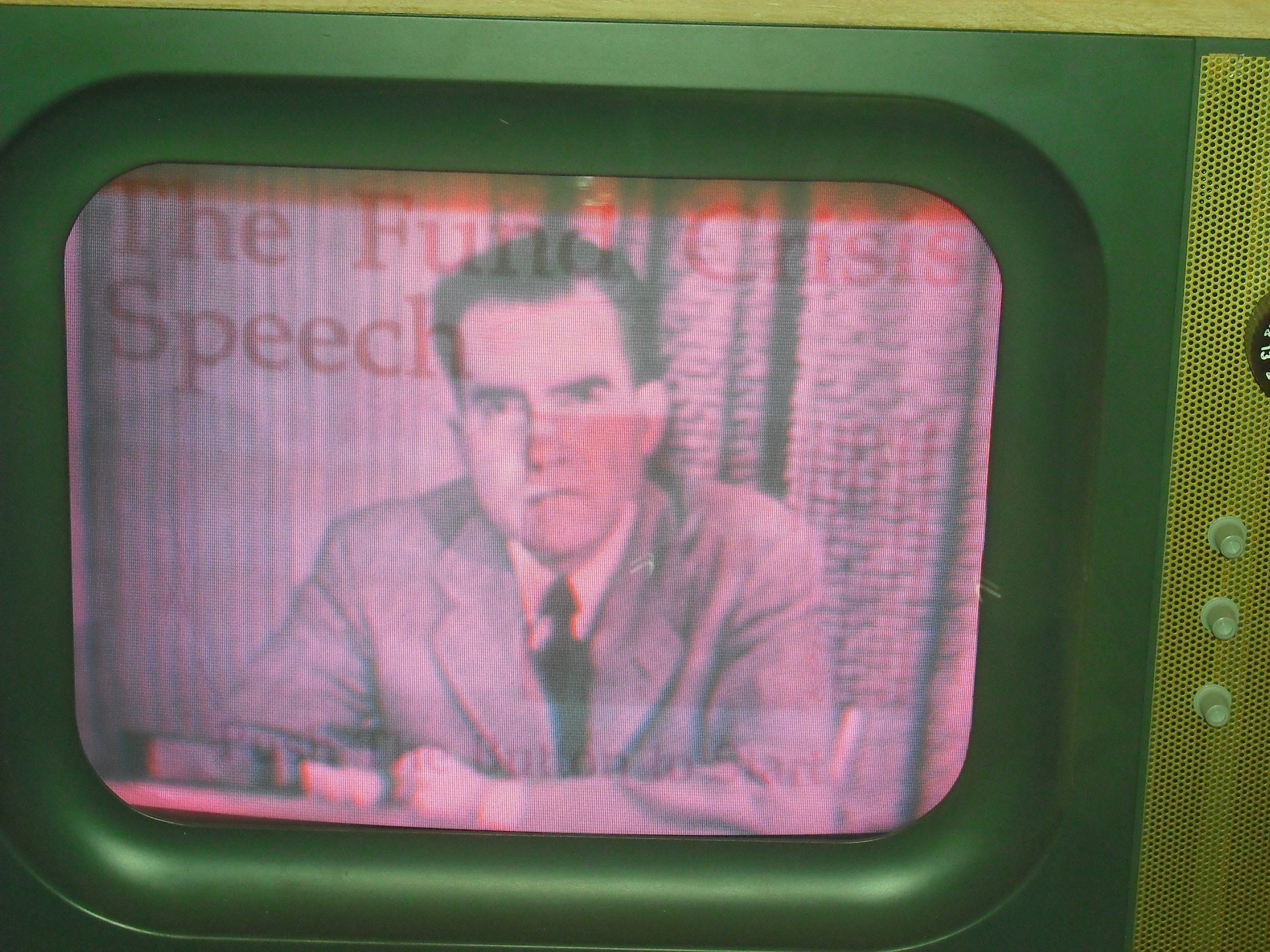
At the Nixon Library, the "Checkers Speech" has an alternate name

wealthy supporters had established a slush fund for Nixon and his family. (Nixon was far from the only person in Washington with one.) However, Eisenhower was thinking of dropping Nixon from the ticket because of the furor. Nixon gave a public speech to address the problem. It went down in history as “The Checkers Speech” as Nixon insisted that the only gift he received that he did not give back was a dog named Checkers. (You can view the speech in two parts.) The speech was a big hit. Eisenhower publicly told Nixon that “You’re my boy!” And so, Richard Nixon was able to become Vice President.

Eisenhower did not have much use for Nixon, and did not particularly like him. There was little for Nixon to do, even with Eisenhower’s questionable health. Nixon would make headlines when survived a hostile reception on a visit to Venezuela. Nixon’s motorcade was pelted with rocks. However, Nixon remained cool under pressure. In 1959, Nixon held an impromptu debate with Nikita Khrushchev about capitalism and communism. This would be dubbed the “Kitchen Debate” as it took place in a sample kitchen at a trade show in the Soviet Union.

Nixon made his first run at the White House in 1960. Facing John F. Kennedy, Nixon narrowly lost. The 1960 campaign may be one of the most discussed in American history. And I already discussed it in the Kennedy review. So, go look over there.

Only 47 years old, Nixon did not want to leave politics. He went back to California, wrote a memoir called Six Crises, and took on incumbent governor Pat Brown. Nixon felt that these activities were needed the position to establish national credibility again. However, Brown clobbered Nixon by over 300,000 votes. After the election, Nixon gave a rambling speech to the press declaring “you won’t have Nixon to kick around anymore.”

The losses to Kennedy and Brown reinforced for Nixon that the main reason he could not advance in politics was that the “Establishment” was out to stop him. This group consisted of Ivy Leaguers (like Kennedy) or the media (all forms of them whom Nixon felt were out to keep him from office and distort his views.) Later on, Nixon would begin to include Jews among his enemies.

Nixon then started one of the country’s most remarkable political comebacks. First, Nixon moved to New York to increase his earning potential as a senior partner in a law firm. Nixon endorsed Republican congressional candidates. Nixon targeted 1968 as the year to start his comeback.

With the country deeply divided over the Vietnam War, civil rights, and other social upheavals, the Republican nominee was going to have a good shot at winning the White House. Nixon’s principal competitors for the nomination were Michigan governor George Romney, New York governor Nelson Rockefeller, and California governor Ronald Reagan. All the competitors had their shortcomings. Romney was too weak. Rockefeller had too much baggage. Reagan was too inexperienced.  Nixon won the nomination fairly easily.

Much to the surprise of political pundits of the day, Nixon chose Maryland Governor Spiro Agnew as his running mate. Agnew had almost no national profile; but, Nixon liked some statements Agnew had made that made him appear to be tough on crime. Also, Nixon was trying for a “Southern Strategy” and hoped that Agnew would appeal to Southern conservatives.

The 1968 campaign saw Nixon not try to do too much since he had a substantial lead in the polls over Democratic challenger Hubert Humphrey. Nixon claimed he had a plan to end the war in Vietnam, but would not give its details. (It would be dubbed his “secret plan” even though it wasn’t secret or even a plan.) Nixon also stressed “law and order.” Nixon would “bring us together.”

Late in the campaign, Humphrey broke with President Lyndon Johnson over the Vietnam War and publicly declared his intention to end U.S. involvement in Vietnam. Around this time, Nixon’s campaign, using Anna Chenault as a conduit, got word to the South Vietnamese negotiators in Paris that Johnson and Humphrey wanted to end the war. The South Vietnamese pulled out of the peace talks. The war in Vietnam would continue well past Election Day 1968.

Nixon won the election in 1968, but by a narrow margin, 43.4% to 42.7%. This worked out to a little over 500,000 votes nationwide. Nixon earned 301 electoral votes to 191 for Humphrey. George Wallace won the other 45.

Now that Nixon was in office, he had to face the task of running the country. The problem was that Nixon was more interested in the process of becoming President than actually being President. He appointed a Cabinet that was made up of lesser lights in the Republican Party. There were no Ivy Leaguers in the group with the exception of George Shultz, who was the Secretary of Labor. The Secretary of State, William Rogers, would be routinely ignored by Nixon. The Attorney General, John Mitchell, wanted to emphasize that the Justice Department was a law enforcement agency, even though he would turn out to be violating Federal laws in the process.

Early on, Nixon had the chance to appoint a new Chief Justice. He chose Warren Burger, a conservative from Minnesota, whom Nixon thought would start to reverse the more liberal decisions of his predecessor, Earl Warren. In 1970, Nixon tried to appoint two different Southerners to another vacant seat on the Supreme Court: Clement Haynsworth and G. Harrold Carswell, but both were rejected for a combination of reasons, but primarily both of the men were considered incompetent. Nixon would finally appoint Harry Blackmun to the seat. And Blackmun would go on to write the majority opinion in Roe v. Wade.

Drew examines Nixon’s attitude toward domestic policies and found them lacking. Nixon’s policies were actually quite liberal. The Environmental Protection Agency and Occupational Safety and Health Administration were created under Nixon and consumer protection laws were greatly expanded. Under the direction of Daniel Patrick Moynihan, welfare and poverty programs were revamped.

The economy was in a strong inflationary period and unemployment was rising. Nixon tried to respond to this by imposing wage and price controls. He took the dollar off of the gold standard.

Drew does not believe that Nixon actually thought much about domestic policy, except he just wanted to adopt plans that were politically popular. There was no overarching idea for what Nixon was trying to accomplish. She insists that Nixon’s domestic policy was the result of cynicism and political calculation and little else.

What Nixon cared more about domestically were his political enemies. The White House became obsessed with monitoring the activities of Vietnam War protesters and other political opponents. Some of the ideas that Nixon and his aides developed for monitoring the opposition were considered too invasive even for FBI Director J. Edgar Hoover’s tastes.

The White House under Nixon was an odd place. The President would send formal memos to his wife about how to arrange the living quarters. The memos would be addressed to “Mrs. Nixon.” Drew relates that Nixon, through the assistance of some of his well-heeled supporters, used Dilantin, an anticonvulsant, as an anti-anxiety medication, washed down with helpings of Scotch. (Dilantin is not prescribed for anxiety and all anticonvulsants now come with warning labels telling you two or three times not to mix it with alcohol.) Nixon was showing signs of erratic behavior very quickly into his Administration.

Nixon always wanted to be viewed as a master of foreign policy. He relished the chance of negotiating with world leaders. And in this arena, Nixon tends to get the most praise from historians. Nixon also tended to give a lot of praise to himself in this field. Nearly all foreign policy initiatives from Nixon were orchestrated by National Security Adviser Henry Kissinger, the only person Nixon trusted in this field.

The Vietnam War was far from over when Nixon was inaugurated. Nixon had promised to reduce troop levels in Vietnam in a process he described as “Vietnamization.” At the same time, Nixon ordered an expansion of the war into Cambodia. Protests over the expansion of the war into Cambodia turned into even more protests than during the Johnson Administration. A protest at Kent State University on May 4, 1970 resulted in the deaths of four people when Ohio National Guard troops fired on them. Ten days later, two student protesters were killed at Jackson State University in Mississippi.

Nixon would eventually end the military draft. Kissinger negotiated an end to American involvement in Vietnam that went into effect in early 1973. Kissinger and North Vietnamese negotiator Le Duc Tho were awarded the Nobel Peace Prize. (Le Duc Tho declined the prize, the only person to ever do so with a Peace Prize.)

Other parts of the world were undergoing turmoil. Bangladesh was winning its independence from Pakistan in a bloody civil war that also involved India. Nixon, who did not like Indian Prime Minister Indira Gandhi, sided with Pakistan. It turned out that America’s desire to help Pakistan stemmed from a desire to use that country as an entree to an even bigger goal: relations with China.

During a diplomatic trip to Pakistan, Kissinger disappeared from public view for a spell with what was called “stomach flu.” Actually, Kissinger was negotiating a trip by Nixon to China. Before Nixon visited, the Chinese invited an American table tennis team to come visit and participate in exhibitions. This would be dubbed “ping-pong diplomacy.” (Except by the International Table Tennis Federation perhaps.)

In February of 1972, Nixon traveled to China, where he conducted high level meetings almost entirely on his own. Nixon went as far to use the translators that the Chinese provided instead of State Department translators, whom he did not trust. The visit began the process of starting the normalization of relations between the U.S. and the world’s most populous country.

The visit to China also made the Soviet Union more eager to negotiate with the U.S. on nuclear arms control. In May of 1972, Nixon went to Moscow. The Anti-Ballistic Missile Treaty and the first Strategic Arms Limitation Treaty (SALT) would be the results of these trips.

Despite Nixon’s good standings in the polls, he was worried about domestic enemies. The leaking of the Pentagon Papers, an in depth examination of the Vietnam War during the Johnson Administration, seemed to set off Nixon. Nixon wanted to tighten up internal security procedures and identify people who leaked information to the press. To stop these leaks, a group was formed in the White House that would become known as “The Plumbers.”

The Plumbers talked a much bigger game than they actually performed. The group, led by men like E. Howard Hunt and G. Gordon Liddy, (to join the group you had to not like your original first name it seemed), fancied themselves to be world-class spies. However, their incompetence would be Nixon’s undoing.

One plan the Plumbers came up with was to firebomb the Brookings Institution, a liberal think tank in Washington. The plan was to steal safes that were supposed to contain leaked information about the Vietnam War that scholars at the facility. However, the scholars neither had safes nor did they have any leaked confidential information.

Another plan involved breaking into the office of the psychiatrist of Daniel Ellsberg, the former Pentagon employee responsible for leaking the Pentagon Papers. That proved to be a fruitless endeavor.

On June 17, 1972, five men, including a White House official named Robert McCord were arrested at the Watergate Hotel trying to bug the office of Democratic National Party chairman Lawrence O’Brien. Six days after the break in, Nixon and aide H.R. Haldeman held the discussion linked here.

The Watergate Scandal is far too complicated for me to describe here (not that I don’t like to talk about.) It turned out to be more than just the break in at the hotel. It turned in to a major Constitutional crisis. Nixon, despite being reelected in a landslide in 1972 against George McGovern, would soon lose the confidence of the nation. A pattern of criminal behavior in the Executive Branch was revealed. (It probably wasn’t as cinematic as this though.)

A Senate Committee was set up to investigate the scandal and it seemed that new revelations turned up every week. Some geeky kids, like this seven-year old, enjoyed sitting in front of the TV set with his mother and grandmother listening to the testimony of John Dean and others. Ahh, good times. (At the same time as this was going on, Vice President Spiro Agnew resigned after pleading no contest to income tax evasion charges on kickbacks he received while governor of Maryland. Gerald Ford replaced Agnew.)

In the summer of 1974, the House Judiciary Committee approved three articles of impeachment against Richard Nixon. After Nixon lost a Supreme Court battle to keep the tapes from being subpoenaed, a group of prominent Republicans in Congress visited Nixon and told him that he had to resign for the sake of the country. Hesitant at first to quit, Nixon relented. He announced his resignation on August 8, 1974, effective the next day.

Nixon’s final days in the White House were not pleasant. His drinking became more severe. Secretary of Defense James Schlesinger told the Chiefs of Staff to run any orders from Nixon past him before enacting them. Schlesinger feared that an increasingly unstable Nixon could potentially involve the United States in a catastrophic war.

After leaving office, new President Gerald Ford would issue Nixon a pardon for any crimes he may have committed while in office. Nixon retreated for a time to his home in San Clemente, California.

Nixon had one more comeback of sorts left in him. After making a considerable sum of money for a series of interviews with David Frost, Nixon left California to move back to New York. Back in New York, Nixon would hold court and take on the role of the senior statesman. He wrote his memoirs and several other books on foreign policy.

In 1981, Nixon, along with former Presidents Ford and Carter, flew to Egypt for the funeral of the assassinated Anwar Sadat. Nixon would offer advice to Presidents Reagan and Bush.

Even when a Democrat, Bill Clinton, moved into the White House in 1993, Nixon was still trying to influence foreign policy. On April 18, 1994, Nixon suffered a severe stroke. Four days later, he passed away. He was buried on the grounds of his museum in Yorba Linda. President Clinton delivered a eulogy. Nixon could no longer see people kick him around.

Drew concludes her book with the examination of Nixon’s Presidency. She calls it the “Yes, but” question. Would Nixon have been a great President, if not for Watergate. According to Drew, the answer is no. Nixon’s mental instability and extreme paranoia almost destroyed the country. Nixon wanted his legacy to be his foreign policy success in China and Russia. But, Nixon’s legacy is mainly just an almost complete distrust in our leaders by the American public.

Nevertheless, Nixon’s historical profile is improving. The Ivy Leaguers that Nixon envied (or just hated) seem to be showing him more respect. Why this is so remains a puzzle to me.

Other stuff: Because of a dispute between Nixon and the National Archives, the Richard Nixon Presidential Library and Museum was originally run by a private foundation. The National Archives took over the facility in 2007. Many parts of the museum are being renovated, including the section on Watergate. The facility is in Yorba Linda.

Richard Nixon was considered to be a California resident when he was chosen Vice President; but, he was considered a New Yorker when he ran for President. In his three runs for the Presidency, Nixon received over 113 million popular votes, about 1 million more than George W. Bush had in his two successful runs for the White House.

Add to FacebookAdd to DiggAdd to Del.icio.usAdd to StumbleuponAdd to RedditAdd to BlinklistAdd to TwitterAdd to TechnoratiAdd to FurlAdd to Newsvine

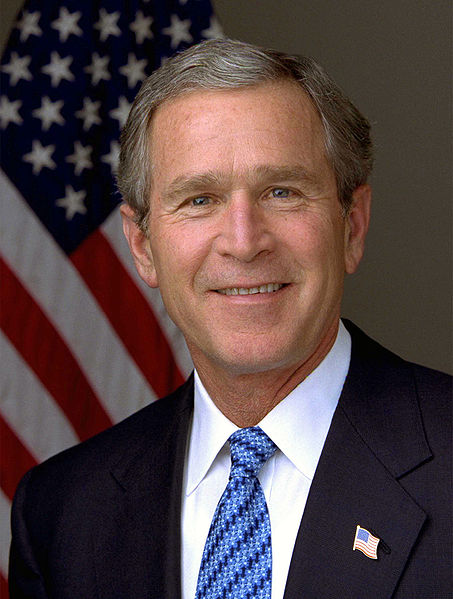
George W. Bush by TBA

President #43, C-SPAN Historians ranking #36

… and of the Son

My goal in this blog was to review a biography of every former President. I also wanted to do it in a random order.

At first, I assumed I would have a more leisurely stroll through the biographies of the 42ish men who served in the White House. But, I discovered that a lot of the books I was reading were only 150 pages or so and I could devour them quickly. Sometimes books weren’t in that series and I had to read very long tomes (such as with Kennedy and Lyndon Johnson.)

And although the order was random, it happened that George H.W. Bush and George W. Bush happened to fall right after each other in line.

This helped me in terms of finding a tag line at the beginning, but it left me with another problem. That is, there is no adequate biography of George W. Bush to read.

Don’t get me wrong. There are a LOT of books about our newest former President. However, they were either written before he was in office, or while he was in office, or just examine particular aspects of his Presidency. (Did you know there was a war in the Middle East the last few years? I need to read about this. I hope I can find a book.)

George W. Bush has just been out of office for about 11 months (depending upon when you read this, I’m hedging.) Historical perspective on the Bush 43 Administration will take a few more years to come in to focus.

As for now, there are a lot of books available which portray George W. Bush as a saint, a sinner, a hero, a villain, a statesman, a war criminal, etc.  If you are a regular reader of this blog, I am fairly certain you are fairly familiar with what happened between January 20, 2001 and January 20, 2009. If not, I applaud you for making a rapid recovery from your long coma or being a very precocious child.

Presumably, George W. Bush will publish memoirs in the next couple of years. And they will be dissected by political pundits for a few months. People on Fox News will say how good they are. People on MSNBC will say how bad they are.

When Bush left office, historians were not kind to him in their rankings. But that may be expected for a President who leaves office with an approval rating of 22%, which is Nixonian. In contrast, George H.W. Bush left office with a 54% approval rating. It helps not to have a major recession start while you are finishing up your Presidency.

I do not think I can add too much to the past eight years, except for this.

I think it was sometime in 1997 when I was talking to someone about how the Electoral College worked and I explained that three Presidents had won despite not getting the most popular votes (John Quincy Adams, Rutherford Hayes, and Benjamin Harrison.) I predicted that such an event would never happen again in our lifetime because there would have to either be a significant third party vote (like in 1824) or a huge sectional divide (1876, 1888.)

The 2000 election put me in my place. (Lots of things put me in my place. I should be put in my place more often. Perhaps I need a new place to be put.) As it turned out, there was enough of a sectional divide in 2000 to propel George W. Bush to the White House. But, it was not exactly the same divide as those after the Civil War. And no other election has ended with the two major nominees listed in a Supreme Court opinion to decide the election.

In time (and that time has not yet come), we can look back at 9/11 and the wars in Afghanistan and Iraq, the Patriot Act, the No Child Left Behind Act, the Wall Street bailout, the aftermath of Hurricane Katrina (I’m waiting for Kanye West’s book with a befuddled foreword from Mike Myers), and the influence of Vice President Dick Cheney and see what has become of the United States. Perhaps more will be written when the George W. Bush Presidential Center opens in Dallas on the campus of Southern Methodist University (sometime in 2013.) It is temporarily located in Lewisville, Texas.

And maybe, just maybe, someone will write the definitive biography of George W. Bush. But, there is not one now. So, I will just move on to the next President in line.

Feel free to boo this decision below.

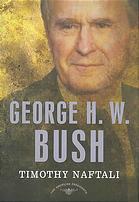
George H.W. Bush by Timothy Naftali

President #41, C-SPAN Historians Ranking #18

In the name of the father …

George Herbert Walker Bush (not that anybody called him that when he was President except when he was sworn in) did not have an easy act to follow, succeeding one of America’s most popular Chief Executives in Ronald Reagan. He came into office in a time when the entire post World War II world was changing in incredible ways. There were economic problems. And there was a war to be fought (but was it to be won?)

At one point during his Presidency, George Bush had an approval rating of 88 percent according to a Gallup Poll. And when he ran for reelection, few people were surprised that Bill Clinton soundly defeated him.

Timothy Naftali, who was written about U.S.-Soviet relations, and now serves as the director of the Richard Nixon Presidential Library and Museum, has the unenviable job of trying to figure out just where George Bush fit into the grand scheme of the rapidly changing world from 1989 through 1993. It is a difficult job to put a living figure just 16 years out of office with a far more famous son; but, I enjoyed Naftali’s presentation. He managed to distill the life of a man with a long resume and a Presidency filled with events of great import into an interesting narrative. You can see how George H. W. Bush (he dropped the initials before going into politics and then added them back to his name after George W. Bush became President in 2001) fits into the post Cold War world.

I did notice though it is impossible to write about George H.W. Bush without writing about Ronald Reagan or George W. Bush.  Much of George H.W. Bush’s life is circumscribed by his predecessor and his son. Naftali runs into this problem too. The last chapter of the book is more about Bush 43 than Bush 41 it seems.

George Bush was born in Milton, Massachusetts on June 12, 1924, the son of Prescott and Dorothy Bush. The Bush family moved to Connecticut when George was quite young. Prescott Bush was a successful businessman and would also go on to serve 11 years in the U.S. Senate.

Like his father, George Bush enrolled at Yale. However, World War II got in the way. Bush postponed his entrance into Yale to become a naval aviator, a feat he achieved just before turning 19. In 1944, Bush’s plane was shot down by Japanese anti-aircraft guns. All of the crew except for Bush perished. Bush was able to parachute to safety.

With the war nearing its end, Bush returned to Yale. He married Barbara Pierce in January of 1945. Bush captained a Yale baseball team that made it to College World Series. He and Barbara produced six children, some of whom went on to some renown (but that’s for a later post.)

It was a tradition in the Bush family for the men to go out on their own and not to rely on their father’s wealth. So, after graduating from Yale, the Bush family headed for Texas. George Bush started an oil drilling business, along with some friends from Yale. It proved to be quite successful and Bush became a millionaire in his own right.

Like his father, George Bush began to show an interest in politics. He decided to follow in his father’s footsteps and run for a seat in the Senate against Democrat Ralph Yarborough in 1964. Bush decided to ally himself with Republican Presidential nominee Barry Goldwater. This strategy raised Bush’s profile nationally, but did not help him in the election. Yarborough won with 56% of the vote.

Two years later, Bush opted to run for a House seat and won. He became the first Republican to represent a Houston district, serving two terms. In 1968, Bush took aim at Yarborough’s Senate seat. However, Lloyd Bentsen defeated Yarborough in the Democratic primary. Bush would lose to Bentsen.

Bush was not through with politics. Richard Nixon rewarded Bush for his efforts in Texas by naming him Ambassador to the United Nations in 1971. Two years later, Bush had an even more difficult job. He was named Chairman of the Republican National Committee as the Watergate crisis was coming to a boil. Bush, as was his nature, stayed loyal to Nixon as long as he could, but even he realized that the longer Nixon stayed in office, the worse off the Republican Party would be.

New President Gerald Ford decided to give Bush a less depressing assignment. In 1974, Ford appointed Bush as the United States Representative to China. (The two nations had not established formal diplomatic relations.) Bush had hoped to be named Ford’s Vice President (and he also had hoped that Nixon would have added him to the ticket in 1972), but that was not to be. Nelson Rockefeller was appointed to the position.

Bush worked in China for a little over a year, but was brought back to the United States to head up the Central Intelligence Agency, which was then under heavy fire after a series of Senate hearings revealed a pattern of illegal or unwarranted activities done by the agency. Bush thought this job would finish him off politically as there was too much baggage attached to it. But, Bush did not want to appear to be disloyal to the President, fearing that it would hurt his chances to run with Ford in 1976.

As it turned out, Ford chose Senator Bob Dole as his running mate in 1976, but lost anyway to Jimmy Carter. Bush offered to remain on as CIA director under Carter, but the new President chose Admiral Stansfield Turner for the job. George Bush was seemingly gone from public view.

Or was he? Bush decided to make a run at the White House in 1980. He adopted Carter’s model and announced early, in 1978. He started organizing in Iowa before the presumptive nominee, Reagan, had made much headway there.  The move paid off and Bush surprised many pundits by winning in Iowa. As Bush proclaimed, he had “the Big Mo!”

However, it all fell apart quickly in the rest of the 1980 campaign. In New Hampshire, Bush got into a situation where he refused to debate all of the Republican contenders, except for Reagan. So, at a debate when the other candidates showed up (Howard Baker, John Anderson, John Connolly, Phil Crane, and Bob Dole),  Bush wouldn’t speak. And when Reagan began to speak, the moderator ordered the microphones cut. Reagan then famously declared, “Mr. Green [the moderator] I paid for this microphone!”

Actually, Reagan hadn’t paid for the microphone. But, it certainly looked like he did. Bush looked meek compared to the forceful Reagan. Reagan won in New Hampshire and cruised to the nomination.

When it came time to pick a nominee for Vice President, Reagan’s first choice was going to be former President Gerald Ford. But, Ford wanted to have unprecedented latitude for someone in the job. Ultimately, both Reagan and Ford realized the idea was unworkable. So, Reagan went for the safe choice, George Bush.

However, there were a few problems. For starters, the two men weren’t close. And during the campaign, Bush had referred to Reagan’s supply side economic plan for the United State as “voodoo economics.” However, Bush showed himself quite adaptable to what the top of the ticket wanted. The 1980 election would be described as “not close.”

As Vice President, Bush quickly had a chance to show that he was up to the job. On March 30, 1981, Ronald Reagan was shot and wounded in an assassination attempt by John Hinckley. In the confusion that ensued, Secretary of State Alexander Haig declared that he was in charge. Except Haig wasn’t. Legally, Reagan was still in charge. But, it was Bush who appeared on TV screens reassuring the public. Bush also declined to use the same privileges (such as special entrances to the White House) that the President was entitled to.

As Reagan recuperated, he began to include Bush in more policy-making decisions. Reagan and Bush won reelection in 1984 in a landslide.

Toward the end of Reagan’s second term, a scandal began to brew. The complex Iran-Contra Scandal would be one of the major blemishes on Reagan’s record. The convoluted plan involved the U.S. government attempting to gain leverage with Hezbollah groups holding American hostages in Lebanon. To accomplish this, the U.S. sold missiles to Iran, through an Israeli intermediary. Then, the plan was changed to sell the arms directly to Iran, but siphon off some of the money to help fund the Contra rebels in Nicaragua.

However, it was against the law to give money to the Contras. Nevertheless, the plan was approved. Hezbollah released some hostages, but took more to replace them. It was a bit of a mess. Only two people, National Security Adviser John Poindexter and his aide, Oliver North, were tried in court in connection with this affair. Although both men were initially convicted, their verdicts were overturned for differing reasons.

Although Bush served on the National Security Council, he somehow managed to avoid any involvement (at least that has been shown to date) in the matter. Whether or not Bush agreed with the aims of the plan is still debated.

1988 would be George Bush’s year. He was the leading candidate for the nomination to replace Reagan. However, no sitting Vice President had been elected President since Martin Van Buren in 1836. Bush’s major opponent would be Robert Dole.  However, television evangelist Pat Robertson also entered the race, changing the dynamic, making the evangelical vote more important.

Dole prevailed in the Iowa caucuses, but Bush came back to win in New Hampshire. After that, it was mostly smooth sailing. On May 12, 1988, Reagan endorsed Bush for the Presidency.

Bush went to the Republican Convention needing to pick a running mate. He settled on Indiana Senator Dan Quayle.  The announcement was far from smooth. Quayle was at the back of a large crowd when the announcement was made and came charging up on to the stage with a great deal of exuberance. However, Bush’s team hadn’t completely vetted Quayle. Questions about Quayle’s avoidance of military service in Vietnam and seeming lack of experience would dog the campaign until Election Day.

During his acceptance speech, Bush decided to appeal to the conservative base of the party when describing how he would handle the rapidly increasing budget deficit. He said, “Read my lips, no more taxes.” It would be a catch phrase that would haunt Bush for his whole administration.

The general election campaign against Democratic nominee Michael Dukakis of Massachusetts was decidedly unpleasant. Dukakis, who had started with a huge lead in the polls, quickly frittered it away, mostly by being himself. That is, he was an incredibly dull candidate who managed to make Bush look charismatic.

Bush’s campaign also continued to hit at Dukakis on issues such as prisoner furloughs (the linked ad was not directly paid for by Bush’s campaign), and whether or not Massachusetts school children should be required to recite the Pledge of Allegiance. The televised debates involved enlightened questions such as this one.

Dukakis seemed fortunate to win 45.6% of the vote and 111 electoral votes (10 states and the District of Columbia.) Bush was finally able to put the job he always wanted on his resume.

Upon taking office, Bush inherited a major financial crisis. The savings and loan industry, which had been deregulated to some extent in the early 1980s, was facing massive amounts of failures. The S&L’s were allowed to invest in even riskier real estate dealings (they previously had been limited to financing residential property almost exclusively) and other questionable financial practices. The whole industry was on the brink of collapse, as they had to offer higher and higher interest rates to investors, while being unable to raise interest rates to lenders. It would require $161 billion from the Federal Government to clean up the situation.

The S&L bailout only made the budget deficit problem worse. Democrats and moderate Republicans hoped to put into place a package of limited tax increases along with budget cuts.  But, Bush refused to go along with any new taxes because of his campaign pledge. As has been the norm in the American history, the problem was deferred to a later date.

Some issues could not be put off. Bush’s National Security Team, with Secretary of State James Baker and National Security Advisor Brent Scowcroft, in charge wanted to thoroughly study the changes going on in the Soviet Union before making a commitment to a new policy. But, there was no time for a study. The Iron Curtain fell apart in a matter of months.

Poland’s Communist leaders legalized the Solidarity movement of Lech Walesa in February of 1989. After a brief power sharing agreement, the Communists faded away. Yugoslavia began to split apart along on ethnic lines, although this would prove to be far from a peaceful process. The Baltic states of Latvia, Lithuania, and Estonia pulled away from the Soviet Union.

The biggest change was in Germany. East Germany, which suffered under one of the most oppressive Communist governments, collapsed in October of 1989. The Berlin Wall, the most visible symbol of Communism, came down. As the rest of the Soviet satellite states sloughed off Communism, so too did the Soviet Union. It broke apart (although some hard-liners tried one last coup for old time’s sake) into independent republics.

Bush was restrained in his initial public statements about the events in Europe. “I’m not an emotional kind of guy,” Bush would say. It seemed odd when the primary foreign policy goal of the United States, particularly Bush’s predecessor, had been met.

However, not all went smoothly in the world of foreign affairs. While Communism in Europe passed away, Communism in China persisted. Demonstrations in the streets of Beijing in May of 1989 were suppressed by the military. The death toll was in the thousands, the exact total never known. Bush sent Scowcroft to Beijing for secret talks to ask for leniency for the protesters. The United States had no leverage though and could do little but complain.

Bush ordered U.S. troops into Panama to arrest Manuel Noriega, the leader of the nation, so he could be tried in the United States for drug trafficking. Operation Just Cause ultimately restored some semblance of order in a country that was once of the strongest allies of the United States.

On August 1, 1990, the Bush Presidency faced its biggest crisis. Iraqi forces invaded and occupied the nation of Kuwait. Saddam Hussein declared that he had annexed Kuwait as part of Iraq. Suddenly, the entire Persian Gulf region was in danger from Saddam’s forces.

At first, the United States sent in forces to Saudi Arabia to help protect the oil-rich nation. This was Operation Desert Shield. Delicate diplomacy in the UN was able to expand the forces in the Gulf Region and give it a UN blessing. Congress approved a joint resolution authorizing the use of force.

On January 17, 1991, Desert Shield became Desert Storm. The Iraqi forces were quickly driven from Kuwait, and they retreated back into Iraq. Bush and his generals faced the decision on whether to continue the battle into Iraq. The decision was to stop. The belief was that a prolonged war in the Persian Gulf was something that the country was not prepared for. (Similarly, I’m not prepared to write about this at length either. Because it would take several thousand more words. And I would get depressed.)

After the success of Desert Storm, Bush soared in his approval ratings. A calamitous drop would soon follow. As Naftali puts it, Bush’s support was wide, but it was not deep. By the time of the election, Bush’s unfavorable ratings were higher than his favorable ones.

Bush’s downfall would be the economy. Despite his pledge of no new taxes, Bush was forced to approve an increase in the income tax and the capital gains tax.  Unemployment went up to 7.8%. Conservative Republicans felt betrayed. They did not believe that Bush was another Reagan. Bush’s approval ratings went on a sharp decline.

During the 1992 campaign, Bush faced a primary challenge in New Hampshire from conservative political pundit Pat Buchanan. Bush won in New Hampshire; but, Buchanan picked up a surprisingly high 37% of the vote. This forced Bush to move farther to the right, a place he was not comfortable.

Further complicating matters was the addition of Texas billionaire H. Ross Perot. Perot mounted a campaign based on a balanced Federal budget and an opposition to the North American Free Trade Agreement (NAFTA). Perot said he would run for President if volunteers could get his name on the ballot in all 50 states.

The Democrats were going to nominate Arkansas Governor Bill Clinton. Despite admitted extramarital affairs and his avoidance of military service in Vietnam, Clinton pushed on ahead to seize the nomination easily.

The three-horse race for a while turned into a two-horse race when Perot dropped out, citing interference from the Bush campaign, even accusing Bush’s people of trying to disrupt his daughter’s wedding. Perot would rejoin the race a week later, but now was more or less branded as a flake.

The campaign between Bush and Clinton was quite a contrast. Clinton was the first Baby Boom generation candidate. He had far more charisma than the dour Dukakis of 1988. Also, Clinton was not nearly as liberal as Dukakis, making him a much more palatable choice to a good swath of the country. Bush seemed to be older and out of touch. Clinton won the election by a wide margin in the Electoral College (370-168), although Perot’s participation kept Clinton at just 43% of the popular vote.

Soon after his electoral defeat, Bush’s mother, Dorothy, died at the age of ninety-one. As Bush left office, he gave pardons to many of the principals in the Iran-Contra scandal, including Poindexter, North, and former Secretary of Defense Caspar Weinberger. George and Barbara Bush retired to Houston, where the home they hoped to have built for them after he left office in 1993 was not yet finished.

Bush went on speaking tours. One such tour in 1993 took him to Kuwait, where it turned out that the local authorities had foiled a plot by Iraqi operatives to assassinate the former president. This event would be remembered by Bush’s son, George W. Bush.

The Bush family would be heard from again. It would take just eight years.

(Insert dramatic music and pause to create “To be continued…” effect like they do on TV.)

Other stuff: The George Bush Presidential Library and Museum is on the campus of Texas A&M University in College Station. Note that they don’t use any initials in the name.

George H.W. Bush is the only father of a President who saw his son be inaugurated. John Adams was not able to see John Quincy Adams take the oath of office in 1825 because of his advanced age (89).

The Navy’s most recently commissioned aircraft carrier is called the U.S.S. George H.W. Bush. The principal airport in Houston is called George Bush Intercontinental Airport.

Add to FacebookAdd to DiggAdd to Del.icio.usAdd to StumbleuponAdd to RedditAdd to BlinklistAdd to TwitterAdd to TechnoratiAdd to FurlAdd to Newsvine