Just because you’re a Populist, that doesn’t make you popular
Picture a time in American history when Presidential elections produced enormous turnouts, people debated the issues intently, and felt that their identity was closely tied to their party affiliation. A time when one of the major party candidates went from being virtually unknown a few months before the party convention to becoming the party nominee. When one of the nominees was so popular that hundreds of thousands of people came to his home to visit him. This time was 1896. And, today, most history students get shuffled through it as quickly as possible because the issues involved are often too esoteric or too removed from today’s problems, that people cannot identify with them.
In this book by Southern Methodist University professor R. Hal Williams, as part of the University Press of Kansas series on American Presidential Elections, the 1896 election is presented as the one that marked a major change in the way Americans treated Presidential elections. Although the calendar did not say it was the 20th Century, the 1896 election is, in many respects, the first “modern” Presidential election.
The lead up to the 1896 election was extraordinarily turbulent, and, for the most part, mostly ignored today. Starting in 1876, elections became close affairs in the United States. Republicans eked out wins in 1876 and 1880. The Democrats won the White House in 1884 under Grover Cleveland, but lost it in 1888 back to the Republicans and Benjamin Harrison despite Cleveland winning more popular votes.
The Republicans of this era liked to spend money. They liked to raise revenue and in 1890, President Harrison signed into law a major increase in tariff duties called the McKinley Tariff, named for the Ohio Congressman who chaired the House Ways and Means Committee. The Democrats complained about the enormous spending done by the Republicans. They derisively referred to the “Billion Dollar Congress” because they Federal budget had finally topped that mark.
In the 1890 midterm elections, the House Republicans were nearly wiped out at the polls. They lost 93 seats, the most ever. The Democrats picked up 86 of them, with a third party, the Populists, a Western-based movement that opposed the concentration of capital in Eastern banks, picking up the balance. McKinley lost his seat. The voters of Nebraska’s first district chose a 30-year old named Williams Jennings Bryan.
In 1892, Cleveland returned to the White House (while McKinley was elected governor of Ohio), avenging his defeat to Harrison. However, events went bad for Cleveland almost immediately. The nation’s gold reserves were dwindling, creating turmoil in the financial markets. Where was the gold going? It was going overseas.
At the time of Cleveland’s second inauguration, you could take a certificate for a certain amount of silver and have it exchanged for a fixed rate of gold. (About 16 oz of silver for 1 oz of gold). The problem was that gold was worth much more than silver than the exchange rate the Treasury offered. And nearly every other country in the world would not accept deposits in silver because there was too much of it.
Almost immediately after the March 4 inauguration, Cleveland was facing a full-fledged financial panic as credit was squeezed. Cleveland asked Congress to repeal the Sherman Silver Purchase Act of 1890. When this happened, Western Democrats, like Bryan, felt betrayed by Cleveland. While the U.S. economy did not collapse, it certainly did not get better. Unemployment went up.
In the 1894 elections, the Republicans broke the four-year old record for biggest turnaround in an election. They picked up 130 seats in the House, putting Thomas Reed of Maine into the Speakership.
By the time of the 1896 election, the Republicans were fairly sure that they would win back the White House. But whom would they choose? McKinley was considered one of the leading contenders. He was the governor of a swing state (Ohio), he was a Civil War vet (he was called Major McKinley in the press), and he had the substantial financial backing of Mark Hanna, one of the wealthiest men in Ohio.
Reed tried to present himself as a candidate, but he came from a small state (Maine), and he was considered too abrasive to appeal to a national electorate. Pennsylvania senator Matthew Quay also made a play for the nomination.
When the Republicans convened in St. Louis, it didn’t take them long, just one ballot, to nominate McKinley, whom most tabbed as an easy winner in November. Garret Hobart, a New Jersey business magnate, was nominated for Vice President.
The Democrats were not in a great position. All of the leading contenders for the nomination were running against the policies of the incumbent President, who happened to be in their party.
The front-runner was Missouri Senator Richard Bland, who was such a big advocate of restoring the silver standard, that he was commonly referred to as “Silver Dick.” That name wasn’t as funny in 1896 as it is now, but it was likely funny enough that Bland didn’t get the nomination.
Instead, William Jennings Bryan, a 36-year old Representative from Nebraska, got the nomination? How did this happen? There were two reasons: 1) Bryan gave one of the most convincing speeches in American political history: the Cross of Gold Speech. The delegates may have nominated Bryan right after he gave the speech if not for a hasty adjournment and 2) the Democrats didn’t have many other good choices. The Democrats nominated Arthur Sewall, a wealthy lumberman from Maine, as Vice President.
So, the 1896 election matched up a Republican governor who looked like Presidential, fought for the Union, and stood for a sound economy. The Democrats nominated someone who was too young to remember the Civil War and backed a potentially inflationary economic scheme. As it turned out, Americans loved the debate.
Bryan was on the campaign trail constantly. He traveled by train all over the nation, but he targeted states that he felt were crucial to his chances for victory. It was not common to do that at this time, but it was not unheard of.
McKinley knew that if he tried to match Bryan speech for speech across the country that he would lose. He knew he held the upper hand in the election and he had no need to make himself look like he had to work as hard as Bryan to get elected. So, Hanna, McKinley’s money man, had trains full of eager Republican voters brought to Ohio, where McKinley would address them from his front porch. It was estimated that nearly 750,000 came to hear McKinley speak over the course of the campaign. The heads of the visiting delegations were given questions by McKinley to ask ahead of time.
The Republicans also had a sophisticated direct mail campaign, flooding the mail boxes of likely Republican voters with materials printed in a variety of languages. McKinley and the Republicans may not have been able to out talk Bryan, but they could definitely outspend him and out organize him.
Complicating matters for Bryan was the presence of a third party, the Populists. They had made a difference in the 1892 election. However, in 1896, they found that their platform, with its reliance on silver, had been co-opted by Bryan and the Democrats. The Populists held a convention of their own and nominated Bryan as their candidate, but refused to nominate Sewell. Instead, they substituted Thomas Watson of Georgia. This left Bryan in the uncomfortable position of having the support of a third party, but not the support of his running mate, which could prove to complicate Electoral College matters. In some states, the Byran-Sewell tickets and Bryan-Watson tickets would run separately, making it harder for Bryan to win. (A group of conservative Democrats favoring the gold standard also nominated a ticket, but it received little support.)
Election Day 1896 was a big day. The turnout was massive. In Illinois, Indiana, Michigan, Iowa, and Ohio, the turnout was nearly 95% of the electorate (which was almost all white males at the time.) In New York City, newspapers used “magic lanterns” (early versions of slide projectors) to show a map of the United States with each state colored in to show which candidate had won there. (The book does not have examples of what colors were used.)
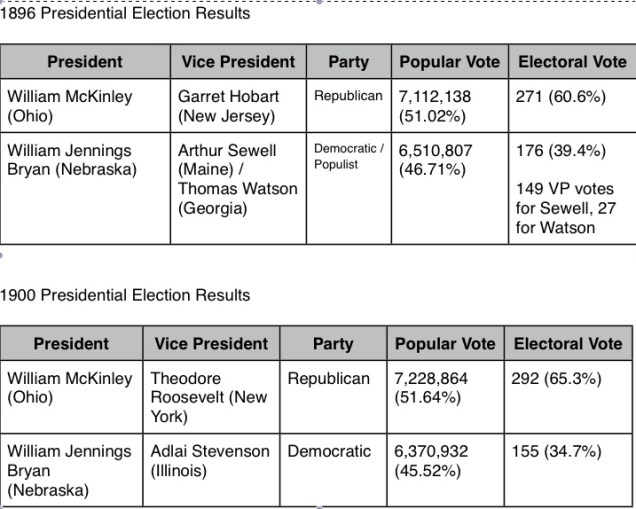
McKinley won with 51% of the vote and 271 electoral votes to Bryan’s 47% and 176 electoral votes. Bryan failed to win any state out of the Democratic South and the Populist West. McKinley managed to pull in Oregon and California and also the border states of West Virginia and Kentucky.
Why was the turnout so big? Williams makes the point that at this time, Americans tended to identify themselves very closely with political parties. Being a Republican or Democrat made you who you were. Politics was a unifying force in communities. People enjoyed elections, some states holding several per year.
Most people would vote a straight ticket and show up at the polls with a ballot that would distinctly indicate whom they were voting for, although by 1896, the Australian ballot (which actually started in Australia), changed matters. This style of ballot listed all the candidates on the ballot from all the parties. Voters would then indicate whom they wanted. And they would do this secretly.
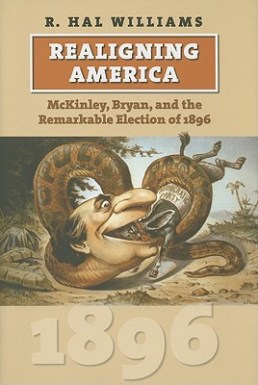
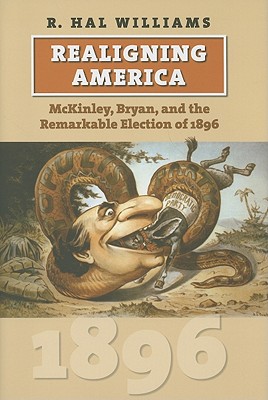
McKinley’s victory in 1896 was not hard to predict. The Republicans of this era were the only party that was actually trying to do things. The Democrats of this era were best known for only wanting to oppose what the Republicans did, such as expanding civil rights. Bryan attempted to change the Democrats from being a conservative party that mainly said no into a party that appealed to the Populist movement of the West. The book cover shows a cartoon of Bryan as a snake swallowing the Democratic Party whole, which would ultimately be their undoing.
The economy greatly improved during McKinley’s first term, partly because of natural economic cycles and also because gold became more plentiful in the world, making the return to the gold standard far less risky. In 1899, Vice President Garret Hobart died.
In 1900, the Republicans renominated McKinley. The young governor of New York, Theodore Roosevelt, a hero of the Spanish-American War, was nominated as Vice President. The Democrats, lacking anyone better to run, nominated Bryan again, this time with former Vice President Adlai Stevenson as his running mate. McKinley won again, by a slightly larger margin.
American political involvement would never be as great as it was during this time. The Australian ballot allowed people more freedom to choose the candidate they liked instead of the party they liked. People began to identify less with their political party as they realized that their parties didn’t do much for them.
We no longer live in a world where the hottest political issue is bimetallism. Candidates do not espouse the quantity of money theory (as Bryan did) to stimulate the economy. But these were the issues of 1896. Ultimately, the issues were still ones that people argue about today: employment, debt, and the standard of living. The framework of the debate was different than it was today. But, people cared. Or at least they were told to care. Do we care as much today?



 One through Forty-Two or Forty-Three